 ЕКИП – Експертен клуб за икономика и политика Едно различно мнение

OPEN LETTER
to halt the flawed and undemocratic process of euro adoption in Bulgaria in view of significant risks
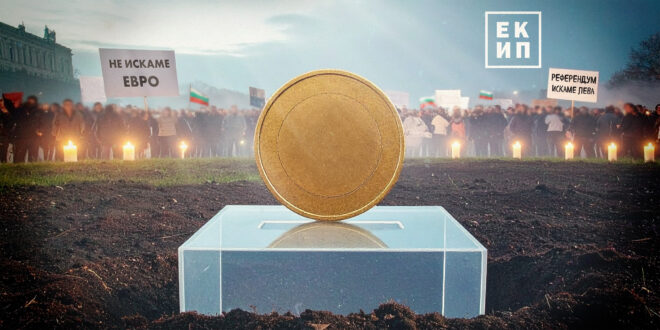
Whereas we believe that the European Union stands by the values of democracy and the principles of cooperation among sovereign members and subsidiarity in decision-making, we call for halting the current process of euro adoption in Bulgaria. Our concerns stem from the significant risks if Bulgaria joins the euro area amid a corrupt and undemocratic process concealing underlying deep-rooted corruption, institutional capture and weaknesses, political instability, and widespread domestic opposition to replacing the Bulgarian Lev with the euro. We recognise the urgent need for transparency, true economic statistics, objective assessment of the preparedness of the economy and the soundness of Bulgarian institutions, and broad national consensus before such a strategic decision. The current process of euro adoption entrenches corruption in Bulgaria, while the euro area risks undermining its credibility and stability if integrating a member with compromised governance structures whose economic preparedness is questionable and where euroscepticism is on the rise.
* * *
Bulgaria is quite far from a consensus on adopting the euro. Political parties and institutions are divided on this. The vast majority of the population do not want the euro to replace the national currency, the Bulgarian Lev, anytime soon. Neither do they want Bulgaria to leave behind its successful monetary regime, the currency board, by becoming part of the euro area.
Opinion polls confirm Bulgaria’s long-standing public opposition to the euro. In a recent poll 71% of Bulgarians responded that they are against adopting the euro from 1 January 2026 (the date planned currently), with 38% against adopting it ever at all. The same poll revealed that 59% want a referendum on the issue.[i] An earlier poll indicated even higher support of 63% for a referendum.[ii]
Without the decades-long macroeconomic stability and discipline induced by the currency board, the country is feared to slip into unsustainable fiscal trajectories, akin to the untenable policies historically characteristic of Bulgaria as precursors to financial crises in the past. Adding also widespread concerns about statistical manipulations to pretend fulfilling the numerical criteria for the euro, Bulgaria increasingly looks like following a “Greek scenario”.[iii]
The economy of Bulgaria is not sufficiently prepared for the euro, and the country remains the poorest in the EU. Recently produced official statistics on inflation and the budget performance raised serious credibility doubts. Public trust in the authorities, particularly the Government and Parliament, is very low. The latest Eurobarometer survey acknowledged that only 27% of Bulgarians trust the Government and 65% do not trust it; just 21% of Bulgarians trust the national Parliament and 72% do not trust it.[iv]
The mistrust in domestic institutions is not surprising. Bulgaria has become notorious for endemic corruption, increased money-laundering risks, inefficient and politically dependent institutions including the judiciary, manipulation of election process and results[v], captured regulators and media, and receding democracy overall. Both international and domestic reputable watchdogs have been documenting for decades Bulgaria’s deep-rooted vulnerabilities in these areas, emphasizing the country’s little progress and insufficient political motivation to resolve the problems.
Most Bulgarians fear their country is being dragged into the euro area by the ruling elites pursuing narrow political agendas linked to new opportunities for embezzlement and misuse of public funds.
Corruption, money laundering, captured institutions and media, democracy backsliding
A scathing recent research coordinated by the Center for the Study of Democracy provides a bleak picture of corruption in Bulgaria.[vi] Titled “The State of Capture: The Elusive Quest for Anti-Corruption Results”, the document alerts that 35% of individuals and a quarter of businesses in Bulgaria reported increased pressure and involvement in corruption.[vii] There have been “signature cases of state capture”, further compounded by “newly emerging evidence of criminal and political influence peddling in the judiciary, and by incapacitated regulatory and specialised anti-corruption institutions”. Moreover, Russia is deliberately taking advantage of these weaknesses, using corruption as an instrument to weaken Bulgaria’s economic stability and democratic structures. Corruption is even peaking in recent years in Bulgaria, along with anti-corruption pessimism: with 66.8% of individuals thinking that corruption cannot be substantially reduced.[viii]
An earlier research by the Center for the Study of Democracy uncovered another alarming aspect of Bulgaria’s corruption: approximately 15% of the funds received from the EU are embezzled. The siphoning of EU funds is considered among the main revenue streams of organised crime groups in the country.[ix]
The dire state of corruption in Bulgaria is also confirmed by Transparency International. In its latest annual ranking Bulgaria dropped two slots down to 76thout of 180 countries and territories. There is only one other EU member, Hungary, where the perception of corruption is higher.[x]
As for money laundering, Bulgaria was added to the “grey list” of the Financial Action Task Force (FATF) in October 2023. This list includes “jurisdictions under increased monitoring”, that is countries identified by the FATF to have strategic deficiencies in their anti-money laundering/counter-terrorist financing regimes.[xi] In addition to corruption, the FATF found limited use of financial intelligence, weak investigations and prosecutions, ineffective confiscation of criminal proceeds, inaccurate information on beneficial ownership, and gaps in targeted financial sanctions frameworks. Bulgaria then received a rating of „partially compliant“ with 23 out of 40 FATF recommendations.[xii]
Following the FATF’s latest review, Bulgaria still remains on its “grey list” as of today. The FATF points out that Bulgaria “should continue to work on implementing its action plan to address its strategic deficiencies, including by: (1) addressing the remaining technical compliance deficiencies; (2) improving investigations and prosecutions of different types of money laundering in line with risks, including high-scale corruption and organised crime; (3) ensuring the ability to conduct parallel financial investigations in all terrorism investigations; (4) addressing gaps in the proliferation financing targeted financial sanctions frameworks; and (5) demonstrating initial implementation of risk-based monitoring of non-profit organisations to prevent abuse for terrorism-financing purposes”.[xiii]
Media freedom in Bulgaria also causes grave concerns, as documented among others by Freedom House and Open Society and affiliated organisations. In a recent country report Freedom House notes that although in name “media sector remains pluralistic, many outlets are dependent on financial contributions from the state through advertising, effectively resulting in pressure to run government-friendly material”. Furthermore – “ownership concentration remains a problem. Private media ownership remains opaque, raising concerns of undue business and political influence over editorial content.”[xiv]
A recent report by the International Press Institute also highlights mechanisms of political interference in Bulgaria’s media. It notes “the capture of media by vested business and political interests and the corrupting relationship between media owners and politicians”.[xv]
The overall weaknesses of institutions in Bulgaria are both a result of and a factor for their further capture. Political and corporate interferences are intertwined and permeate across government institutions, state-owned enterprises, and regulated industries. International observers have long depicted the capturing of the judiciary and regulatory bodies. This includes the rising influence of politicians, sanctioned by the United States and the United Kingdom for alleged corruption, who are currently supporting the incumbent Government in Bulgaria.[xvi]
Disturbing fragility has also damaged the Bulgarian National Bank (BNB). Recent legal changes and a major controversy involving a newly-appointed member of the Governing Council have seriously impaired the integrity and reputation of the central bank.
The recent amendments to the Constitution of Bulgaria increased the political dependence of the BNB and its vulnerability to political interferences. Under the new provisions, the Governor and the three Deputy Governors of the Bulgarian National Bank, who are executive members and manage day to day activities of the bank and taken together have the majority of votes at the Governing Council of the BNB, are made eligible to become Caretaker Prime Minister if asked so.
Furthermore, the process of electing the Governor and Deputy Governors is now much more politicised, being determined not by their central banking credentials but by their political affiliations and expected partisan behaviour. As a result, the Governor and Deputy Governors become dependent politically and will not be able to exercise their duties as independent central bankers.
The BNB was also embroiled in a prominent institutional scandal, exposing its internal vulnerabilities and openness to external political influence, revolving around the case of Deputy Governor Andrey Gurov. Mr Gurov’s tenure was abruptly interrupted in July 2024 when the BNB’s Governing Council terminated his powers following a decision by the Anti-Corruption Commission. The case then escalated to the European level, with the Supreme Administrative Court requesting a preliminary ruling from the Court of Justice of the European Union regarding the interpretation of the European System of Central Banks’ statutes and EU treaties. As of today, the Deputy Governor remains barred from exercising his duties in the central bank pending the judicial and parliamentary outcomes while Mr Gurov’s party colleagues keep claiming that he was removed from BNB so that he would not be able to assume the position of caretaker prime minister[xvii]. The whole story raises concerns about how political pressures can undermine the autonomy of a critical institution responsible for monetary stability, financial oversight and Bulgaria’s integration into the euro area.
Plagued by persistent institutional failures, Bulgaria has been backsliding on democracy and became susceptible to political fragmentation and a rise of populism. The Sofia-based Institute for Market Economics embarked on documenting these negative trends a decade ago. Its first detailed analysis on these issues, conducted with the support from the US Center for International Private Enterprise, highlighted the interconnectedness of risks related to economic populism, cronyism, political corruption, and the worsening media environment in Bulgaria.[xviii]
Against this background, there is one still preserved institutional arrangement standing out for its efficiency, resilience and credibility: the currency board.
Bulgaria’s currency board: historical background and importance
In 1997, in the aftermath of a severe financial and banking crisis in the country, Bulgaria adopted a special monetary regime: the currency board. It fixed the exchange rate of the national currency initially to the German Mark and then to the euro from 1999 when the euro area was created.
Under the currency board rules the Bulgarian National Bank cannot issue money at its discretion unless all money created needs to be backed by high-quality euro-denominated assets and gold. This provides full and high-quality coverage of all Bulgarian currency in circulation and bank reserves (reserve money). Furthermore, economic agents can exchange unconditionally the Bulgarian domestic currency against euros at any time at the fixed exchange rate. Notably furthermore, the central bank in Bulgaria is prohibited from financing the Government in any form, including a prohibition to buy Government debt on both primary and secondary markets.
The introduction of the currency board in 1997 immediately restored price stability. Ever since, that monetary arrangement has instilled macroeconomic stability and policy predictability, eliminating exchange-rate risk for the national currency against the euro. The currency board has been a remarkable success, staying resilient in the face of major external shocks, such as the Asian financial crisis, the Russian sovereign default, the Global Financial Crisis, the euro crisis, the COVID 19 pandemic crisis, and during varying domestic political and economic cycles.
The strict prohibition on central bank financing of the state, both directly and indirectly through purchases of Government debt, has effectively constrained attempts to deviate from prudent fiscal policies, for years keeping the state budget balanced or in surplus. If it needs to finance fiscal deficits, the Government has to tap financial markets where investors would require higher yields, thus raising the cost of Government borrowing, if fiscal policies and public finances deteriorate. This provides a clear market-based mechanism imposing self-discipline in the fiscal area. As a result, today Bulgaria has the second lowest public debt-to-GDP ratio in the EU.
Recent push to make Bulgaria part of the euro area
Bulgarians trust their national currency and the currency board.
However, in recent years the ruling political parties in Bulgaria have been loosening their fiscal policies. This made them increasingly eager to abandon the currency board by joining the euro area: with a view to allowing substantial increases in fiscal expenditures. This would be in line with historical evidence from the euro area where restraints on public finances turn out to be less effective in practice.
Bulgarian Governments have been incentivised to make every effort to demonstrate that Bulgaria is compliant with the criteria for euro adoption. Whereas the Bulgarian economy has been converging slowly and hesitantly towards the euro area, for many years failing to satisfy the requirements for the euro, the Bulgarian authorities recently focused on devising schemes aimed to provide an apparent fulfilment of the criteria.
What is commonly believed to be manipulations of official statistics in Bulgaria refers to two areas: inflation and the fiscal stance. Alarmingly, EU institutions now seem to have lowered the bar regarding the statistical practices in Bulgaria.
Statistical manipulations to pretend readiness for euro adoption – prices
Regarding prices, there is ample evidence of the National Statistical Institute and regularly meeting retailers and business associations in all sectors in Bulgaria to advise them to report lower prices. The latter are then used as inputs in the calculation of the inflation index.
The National Statistical Institute also recently amended their methodology by assigning lower weights to items where prices were rising faster. Furthermore, they calculated substantial deflation in the case of items where prices had stayed broadly unchanged for years before.
Earlier in 2025 the National Statistical Institute refused to disclose their input dataset used for calculating the inflation index, despite public pressure to do so and the existing legal ground for providing access to such information. This additionally undermined public confidence in official statistics, fuelling concerns that the inflation numbers as officially reported are distorted.
Indeed the inflation rate as published by the National Statistical Institute since the beginning of the year fall well short of both the general public inflation perceptions and the numerously documented price increases in recent months. The latter include heavy price hikes of food, everyday essentials, electricity, water, heating, fuel, communications, and other services in Bulgaria. That also contributed to discrediting the official inflation statistics.
Going forward, irrespective of all data manipulation efforts, the price criterion for euro adoption should not be expected to be fulfilled on a sustainable basis in the near future, given the structural features of the Bulgarian economy. Price and incomes overall in Bulgaria are still well below the average euro area levels. The sizeable gap between increases in labour costs and in labour productivity also implies that stable prices and price convergence will remain a challenge for Bulgaria for years to come.
Statistical manipulations to pretend readiness for euro adoption – fiscal data
Regarding fiscal data, there were visible political efforts to disguise the true stance of Bulgaria’s public finances. 2025 started with abundant media reports on attempts to manipulate the 2024 fiscal outcomes.[xix] Overwhelming expert opinions then signalled that Bulgaria’s budget had collapsed, with a record deficit of BGN 18 billion (around 9% of GDP). Pointedly, that concern was also shared personally by the Finance Minister then.[xx]
More precisely, the newly-elected Government itself originally revealed cases of fiscal payments, due in 2024, which had been deliberately delayed to yield a lower deficit for 2024 on a cash basis, affecting the deficit in accrual terms too. There was also evidence of backdating some legal acts annulling certain 2024 fiscal transfers, thus again aiming to produce a lower 2024 deficit. Furthermore, there were reports that the authorities started looking for ways to “identify” previously unreported fiscal revenues in 2024. At the same time sources close to the Government alerted to attempts to fudge the data of nominal GDP, so as to reach a lower deficit/GDP ratio.
In February the reformist pro-EU We Continue the Change political party, in opposition in Parliament, was still accusing the ruling coalition of exerting pressure on the Ministry of Finance and the Bulgarian National Bank to make them “forge” the official statistical data on the budget deficit.[xxi]
However, the initial narrative by the newly-established political majority[xxii] changed in the run-up to adopting the 2025 State Budget. Gradually, discussions of the 2024 fiscal performance were silenced in mainstream media. That was a step to prepare to report convenient statistical data to Eurostat to avoid Bulgaria becoming subject to an excessive deficit procedure by the European Commission.
Then the 2025 State Budget, passed with a considerable delay in Parliament, drew almost universal criticism.
The 2025 Budget of Bulgaria represents an accounting exercise entirely focused on demonstrating a fiscal deficit within the limit of 3% of GDP, to pretend compliance with the criterion for euro adoption. This is achieved primarily by very inflated budget revenue projections in 2025, including a whopping 21.3% increase of revenues from taxes on production and imports (indirect taxes). The latter exceed more than three times even the optimistically projected nominal GDP growth. The overly optimistic nominal economic growth projections comprise 2.8% real GDP growth and 6.8% nominal growth in 2025, overlooking any negative effects from global trade, investment and financial uncertainty and risks in the international environment. Moreover, creative accounting has been employed: huge budget expenditures are masked as transfers to state-owned entities (most of them outside the scope of the General Government statistics) in the form of equity capital increases and share purchases. Such expenditures will exceed BGN 3% of GDP in 2025. The latter are recorded off-balance, thus hidden from the state budget deficit number.
Alongside the overall distorted budgetary framework, significant debt accumulation is envisaged, putting more strain on Bulgaria’s long-term fiscal sustainability. Bulgaria will raise new debt of around 9% of projected GDP in 2025.
The ultimate conclusion is that instead of seeking gradual fiscal consolidation over the medium term horizon a sharp “improvement” in 2025 ostensibly reduces the budget deficit by about 9% of GDP (exactly corresponding to the fiscal gap publicly acknowledged just months ago). The overarching goal is to pretend fulfilling the Maastricht criteria for the euro adoption.
A forced, undemocratic process fuelling euroscepticism
Beyond the dubious statistical exercises, the entire process of replacing the national currency with the euro has been characterised by a severe lack of transparency and violation of fundamental principles of democracy.
Several consecutive Governments of Bulgaria have neglected public demands for more information, including for an in-depth critical assessment of the risks expected upon joining the euro area. The Ministry of Finance and the Bulgarian National Bank refused to produce and publish their official analyses to that end, despite initially obliged to do so by a government decree. All major negotiation stages involving Bulgarian officials and their EU counterparts have been kept closed to the public, while only final decisions at key stages of the euro adoption process were disclosed. That further alienated an already rather sceptical Bulgarian population.
As the public support for the euro remains rather low and declines further, the topic is bound to only stoke more euroscepticism and mistrust in mainstream politics.
The clearly undemocratic nature of the euro adoption process as widely perceived in Bulgaria has provoked a public backlash.
Bulgaria wants a referendum on the euro
Two years ago over 604 thousand Bulgarians signed a petition for a referendum on postponing the euro adoption for two decades until at least 2043. Such an impressive support for a referendum was without precedent in Bulgarian history: signed by close to 1/10 of the entire population of Bulgaria and a quarter of those who voted in Bulgaria’s last parliamentary elections. Sadly, the ruling political class in the Bulgarian Parliament is still blocking such clearly expressed will of the people.
Bulgaria has a particularly dismal democratic deficit historically on matters related to the EU and the country’s EU integration. Notoriously, Bulgarian citizens have never been consulted on any such matter. Bulgaria never held a referendum for the EU membership or for any Treaty changes.
The support for a referendum on the euro is again gaining traction in Bulgaria. The Bulgarian President Rumen Radev recently announced that he wanted a national referendum to be held on whether the country should adopt the euro in 2026. In his motives the President notes the overwhelming public opposition to the euro, the fears that the euro will inflate prices, the authorities’ failure to inform the public on the process of euro adoption and to provide safeguards against speculative price hikes related to the euro, as well as the unpreparedness of the Bulgarian economy for becoming part of the euro area.
The widespread support for a referendum on the euro adoption was demonstrated at mass protest rallies in the capital Sofia and across the whole country on 31 May 2025. The scale of these protests has not been seen for decades in Bulgaria.
While most Bulgarians support the President’s move, so far the Bulgarian Parliament has refused to admit it for deliberations and voting. Unleashing institutional and legal clashes, now the case is to be reviewed in the country’s Constitutional Court which is expected to rule on whether the Parliament should vote on the President’s proposition rather than discarding it without consideration.
All in all, the discredited process of euro adoption is causing lots of apprehension in Bulgaria. It has sparked much controversy and is widely perceived as misguided, manipulative, not transparent and undemocratic. The authorities have failed to provide convincing information, let alone clear arguments in favour of replacing the national currency with the euro and abandoning the currency board in Bulgaria.
An appeal to halt the introduction of the euro
That is why today millions of Bulgarians are appealing for a pause in the process of euro adoption until Bulgaria holds a referendum allowing its citizens to be informed honestly and comprehensively about all arguments for and against the euro, and to vote whether they agree to adopting the single currency from 1 January 2026 as currently planned.
Sources
[i]“Trend” agency survey conducted between 12 and 18 May 2025; results cited here: https://fakti.bg/en/bulgaria/972883-trend-55-ot-balgarite-ne-se-chuvstvat-informirani-za-vavejdaneto-na-evroto
[ii]“Myara” agency survey conducted between 10 and 13 May 2025; results cited here: https://bntnews.bg/news/myara-polling-agency-63-of-bulgarians-support-holding-a-referendum-on-the-adoption-of-the-euro-1338909news.html
[iii]On 2 February 2025 the Vice President of the Republic of Bulgaria,Mrs Iliana Iotova, made a statement warning that Bulgaria should report the “real numbers” to the EU to avoid a “Greek scenario”; full quote available here in Bulgarian: https://epicenter.bg/article/Yotova–Tryabva-da-dadem-istinski-tsifri-na-evropartnyorite-si–za-da-ne-se-ozovem-v-gratski-stsenariy/375542/2/0
[iv] Standard Eurobarometer, Spring 2025, Bulgaria Factsheet; available at: https://europa.eu/eurobarometer/api/deliverable/download/file?deliverableId=98486
[v] Bulgarian Constitutional Court, 26 Feb 2025
https://www.constcourt.bg/bg/act-10079
[vi]“The State of Capture: The Elusive Quest for Anti-Corruption Results” (2024); Policy Brief available at: https://seldi.net/wp-content/uploads/2024/04/R2G4P_Brief_2_ENG_WEB.pdf
[vii]Results depicted in Figures 2 and 6, op. cit.
[viii]The negative trend in anti-corruption pessimism illustrated in Figure 4, op.cit.
[ix]These results and arguments summarised here: https://www.mediapool.bg/bulgaria-wake-up-corruption-and-money-laundering-go-hand-in-hand-news355573.html
[x]Transparency International, “Corruption Perceptions Index”(2024); available at: https://www.transparency.org/en/cpi/2024?gad_source=1&gad_campaignid=15272914516&gclid=EAIaIQobChMI9sOb_u7QjQMVEItoCR1rShWIEAAYASAAEgKGBvD_BwE
[xi]More information available at: https://www.inscope-aml.com/fatf-grey-list-october-2023-bulgaria-panama-cayman-islands
[xii]Royal United Services Institute,Bulgaria Conference Report (2024), “Restricting Kleptocracy:Strengthening Monitoringand Accountability in theFirst Mile”; available at: https://static.rusi.org/restricting-kleptocracy-bulgaria-conference-report.pdf
[xiii]More information available at: https://www.fatf-gafi.org/en/publications/High-risk-and-other-monitored-jurisdictions/increased-monitoring-february-2025.html
[xiv]Freedom House, Freedom in the World Bulgaria Country Report 2024; available at: https://freedomhouse.org/country/bulgaria/freedom-world/2024
[xv]International Press Institute, “Media Capture in Bulgaria: Hidden Alliances and Vested Interests” (2022); available at: https://ipi.media/wp-content/uploads/2022/03/IPI-Bulgaria-Media-Capture-Report-24-03-2022.pdf
[xvi]“Democracy Captured: Bulgaria’s Peevski Predicament” (2025); article available at: https://www.gmfus.org/news/democracy-captured-bulgarias-peevski-predicament
[xvii] BNB removes Gurov, so that he would not be able to assume the position of caretaker prime minister
https://www.24chasa.bg/bulgaria/article/18433480
[xviii]Institute for Market Economics, “Democratic Backsliding in Bulgaria (2017); full report available at: https://ime.bg/var/images/IME_democractic_backsliding_English.pdf
[xix]An example of a typical local media report from end-January 2025: https://fakti.bg/razsledvania/944924-tiha-panika-v-ministerstvoto-na-finansite-predvaritelni-ocenki-veshtaat-svrahdeficit-za-2024-g
[xx]Ministry of Finance press release dated 24 January 2025: https://www.minfin.bg/bg/news/12907
[xxi]Full quote available in Bulgarian at: https://offnews.bg/politika/denkov-borisov-natiska-bnb-da-promenia-danni-za-da-ne-vlezem-v-evroz-838447.html
[xxii]On 1 February 2025 Mr Boyko Borisov, former Prime Minister, leader of the largest party in the ruling coalition, publicly announced that he would not allow “false” data to be reported to the EU. He announed that actual transfers for fiscal payments accrued in 2024 were delayed for 2025, hinting that such accounting had been intended to hide at least BGN 3 billion from the deficit; full quote available in Bulgarian at: https://www.24chasa.bg/bulgaria/article/19831380





Absolutely agree with the open letter. Bulgaria is not ready for adopting the Euro as a currency.