EKIP– Expert Club for Economics and Politics A Different Opinion
One of the main goals of the European Union and one of its reasons for existence is to achieve economic stability and sustainable growth on the Old Continent. In themselves, these are concepts devoid of particular meaning and without practical value, whose main role is to sound good in political speeches and reports.
It is for this reason that, after nearly 50 years of policies of unification and convergence of the economic policies of the member states, in 1992 the Eurocrats decided that it was necessary to finally fill the pompous concepts with meaning and to give them concrete dimensions and parameters. As a result, the so-called Maastricht criteria were born, which set limits on several basic macroeconomic indicators, which were supposed to guarantee the economic stability of the EU countries [1].
Later, the criteria were also used as a condition for the dubious honor of a certain country becoming part of the eurozone. And indeed, the criteria set out in the book sound quite reasonable for any country that follows a relatively sensible budget policy – no more than a 3% budget deficit, inflation no higher than 1.5% above the average of the three countries with the lowest inflation in the EU (currently 2.5%), no more than 60% government debt as a share of GDP.
However, even the best policies are worthless if they are not implemented. To what extent do EU countries actually comply with the restrictions they have imposed on themselves? Table 1 shows the latest available data on the performance of member states on the various criteria.
Table 1: Fulfillment of the Maastricht criteria (for 2012)
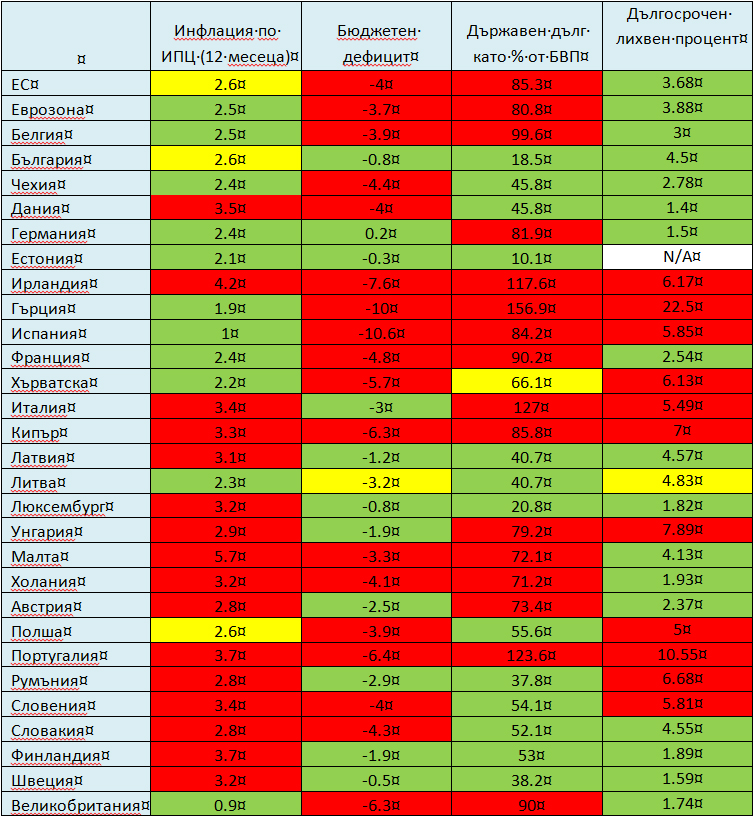
Source: Eurostat . (Legend: green marks the countries that meet the criteria, yellow marks those with approaching values, and red marks those that do not)
The conclusions from examining the data are more than obvious. Of all the countries in the European Union, only Bulgaria, Estonia and Lithuania manage to meet all the criteria, or at least come close to them[1]; conversely, some countries, such as Portugal and Ireland, do not even come close to meeting any of the requirements. In other words, if the Eurozone were being built in 2012, only three countries would have met the conditions for participation in the monetary union. Today, the members are unable to meet the requirements they themselves have set. However, the number of penal procedures is insignificant.
The official explanation for the current situation is the economic crisis and the need for targeted government policies to combat it.[2] In 1998, The Economist explains in detail why most of the countries (then still the future eurozone) are unable to adhere to the criteria[3]. Even then, the magazine predicted the imminent end of this apparently unattainable regulation. Fifteen years later, however, the EU continues to claim that the equalization is reasonable and, despite evidence of its failure, tries to adhere to it.
The bureaucrats in Brussels need to adopt a completely different line of reasoning. Since historically most countries have never managed to comply with the criteria, and this has never led to any particular consequences (even, as in the case of Greece, to generous bailouts), we should ask ourselves whether there is any point in having criteria that are chronically not respected, and mechanisms and penalties for their enforcement that are systematically not used? The answer is no.
Studies of the issue show that attempts to fit the significantly different European economies into a single mold tend to lead to negative results[4]. On the one hand, it is obvious that the criteria have failed to achieve their original goal, namely to guarantee the stability of the eurozone and the European economic area as a whole. What happened to the PIIGS countries since the beginning of the crisis is an example of how “stability mechanisms” are the first victims in times of difficulty.
Another glaring problem is the purely political, not economic, nature of the prescriptions – their specific values are completely random. In practice, there is no real justification for why their observance is considered a magic formula for success and, accordingly, does not bring the countries that adhere to them much more than dubious prestige in the eyes of others. The very attempt to define economic success through a few budgetary characteristics is doomed to failure[5]; here the statist belief that if we “just put the numbers together” everything will be fine is evident. In this sense, it does not matter exactly which indicators are selected, given that the chosen approach is completely wrong.
Bulgaria is the most relevant example of how there is no real connection between these few random indicators and real economic development, and for our efforts we do not receive much more than a pat on the back from Brussels from time to time. I am not trying to say that the goal of the criteria - achieving balanced and conservative budgeting - is bad in itself; however, the chosen approach of random regulation and imposition of restrictions is extremely counterproductive.
Thirdly, they are based on a wrong prediction of the future – in the 1990s, the creators of the euro expected that all EU members would embrace the idea of a common currency and strive to become part of the eurozone. However, as it became clear in the following years, a significant number of countries (such as the UK and Denmark, which decided in a referendum not to become part of the Eurozone, or Poland and the Czech Republic, which did not make any special efforts to join) preferred to preserve the independence of their national currencies, rather than submit fully to the control of the ECB, which makes compliance with random rules an unnecessary and pointless burden when their ultimate goal is not considered a priority by these countries.
Ultimately, the criteria are nothing more than a failed – and self-serving – attempt to impose common frameworks and constraints on vastly different economies. Even if they set seemingly noble goals, such as a moderate and disciplined budget policy, the top-down approach aimed at uniformity inevitably taints and distorts the results. We can only hope that the EU has learned its lesson – attempts to cut economies into a mold are doomed to failure – and will not set itself such unattainable goals in the future.