 EKIP– Expert Club for Economics and Politics A Different Opinion
(For a more detailed analysis of how Trump's policies affect the price of gold, read this article )
To be able to fight your enemies effectively, the first step is to understand them. To be able to work effectively with your allies – the same. No matter whether we perceive Donald Trump’s United States of America as a “friend” or an “enemy,” we are incapable of either fighting or working with them if we do not understand what they are doing and why they are doing it. For those who worry that this might somehow corrupt their minds, I emphasize that “understanding” is not the same as “agreement.” But without understanding, in both cases you will be walking aimlessly like a blind man, regardless of whether you intend to box or dance.
You can't understand what Donald Trump's administration is doing without understanding its economic policy, especially trade policy. Judging by its stated intentions and demonstrated actions, its economic policy is unique in recent decades of US history and, if it achieves its fundamental goals, could lead to the most significant transformation not only of the American but also of the global economy since at least the 1970s.
In November last year, the investment fund Hudson Bay Capital published a report entitled " A User's Guide to Restructuring the Global Trading System ". The author of this report is Stephen Miran, who on March 13, 2025 officially becomes chairman of the Council of Economic Advisers of the US President. As the title suggests, in his report Miran talks about restructuring the global trading system. My speculation is that the Trump administration will try to achieve precisely such a restructuring, because it is necessary to achieve Donald Trump's ultimate economic goal, both in his first and second terms - the restoration of US industrial power. The huge tariffs that were recently imposed and shocked the world are only the first step towards achieving this goal.
Ironically, the main obstacle to achieving this goal turns out to be the power and prestige of the US dollar as a global reserve currency. It may sound surprising, but this thesis, expressed explicitly in the Miran report, is not something new, but a topic discussed among economists during Trump’s first term. The interesting thing now is that people like Miran (and judging by their statements, people like Treasury Secretary Scott Bessent as well) provide a targeted plan for dealing with the dilemma. Accordingly, I will try to explain Donald Trump’s policy, especially as it concerns international economic relations, by using Miran’s report freely. But this text will not be a simple retelling, and where appropriate I will add my own reflections and additional explanations, as well as the necessary historical context, so that it can be understood what are the causal frameworks in which the current US government considers its actions, which to us in Europe may seem chaotic and malicious.
Let’s start where Miran himself begins—with the so-called “Triffin Dilemma.” This is an economic theory first formulated by the Belgian-American economist Robert Triffin in the 1960s that explains the internal conflict faced by a country whose currency (and national debt) serves as a global reserve asset. This paradox has had a profound impact on the development of the American economy in recent decades, shaping its trade policy, fiscal decisions, and industrial capacity. While reserve currency status brings significant advantages, it also imposes severe constraints that contribute to persistent economic imbalances.
Reserve currency status and its advantages
The role of the US dollar as the world's dominant reserve currency provides several key advantages for the US economy. The first is cheaper financing of government debt. To supply themselves with the reserve asset, other countries around the world are always on the lookout to absorb US government debt, which pays them cash flows (interest) in dollars. The constant demand for US government bonds allows the US government to borrow funds at relatively low interest rates. By some estimates, the dollar's reserve status reduces the US borrowing costs by 50-60 basis points per year, saving billions of dollars in debt service. The second advantage is global financial stability. The dollar is the foundation of global trade and financial systems, providing liquidity and predictability that benefit both America and its allies.
The third advantage is financial hegemony. The dominant role of the dollar allows the United States to exert geopolitical influence through its financial extraterritoriality. This includes imposing sanctions, controlling access to global payment systems such as SWIFT, and freezing assets held in US financial institutions. These tools enable the US to achieve its foreign policy goals without resorting to military force, using its financial control to weaken adversaries and reward allies. It is important to note that, however influential, this is still a form of “soft power” that is always secondary to “hard power” in its nature. This is key and must be kept in mind when discussing the impact of the dollar’s reserve status on US production and, therefore, on the country’s ability to self-supply its own military.
The Burden of Reserve Status – Twin Deficits
Despite its advantages, reserve currency status has come at a cost for the United States. A key part of this is chronic trade deficits. The global demand for dollar-denominated assets has led to a persistent overvaluation of the currency. To help you understand what this means, think of the dollar as the world’s “money.” Just as the demand for the paper money we use as “money” in our daily lives is obviously inflated by the fact that we are forced to use it, so too is the demand for the dollar on a global level inflated by the fact that countries around the world want to hold it not only to trade with the United States but also because they need it as a reserve. If the only reason to buy dollars was to trade with the United States, then rest assured, the dollar’s exchange rate against all other currencies would be much lower.
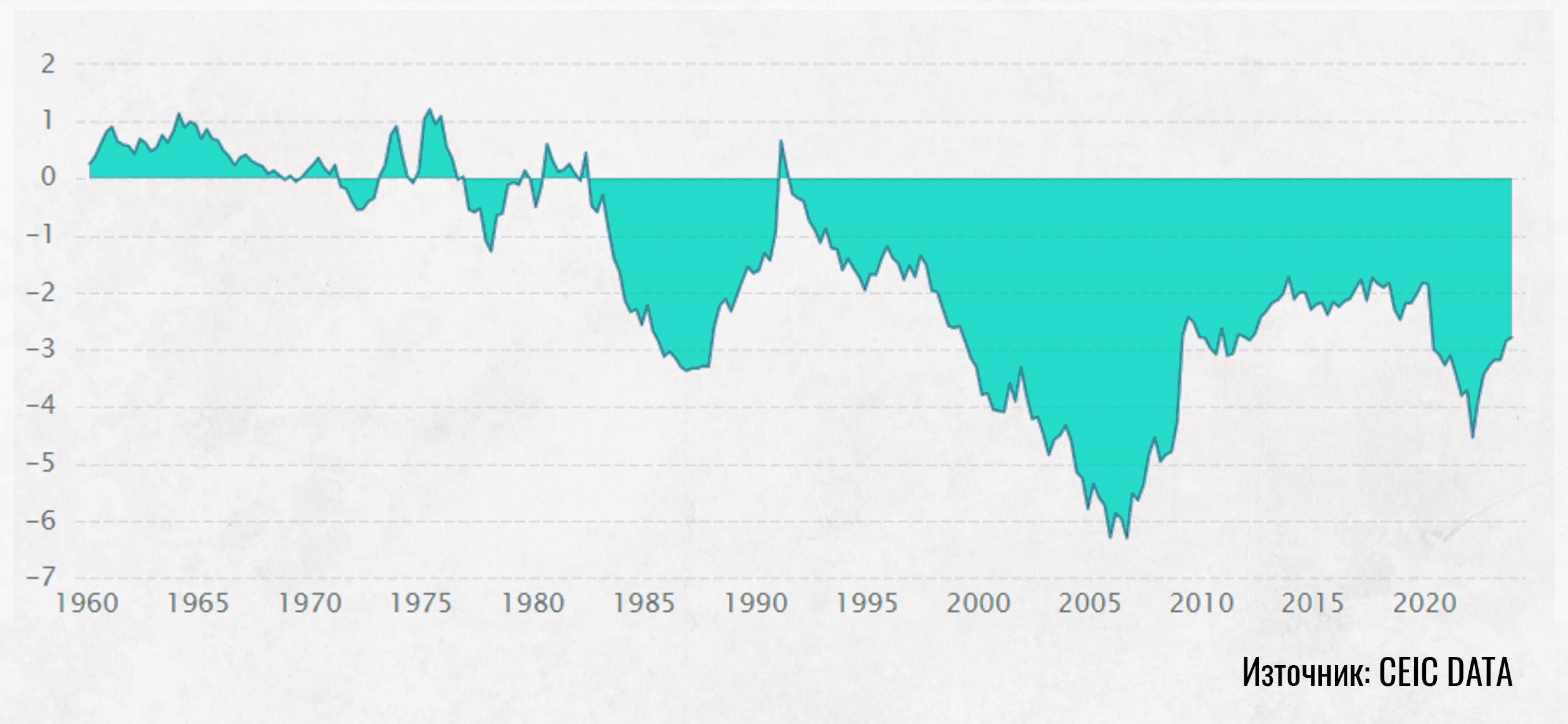
This overvaluation of the currency due to its reserve status makes American exports more expensive on international markets, while imports become cheaper for American consumers. This erodes the profits of American manufacturers and subsequently erodes the US manufacturing base for decades, leading to persistent trade deficits. Since 1982, the country has almost continuously run a current account deficit, especially in goods trade, reflecting the structural imbalances associated with reserve currency status.
Triffin's dilemma explains why countries with reserve currencies often suffer from persistent twin deficits:
- Fiscal deficits (when government spending exceeds revenue)
- Current account deficits (when imports exceed exports)
These deficits are not accidental; they are built into the reserve currency mechanism. To meet the global demand for reserve assets like U.S. Treasuries, the U.S. must run a current account deficit while simultaneously “exporting” these financial instruments. In the process, foreign countries accumulate dollars through trade surpluses with the U.S. and then use those dollars to buy U.S. Treasuries. America receives foreign goods in exchange for dollars, but loses competitiveness in its export sector because of the overvalued currency. In addition, reserve currency status encourages fiscal slack, reducing borrowing costs and increasing demand for government debt. However, this creates vulnerabilities if investor sentiment changes or if geopolitical tensions arise.
Chart 1: US current account balance, % of nominal GDP
When Robert Triffin first formulated his dilemma in the 1960s, the United States accounted for about 40 percent of global GDP—a size that allowed reserve currency obligations to be met without serious consequences for the domestic economy. The situation is very different now. With global GDP growing faster than the U.S. share (which fell to 21 percent in 2012, before recovering slightly to 26 percent today), the tension between domestic priorities and international obligations has intensified. In Triffin’s “world,” reserve assets function as a form of global money supply, driven by international trade and savings rather than by domestic economic indicators such as trade balances or investment returns. This creates persistent deviations between exchange rates that would balance trade (trade equilibrium) and those that are determined by financial demand (reserve equilibrium). For countries whose currencies have global reserve status but whose economies account for a small share of the global economy—like Britain after World War I or the United States today—these deviations lead to increasingly painful economic consequences.
Persistent current account deficits erode industrial competitiveness, and the accumulation of public debt ultimately undermines the fiscal sustainability of the state. Over time, these deficits can reach a tipping point where credit risk undermines confidence in the reserve asset itself—a scenario known as the “Triffin dilemma.” Although the United States is far from such a tipping point due to its deep financial markets and the lack of viable alternatives to the dollar (for example, the Chinese yuan is not fully convertible and European bond markets are fragmented), these risks remain relevant for long-term economic planning. And the overvaluation of the currency resulting from the dollar’s reserve status is already having a very profound negative impact on the productive capacity and, therefore, on the military capacity of the United States.
The history of Britain as a history lesson
Britain’s economic decline after World War I serves as a warning about the dangers of a chronically overvalued currency and its long-term consequences for industrial competitiveness. Once a leading industrial and financial power, Britain prioritized financial stability over manufacturing competitiveness in the postwar period, ultimately undermining its manufacturing capabilities and global economic leadership. This historical episode offers valuable insights into the challenges facing countries whose currencies have reserve status, including the United States today.
In the 19th century, Britain was the undisputed global economic leader, ushering in the Industrial Revolution and dominating international trade. Its manufacturing base was unparalleled, and industries such as steel, textiles, and shipbuilding were engines of enormous economic growth. The British pound served as the world's primary reserve currency, reflecting the country's financial power and vast colonial empire.
However, the dominance of the British economy began to erode in the early 20th century due to structural economic challenges, geopolitical turmoil, and economic policy mistakes. The First World War was a turning point that accelerated Britain's decline. It imposed an enormous financial burden on the country - significant debts were accumulated, both to domestic and foreign creditors, especially the United States. At the same time, wartime inflation devalued the purchasing power of the pound, creating domestic economic instability. The war also disrupted global trade patterns, weakening British export markets and increasing competition from emerging industrial powers such as the United States and Germany. These factors made Britain economically vulnerable in the post-war period. In this context, it made a disastrous mistake in its monetary policy.
The overvaluation of the British currency
One of Britain's most significant economic decisions after the war was its return to the gold standard in 1925 at the pre-war exchange rate of £1 = $4.86. This decision was motivated by a desire to restore financial stability, to emphasize the sterling's prestigious position as a world reserve asset, and to solidify London's status as a global financial center. Alas, the long-term consequences were precisely the opposite. The pre-war exchange rate significantly overvalued the pound relative to the real state of Britain's war-weakened economy. The overvalued currency made British goods too expensive on world markets, while imports became cheaper. As a result:
- By 1930, British industrial production had fallen by about 20% from pre-war levels.
- In industrial regions such as Northern England and Wales , unemployment rates exceed 25%, devastating local economies dependent on manufacturing.
- Britain's share of world exports fell from 14% in 1913 to 10% in 1937, while competitors such as Germany and the United States strengthened their positions.
The social impact is also devastating. Entire communities dependent on manufacturing sectors are pushed into poverty as jobs disappear. Infrastructure deteriorates, housing deteriorates, and regions once thriving with industrial activity become “slums.” Processes that have also been very clearly visible in the industrial regions of the United States in recent decades. Britain’s decision to prioritize financial stability over manufacturing competitiveness reflects a more general dilemma facing countries with reserve currencies—a dynamic that was later analyzed by the economist Robert Triffin in his research. By maintaining an overvalued pound to maintain its role as the world’s reserve currency and financial center, Britain sacrifices its industrial base. This trade-off ultimately catastrophically weakens its economy and drastically reduces its ability to project global power.
The consequences were so serious that during World War II (WWII) England was unable to supply itself militarily and became the biggest beneficiary of the Lend-Lease program, through which the US industry supplied the Allies. In the 19th century, England was the factory of the world. But in the first half of the 20th century, its industry slowly began to weaken and lag behind that of other major industrial powers such as Germany, but especially the US. The lag reached a critical point in the interwar period when Britain made the disastrous decision to link the pound to gold at an excessively high exchange rate. Ironically, this policy, which aimed to maintain the prestige of the British pound and maintain its then position as a global reserve asset, was precisely what doomed it to lose this position 20 years later, when the US dollar became the new global reserve currency after the establishment of the Bretton Woods system.
From "factory of the world" to "bank of the world"
Over time, however, the negatives of reserve currency status began to plague the American economy, as they had earlier with the British. Since the 1970s, the United States has undergone a profound transformation, moving from “the world’s factory” to “the world’s bank.” This transition was driven by globalization, financialization, and the permanent overvaluation of the dollar, which together changed the structure of the American economy. While this process strengthened sectors such as banking and technology, it came at a significant cost: a decline in manufacturing competitiveness. It is this imbalance that the Trump administration is seeking to reverse through its economic policies.
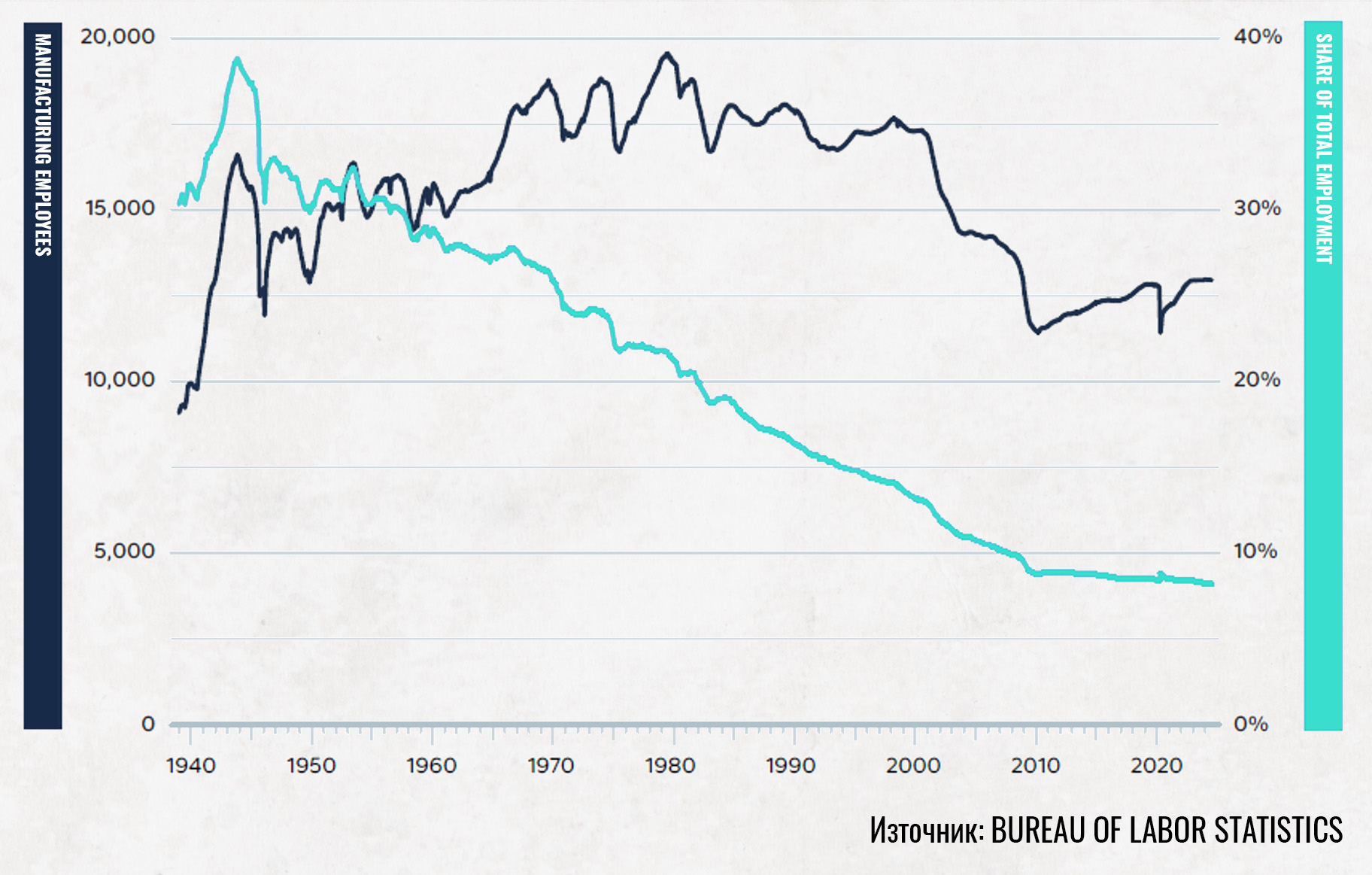
During the mid-20th century, the manufacturing sector was the backbone of the American economy. In 1950, industry accounted for almost 30% of US GDP, with a dominant role in economic growth and employment. By 2020, this share had fallen to just 11%, a clear demonstration of the dramatic decline in industrial activity in the United States. The number of manufacturing jobs has also fallen dramatically: from 19.4 million in 1979 (the peak year for industrial employment) to an estimated 12.6 million in 2023, a loss of nearly 7 million jobs over four decades. The population of one Bulgaria. This decline has been further exacerbated by globalization and trade liberalization, processes in which countries such as China and Germany have established themselves as industrial powers. China's accession to the World Trade Organization (WTO) in 2001 is a turning point that led to the flooding of the American market with cheap imported goods, further undermining domestic production capacity.
The decline of the manufacturing sector is an extremely significant problem. According to data cited in the Miran report, between 600,000 and 1 million manufacturing jobs disappeared from 2000 to 2011 as a result of increased trade with China. A phenomenon known among American economists as the "China shock". The loss of competitiveness in US industry led to factory closures and mass layoffs in industrial regions, especially in the notorious Rust Belt, where all the so-called "swing-states" that proved decisive in Trump's election victories in 2016 and 2024 come from.
The Rise of Financialization: Wall Street Takes Control
As manufacturing declined, financial services rose to become a leading economic driver. In 1950, the financial sector generated just 2.5% of U.S. GDP, but by 2020, that share had grown to nearly 8%, making it one of the largest sectors. Wall Street's dominance was further enhanced by deregulation in the 1980s and 1990s, including the repeal of the Glass-Steagall Act in 1999, which allowed commercial banks to engage in investment banking. The growth of the financial sector also reflected the U.S. transition from an industrial economy to one based on services. U.S.-based multinational corporations moved their manufacturing operations overseas while focusing on financial maneuvering and maximizing shareholder value at home.
This transformation has brought disproportionate benefits to wealthy Americans, as the gains from financialization have accrued mainly to investors and executives rather than to workers, many of whom have lost out, as is evident from the loss of manufacturing jobs. A major factor in this shift is the permanent overvaluation of the dollar, a consequence of its status as the world’s reserve currency. Triffin’s dilemma, discussed above, explains how this status creates structural imbalances. The demand for dollar-denominated assets drives up the value of the currency, making American exports more expensive and imports cheaper. In 2024 alone, the U.S. trade deficit will be roughly $1 trillion, reflecting an imbalance that is eroding the country’s industrial base. The financial sector benefits because all this hunger for dollars, of course, requires the development of a flexible financial sector that can serve the world’s needs with a variety of sophisticated financial transactions and instruments denominated in dollars.
Why industrial production matters
As discussed earlier, the loss of manufacturing jobs has devastated local economies across America, especially in regions like the Rust Belt. Factory closures have led to unemployment, poverty, and the decline of entire communities—a phenomenon often described as “ blight.” These losses have been concentrated in specific cities and states where alternative employment opportunities are scarce. This has had profound socio-economic consequences that have also affected domestic politics. The decline in manufacturing has devastated local economies that depend on this sector, leading to job losses, poverty, and social decline. Infrastructure is deteriorating as governments lose tax revenue from closed factories, housing is falling into disrepair, and entire communities are falling into disrepair. It is these devastated industrial communities that have formed Donald Trump’s electoral base since 2016. The graph below is taken from Stephen Miran's report and presents the number of people employed in manufacturing and their share of all employed people in the US economy.
Chart 2: Number of employees in industry and share of total employment, USA
Even if you consider Trump’s focus on industry to be pure political (successful) opportunism, industry is indeed of strategic importance. The focus on the manufacturing sector logically follows from its crucial role in ensuring secure and independent military supply chains — a cornerstone of national sovereignty. It is no coincidence that in a speech to industrial workers (and his own voters) in 2018, Trump said, “If you don’t have steel, you don’t have a country.” This reflects a deeper philosophy that contains a fundamental truth: without control over key industrial processes, national security is compromised.
If a country does not have a strong manufacturing base, it does not have an independent supply chain for its own military. Reliance on foreign suppliers for critical defense materials undermines sovereignty. A strong domestic industrial base ensures that weapons systems and defense infrastructure are not vulnerable to external interference. Of course, manufacturing also provides stable jobs and supports local economies, reducing dependence on government aid and encouraging self-reliance. As financially strong as the dollar is on a global scale, without military backing its power is hollow. A bank without men with guns to guard it is simply prey for other men with guns. Imagine a bank that cannot guard itself. Who has real control over its money? It? Or the one guarding it? Let us repeat – “if you don’t have steel, you don’t have a country.”
The role of tariffs - the "stick" in Trump's economic policy
It is in response to these deep economic problems that the Trump administration is proposing massive tariffs aimed at restructuring the global trading system, increasing the competitiveness of American manufacturing, and correcting persistent trade imbalances. This case is of fundamental importance not only for the extremely impoverished population of the American “Midwest”. It is of fundamental importance for preserving the position of the United States as the leading superpower in the world.
Tariffs are the most direct and aggressive way to encourage the return of production capacity that has been transferred abroad (“offshored”) back to the United States. The logic of Trump’s aggressive policy in this regard is relatively simple and relies on the role of the United States as the largest consumer market in the world. Wherever industrial products are produced, the largest part of them still goes to the US market, which remains the deepest in the world and, accordingly, brings the largest revenues. The size of the US consumer market is nearly 2 times larger than the size of the second largest consumer market in the world - that of the European Union. As we all know, the profit for a company is formed by the difference between revenues and costs. Many companies choose to produce outside the US, but sell back to the US, because this maximizes the difference between revenues and costs that they can achieve in the modern global economy.
One way to encourage them to produce more in the US is to directly attack the profits they can generate by importing goods produced outside the US into the US market. If that is reduced or completely eliminated due to increased customs costs, the picture looks different. It may even be cheaper to produce in the US if their goal is to sell there. In this sense, Trump's tariffs are a "stick" that "beats" companies' profits. Later, we will talk about the "carrot" that must be applied for this policy to be truly effective. But here it is important to understand something else key.
In this approach, the Trump administration is relying heavily on the role of the United States as the world’s major consumer market. Tariffs certainly lead to a decline in international trade, which could become quite significant if there is a consistent escalation in which other countries respond with tariffs. Such a development risks a decline in the role of the United States as a global market. But the idea is that this sacrifice is worth it if it leads to a significant recovery of industrial capacity. In short, you can view what Trump is doing as an attempt to “trade” some of the size of the consumer market for more industrial production. A smaller “market” in exchange for a larger “factory”. Whether this attempt will be successful remains to be seen, but tariffs will certainly not be enough on their own. Their effect is not at all so straightforward in a world of floating exchange rates and a world in which the US dollar is the global reserve currency.
As has already become clear, the paradox of the reserve currency is that it undermines its own role in the long run, through the twin deficits it naturally stimulates. Therefore, a correction in the opposite direction is needed. The key question is: is it possible for Trump’s economic program to achieve such a correction? The interaction between tariffs and exchange rates is crucial to understanding whether such policies will achieve their goals or inadvertently undermine them by strengthening the dollar — a consequence that could harm the competitiveness of American manufacturing. The irony is that now, in order to preserve the dollar’s status, policies that threaten it are needed. Tariffs have complex effects on foreign exchange markets, especially on the dollar’s exchange rate against other currencies.
Do tariffs increase or decrease the dollar exchange rate?
Tariffs can affect the dollar exchange rate in several ways, depending on the reactions of markets and trading partners. When tariffs are imposed, they often improve the trade balance by reducing imports from the affected countries. This is clearly their primary purpose. This reduction in imports leads to less trade pressure to buy foreign currency (which is used to pay for imported goods) and increases the demand for dollars (which are used to pay for domestic goods). This results in upward pressure on the dollar exchange rate. Furthermore, if tariffs are perceived as improving the U.S. economic outlook or fiscal sustainability (for example, through increased revenue for the Treasury, which is also one of Trump’s goals), they can attract foreign investment in U.S. assets such as government bonds or stocks, further strengthening the dollar. In many cases, countries on which tariffs are imposed intentionally allow their currencies to depreciate against the dollar in order to keep their exports competitive. For example, during the 2018-2019 US-China trade war, the Chinese yuan depreciated by about 13.7% against the dollar after the imposition of higher tariffs.
On the other hand, tariffs can weaken the dollar if they lead to reduced foreign demand for American goods or assets. If trading partners retaliate with reciprocal tariffs on US exports, this could reduce the demand for dollars needed to buy American products. In extreme cases, tariffs can create global economic uncertainty, causing investors to diversify their portfolios and move away from dollar-denominated assets. In general, however, historical data shows that tariffs more often lead to a strengthening of the dollar. In 2018-2019, they led to a significant appreciation of the dollar not only against the yuan, but also against other major currencies. This contradicts the ultimate goal of Trump’s trade policy – increasing the competitiveness of domestic industry and returning manufacturing capacity to the US. Let’s take a closer look at this case.
What is "currency offset"?
The term “currency offset” describes the phenomenon in which countries subject to tariffs pursue a policy of devaluing their own currencies against the dollar. This depreciation helps to maintain the competitiveness of exports by neutralizing the price increases caused by the tariffs. In his report, Miran notes that effective tariff rates on Chinese imports increased by 17.9 percentage points between 2018 and 2019. At the same time, the Chinese yuan depreciated by about 13.7%, offsetting more than three-quarters of the increased costs caused by the tariff hike.
An important positive effect of currency compensation is that it significantly limits the upward inflationary pressures that restrictive trade policies could cause. This is why US inflation remained almost unchanged in 2018-2019, despite the steep tariffs on Chinese imports. Miran writes about this in detail in his report. As a result – ceteris paribus – it is not the US consumer, but the Chinese consumer, who suffers higher inflation (due to the depreciation of the yuan) as a result of this trade policy. This contradicts the oft-repeated claim that tariffs inevitably cause inflation. They do not necessarily do so, especially when you are the largest market in the world, as the United States is.
But this is a double-edged sword. While currency compensation helps to limit inflationary pressures in the United States by keeping import prices stable, it undermines one of the main goals of tariffs – bringing manufacturing back to America. The depreciation of the yuan allows Chinese exporters to remain competitive in American markets, reducing the incentive for American manufacturers to bring their manufacturing capacity back home. Moreover, many companies did not respond to the tariffs by bringing production back to the United States, but instead moved their supply chains to other low-cost countries such as Vietnam or Mexico. This limited the effectiveness of the tariffs in restoring manufacturing capacity in the United States. Does this mean that in order to achieve the desired effect, Trump’s trade policy in his second term will have to be both tougher and more comprehensive? Most likely. It is no coincidence that Trump has been significantly more aggressive in how many and what tariffs (and on whom) he imposes compared to his first term.
But this also carries risks. First, it could lead to higher inflation in the United States if trading partners are unable or unwilling to devalue their own currencies. Second, an overly restrictive trade policy could close down the American economy to the point where the dollar’s status as the world’s reserve currency is called into question. Here, the fundamental dilemma for Trump’s trade policy becomes clear. To restore American industry, he must in effect directly risk the dollar’s status as a reserve currency. If he does not do so, international markets will rebalance in a different way, the dollar will appreciate, and the positive effect on the industrial sector, if any, will be too small.
On the other hand, if it achieves its goal, it risks collapsing a major source of US global power. The more significant risk here is not so much that the dollar would lose its reserve asset status, but that another currency could acquire it. The most likely and most frightening option for the US is the Chinese yuan. Although for now the role of the yuan is still quite limited in the global financial system and Beijing is pursuing economic policies that significantly hinder the possibility of its currency becoming a global reserve, if Washington is careless, a policy of aggressive protectionism could certainly push global economic processes in this direction. Therefore, in the pursuit of reindustrialization, Trump's economic policy must maintain a very delicate balance. How can these risks be managed?
The role of fiscal consolidation and deregulation ("carrot")
Here, first of all, Trump’s plans for fiscal consolidation and economic deregulation play a key role. So far, almost all of the fiscal policies he imposes and the signals he gives about the future trajectory of fiscal policy have a deflationary effect. Tax cuts, government spending cuts, and deregulation – all of these measures have a deflationary effect. This is probably no coincidence, given his aggressive trade policy, which, as it turned out, if successful would have an inflationary effect. Even if tariffs put pressure on inflation, Trump’s fiscal and regulatory programs would work in the opposite direction. Reduced government spending can reduce the trade deficit by reducing the overall demand for imported goods. Deregulation, in turn, can reduce production costs for American companies, increasing their productivity and lowering prices.
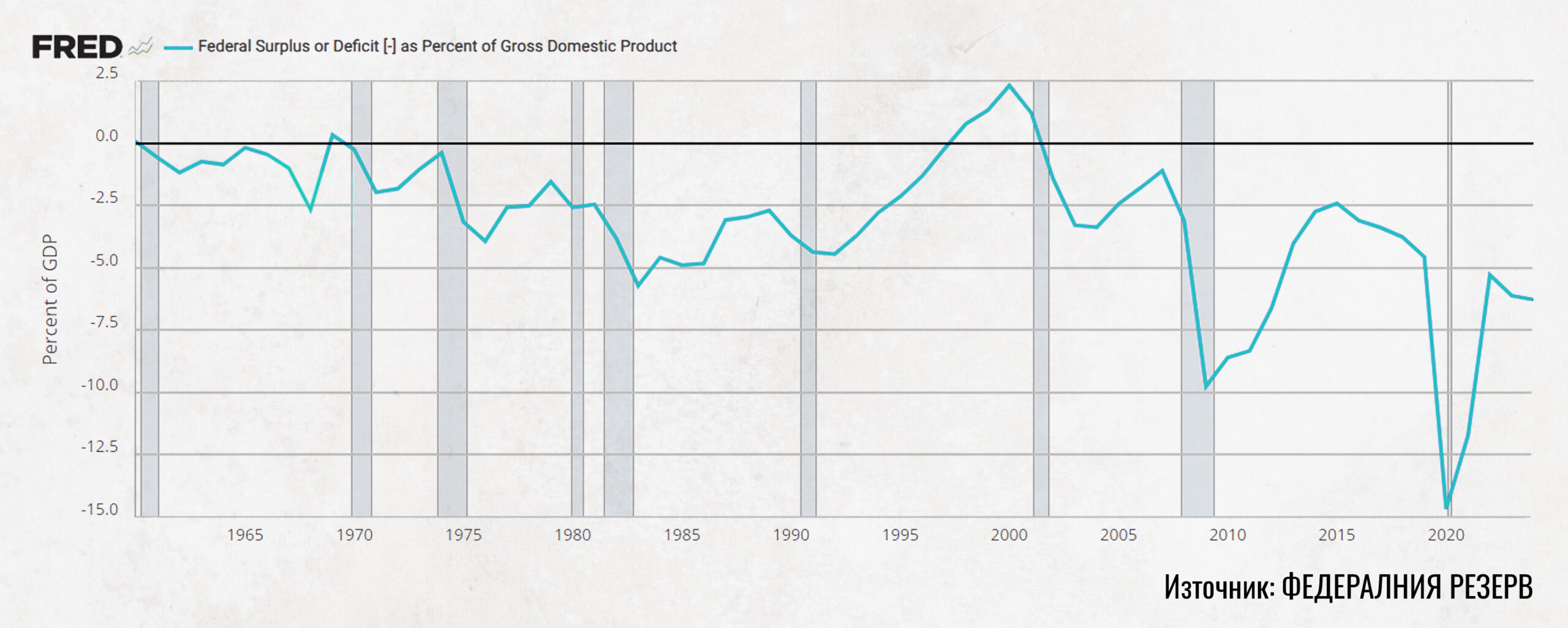
Reducing the budget deficit and public debt also has a direct effect on government financing costs and interest rates. Fiscal consolidation can alleviate concerns about debt sustainability, creating the conditions for lower interest rates. Initiatives such as the Department of Government Efficiency (DOGE), which, with Elon Musk at the helm, is cutting unnecessary government spending, play a key role here. The US budget deficit is currently around 6-7% of GDP in peacetime– a historically very high level, raising questions about its long-term sustainability. However, if Trump were to reduce the deficit by cutting spending, this could improve the US fiscal health enough to lower borrowing costs. This is important because, as explained above, if tariffs are effective in reviving productive capacity, demand for the dollar will decrease, which, ceteris paribus, will increase the US government’s borrowing costs. If this process is left unchecked, it could have a serious impact on the fiscal stability of the United States and even call into question the dollar's status as a global reserve currency.
Chart 3: US budget deficit as a percentage of GDP
Fiscal consolidation and deregulation policies are also important for stimulating the recovery of industrial production, beyond the positive effect they have on exchange rate and inflation risks. For a serious recovery of industry , tariffs alone will not be a sufficient stimulus. The “stick” policy needs to be accompanied by a “carrot” policy. Here, the decline in government spending, the decline in the tax burden and the decline in the regulatory burden are of fundamental importance for freeing up more space for new entrepreneurial activity in the industrial sector.
The clear message to companies should be that while barriers to industrial activity abroad are rising (with tariffs), barriers to industrial activity in the United States are falling. From a corporate finance perspective, the goal is for both sides to begin to close the differential between the rate of return on investment abroad and the rate of return on investment in the United States. Much has been made about the damage that aggressive tariff policies are doing to U.S. capital markets and the negative economic effects of this. But the reality is that no matter how huge the values that accumulate in financial markets are, in this case they are irrelevant if they are not converted into industrial investment in the United States, but flow into investment in factories elsewhere, especially in countries like China.
Money, however, is simply a means of exchange, not the end of economic activity. The Trump administration’s perspective is that no matter how many trillions are traded on American stock exchanges, if they do not contribute to the development of America’s productive capacity – what is the point of them? Remember that Scott Bessent, who is Treasury Secretary under Trump, is one of the most successful traders on Wall Street in the last four decades. It is unlikely that people like him have not thought about what the risks are for the financial markets and whether they are worth it.
The consequences for NATO and Europe
All of this is of great importance to Europe, as fiscal consolidation in the United States has significant implications for the country’s role in NATO and its global military commitments. Military spending is one of the largest items in the US government budget, amounting to approximately $850 billion per year (about 3% of GDP). Reducing defense spending as part of fiscal consolidation requires greater burden-sharing among NATO allies – a key aspect of Trump’s foreign policy. Lower military budgets could limit the US’s ability to guarantee global security unilaterally, meaning that NATO allies would have to increase their defense spending to make up for the shortfall left by reduced American funding.
It should now be clear why Trump sees trade imbalances and defense commitments as interconnected: countries that benefit from the US defense umbrella must contribute more economically – either through fairer trade conditions, higher defense spending, or both. If the current relationship between trade relations and defense commitments continues, the US military presence abroad will prove to be too wasteful, without sufficient domestic industrial capacity to support it. Such a situation could have disastrous consequences not only for the US, but also for allies that rely on US defense in areas of geopolitical tension. This is especially true for Europe, and especially its eastern part.
Without a doubt, if the US continues to supply Ukraine in its war with Russia, such an overexpansion of the US military presence is a very real risk. Therefore, the war must end or someone else must take on the burden of arming the Ukrainian army. Theoretically, this could be Europe, but in practice the EU also lacks the necessary capacity. It would be many years before the EU would be able to provide its own defense to a sufficient extent, let alone effectively wage a proxy war with Russia through Ukraine. When European politicians commit to increasing defense spending, they are actually doing exactly what Trump wants them to do. As it has become clear, achieving a revival of the US industrial base through a more restrictive trade policy requires cuts in US defense spending and, accordingly, increases in the military spending of other NATO allies.
Multilateral currency agreements
In addition to fiscal consolidation, the Trump administration could use other tools, provided it can persuade key trading partners to agree voluntarily. One productive approach would be to pursue multilateral currency agreements. Such an agreement, called, for example, the “Mar-a-Lago Agreement,” could include a commitment by trading partners to strengthen their currencies against the dollar. This would reduce the overvalued dollar and improve the competitiveness of American exports without provoking trade retaliation.
Historically, multilateral currency agreements have been effective tools for balancing exchange rates. For example, the Plaza Accord of 1985 successfully weakened the dollar through coordinated intervention by leading economies. A similar agreement, called the "Mar-a-Lago Accord," was explicitly proposed in the Miran report as a modern version of the 1985 agreements, with the goal of limiting the overvaluation of the dollar and improving the competitiveness of American exports.
Reserve managers would be encouraged to shift their holdings into ultra-long-maturity bonds, such as 100-year bonds or perpetual bonds. This would reduce upward pressure on the dollar by reducing demand for short-term US Treasuries, while also easing pressure on the financing of US government debt. By lengthening the maturity profile of US debt, this strategy would also improve debt sustainability by reducing the risk of frequent refinancing. Of course, countries that currently hold a lot of US debt would be financially hurt by such a shift, which is also a significant obstacle to reaching such an agreement, especially given the strained relations between Washington and its allies.
Moreover, such an agreement would also tie economic and defense policies together, requiring trading partners that are under the U.S. defense umbrella to contribute more to the financing of global security through adjustments to their foreign exchange reserves. Countries that benefit from U.S. security guarantees would be incentivized to strengthen their currencies against the dollar, thereby shifting aggregate demand from foreign producers to U.S. ones. This would be accomplished by selling dollars and buying their own currencies, making U.S. goods more competitive in world markets and reducing dependence on imports.
How will these countries be incentivized?
Here, tariffs could be used as a negotiating tool. The Trump administration could offer lower tariffs on key products, such as cars, to certain partners, such as the EU. Of course, Trump would want the end result to be in favor of boosting domestic production, so the overall level of tariffs, even for allies like the EU, would have to increase during his term. However, there would certainly be some room for negotiation.
In any case, Trump should start by imposing tariffs, because without them the US actually has little leverage to force such negotiations with anyone. In the case of the EU, the other main lever the US has is military defense. Trump is clearly pressuring NATO members along these lines as well. The best option would be coordinated action between all major economies, as this would stabilize the reaction of currency markets as much as possible. But achieving such extensive coordination is likely to be difficult. Even if he can convince Europe, he is unlikely to have much success with China. In 1985, reaching a multilateral agreement that achieves the desired goal was easier because the US and its allies form a much larger share of the global economy. It is different now.
And even with coordination, large-scale currency adjustments can cause significant market volatility, especially in debt markets. Furthermore, tying currency adjustments to security issues can strain relations with allies who would view such demands as excessive and arbitrary. We can already see that the political discourse in Europe towards the US has deteriorated significantly, and it could become even more tense if Trump makes new demands.
Unilateral currency policies
If multilateral cooperation proves elusive, unilateral measures offer an alternative, albeit riskier, way to deal with the overvalued dollar. Miran discusses these in his report. These policies are more flexible, but they carry a greater risk of market volatility and unintended consequences. First, the Trump administration could impose small fees on interest payments paid to foreign official holders of U.S. Treasury bonds. For example, a 1% fee on interest payments could discourage excessive reserve accumulation by foreign central banks while generating revenue for the U.S. Treasury.
This policy has two key advantages. First, it reduces demand for U.S. Treasury bonds, thereby easing pressure on the dollar. Second, it generates additional revenue without directly taxing U.S. citizens or businesses. However, there is a clear risk of capital flight if foreign investors react by selling off U.S. assets. In addition, such a policy could provoke a negative reaction from trading partners who would perceive it as discriminatory or punitive.
A less controversial approach would be for the U.S. government to start selling dollars in exchange for foreign currencies, creating additional demand for undervalued currencies and strengthening them against the dollar. This strategy could be implemented through the Exchange Rate Stabilization Fund (ESF) or through Federal Reserve operations. Such an approach has the advantage of directly addressing perceived currency imbalances by increasing demand for foreign currencies, and also potentially improving the competitiveness of U.S. manufacturing by weakening the dollar. But the ESF’s capacity is limited (approximately $40 billion in net assets), which reduces its ability to significantly influence global currency markets. To be effective, the fund would need to be expanded. There is also a risk of financial losses if the foreign assets it purchases lose value or default. In addition, inflationary pressures could arise from the increased money supply if the accumulation of reserves is not sterilized.
Focus on alternative financial assets – crypto and gold
In the context of trade and currency policies that risk undermining the dollar’s status as a reserve currency, the Trump administration must be careful not to provide a convenient opportunity for a rival global power to dethrone it. Fortunately for the United States, the competition in this regard is not particularly strong, and there are only two currencies that could theoretically displace the dollar.
The first is the euro, but due to the eurozone's economic lag in the digital sphere and the still fragmented financial markets there, it is certainly not currently capable of displacing the dollar as the main global reserve, even if Trump were to offer such an opportunity. The other such currency, of course, is the Chinese yuan, and the threat from it is more substantial.
The Chinese economy is not far from the position in which the US economy was at the end of World War II. Currently, China plays the role of the “factory of the world” with a nearly 32% share in global industrial production. For comparison, the US share is half as small – about 16%. If Trump’s economic policy shakes the dollar’s position as a global reserve currency, many other countries will certainly turn to China with anticipation. Perhaps even the European Union itself. The authorities in Beijing still stubbornly pursue a neo-mercantilist policy, which does not allow the free convertibility of the yuan, which significantly hinders its potential transformation into a global reserve. However, it is not difficult to imagine how this situation will change if the dollar’s position is significantly shaken.
To counter this risk, it would be good for the US to provide a kind of currency “plan B” for the world. If the dollar suddenly becomes a more difficult-to-access asset and cannot so easily fulfill the role of reserve in the global financial system, it would be a good idea for the Trump administration to provide an alternative that is not under the control of any other country, let alone the biggest economic and geopolitical rivals. Cryptocurrencies and, of course, gold fit into this niche. It is no coincidence that the Trump administration has demonstrated an explicit interest in both assets, through the creation of a “Strategic Bitcoin Reserve”, Trump’s exclamations that he will turn the US into the “crypto capital of the world”, and hints at a revaluation of US gold reserves.
The plan would be obvious. If the policy of aggressive trade restrictions aimed at rebuilding American industry were to shake the throne of the dollar as the global reserve currency, the Trump administration is ready to offer a replacement – crypto (mainly bitcoin) and/or gold. In fact, given that neither the euro nor the yuan are particularly well-positioned to replace the dollar as a global reserve asset, there would be a completely natural interest in bitcoin and gold as alternative reserve assets at the global level. The US government may not even need to explicitly promote them as such. It may be quite enough simply to be the country with the largest such reserves to be in the best position to make such a realignment in the global financial system.
Thus, even if the dollar were to lose its global status, the US would be in a position to exert the greatest influence on the new reserve asset, by virtue of having the largest stock of it. According to official data, this is already the case with gold (the US holds over 8,000 tons, while China has about 4 times less), and Trump's "strategic reserve" is apparently intended to become the same with bitcoin. There are some doubts about the official information regarding gold reserves, which is why the Trump administration is talking about an audit and revaluation of these assets. They are certainly not accounted for at the current market price, so even if the real amount is identical to the declared one, a revaluation is necessary.
Is all of this even achievable?
So far, this text has had a purely descriptive function – to describe what the new government in the US is (most likely) trying to achieve. It is difficult to answer unequivocally whether the goals of the discussed policies are achievable. We cannot commit to anything more solid than “maybe”. It should be borne in mind that what has been described so far is a somewhat maximalist vision of the Trump administration’s ambitions. Some of them may fail, and others may be abandoned.
Achieving the simultaneous restoration of US industrial power and maintaining the dollar as the world’s leading reserve currency is an extremely difficult task. It is not clear whether anyone in the new US administration, including the president himself, realizes how difficult it really is. Especially in the current international context, in which the global economic presence of US opponents (such as China) is much greater and relations with allies (such as those in Europe) are much more strained than in the 1980s, achieving a theoretical “Mar-a-Lago” currency agreement seems highly unlikely. Recourse to unilateral measures certainly seems like a far more likely course of events. Which in turn means further straining of relations, including with the countries of the European Union, and additional uncertainty in trade and global financial markets. Given that global financial activity is concentrated in the US, this is certainly a major risk for Washington.
An important question is how far Trump is willing to go if the EU does not cooperate. How aggressive would he be in pursuing unilateral measures to devalue the US dollar? It should be borne in mind that in such a situation the risk of a serious acceleration of inflation in the US would be quite real. This is not just about a spike in inflation and a possible deep correction in US financial markets, such as we saw in 2022. We are talking about an economic crisis, and potentially an even more serious situation. Trade barriers by themselves are unlikely to lead to a very serious price shock, but in combination with an aggressive unilateral currency policy of devaluation, the situation changes. Especially if there is a massive retreat from the dollar as a reserve currency at the global level. Although this does not seem very likely, there is a foreseeable scenario in which an overly aggressive and careless policy on the part of the US could provoke it. This would lead to a sharp revaluation of the purchasing power of the dollar in a direction that would lead to serious impoverishment of the American consumer, at least in the short term. There is also an unlikely, but still real and catastrophic scenario in which it even leads to hyperinflation.
These risks are so significant that the moment they even begin to appear timidly on the horizon, the Trump administration is likely to abandon its maximalist economic vision. It is likely to settle for some more modest achievement, in which US industrial production recovers only partially, in certain key and top-priority sectors (such as chip manufacturing). Not enough to turn the country back into the industrial colossus it was in the mid-20th century, but enough to be in better shape than it was 20 years ago, and therefore enough to count as a political victory.
But even this more moderate scenario would require a significant renegotiation of global trade relations. Europe’s economic model relies on the US as the largest and most open external market for the finished industrial goods of countries like Germany, while smaller and peripheral economies like Bulgaria act as suppliers of parts and materials to the big factory countries. This model of economic growth has been stalling since at least 2018-2019, but now, with the second, more determined and better prepared Trump administration coming to power, it looks completely unprofitable. With the closure of the US economy and competition from the rapid development of Chinese industry, the European Union finds itself squeezed on two sides as an industrial exporter.
What should the European Union do?
The answer to this question is best left to a separate article (or articles) that deals specifically with it in depth. The future of the EU member states in a world in which the US pursues policies such as those above is a very complex topic in itself. This is because the European Union, at least in the form in which it exists today and has developed in recent decades (especially since the collapse of the Eastern Bloc), is a direct product of the US willingness to play the role of both an open market for European goods and a primary guarantor of its security. Of course, this was not something that was done out of a burst of American altruism, but because it had long served Washington's interests. The situation is different now, and future relations between the US and Europe will certainly be different, even if we do not witness a complete withdrawal of American influence from the Old Continent.
The big problem of the EU in the current context is that, both at the level of the individual countries that make it up and at the level of the bloc, it is not in a position to compete with the US, either militarily or economically. The first thing the EU must do is to acknowledge this reality and not live in dangerous delusions. This is a very important step, because without it, the subsequent steps that are necessary to catch up would either not be taken or would be in the wrong direction.
The EU would actually benefit from learning from the new US administration, at least in some respects. First and most obviously, if a significant de-dollarization and an increase in the role of gold, Bitcoin and other cryptocurrencies as reserve assets are emerging, the EU should do everything possible not to be left behind in this regard. If Russia, China and now the US are increasing their gold reserves, the central banks of the EU member states and even the European Central Bank itself should do the same. If the US is accumulating Bitcoin and other cryptocurrencies as a new form of reserve asset, Europe should do the same. Otherwise, it risks falling behind and finding itself in the position of the last player catching up in the context of a new global financial system. Even if the Trump administration’s ambitions fail, or it itself abandons them, the EU should insure itself.
In this vein, Europe should also carry out large-scale deregulation, especially when it comes to the digital sector. Europe could be a natural leader in the field of cryptocurrencies, if it were not for the regulatory stranglehold on digital technologies on the continent. And accordingly, it would be in a much better position to meet a possible transition to a greater role for them within the global financial system. The same applies to artificial intelligence and even defense. Why defense? Because as the experience of Ukraine and Russia in recent years has clearly shown, the role of digital technologies in general and artificial intelligence in particular in 21st century warfare is enormous. The enormous role of drones in the war in Ukraine is the most obvious aspect in this regard, but it is far from the only one.
Regulations like the GDPR and the AI Act must be completely rejected. There is no time for partial “revisions” that would lead to cosmetic “optimizations” of European regulations. It is time for massive deregulation, especially in the digital sphere, because without it Europe is doomed to the fate of a technological and military dwarf. It is also necessary to reject the “green” energy policies that are detrimental to the energy independence of the continent. Policies towards the complete elimination of coal energy and the intermittent nature of energy generation from renewable sources such as solar and wind have made Europe extremely dependent on third countries for imports of raw materials such as natural gas, which will play the role of balancing capacities. Without achieving energy independence, all calls for rearmament and strategic autonomy are empty talk. And the recipe for achieving EU energy independence is obvious – nuclear energy for baseload capacity and coal for balancing capacities. Countries like France and some former socialist republics (like Bulgaria) have solid experience in nuclear energy that could easily be shared with the rest of the EU. And coal is the conventional energy source of which Europe has the largest reserves.
These are the clearest steps the European Union must take to prepare for a world in which the US behaves in a very different way and plays a very different role to it and to everyone else.






Bulgaria's economic decline serves as a warning about the dangers of losing industrial competitiveness. Once the leading industrial power in the Balkans, it began to rely on imports for all goods and on loans to balance the budget. Bulgaria placed financial stability above manufacturing competitiveness, which ultimately destroyed its manufacturing capabilities.
The social impact is also devastating. Entire communities dependent on manufacturing sectors are falling into poverty as jobs disappear. Infrastructure is deteriorating, small towns and villages are depopulating, and regions that once thrived with industrial activity are turning into “decadent” territories. Processes that have been very clearly visible in Bulgaria’s industrial regions in recent decades.
Today, when we look around, we see that over 90% of clothes, electronics, furniture, household appliances, tools and other equipment are imported from China. We see that machines and equipment are also manufactured in China, despite the fact that they are sold by European companies under their brands. Food is also imported, with the exception of pasta and some meat and dairy products. The latter are known to be produced from imported raw materials. Added to this reality is the wrong policy of refusing cheap energy resources and raw materials. The result is one - a complete lack of industry and agriculture and a complete loss of competitiveness.
The conclusion is one. We will import everything, the state debt will grow, as will the poverty of the people.
For the rest of the people in Bulgaria, their livelihood will be civil service or tourist services and entertainment for tourists. Unfortunately, tourists are decreasing, EU funds are only partially helping, our markets for "imported" products have shrunk dramatically, and the sanctions we imposed on ourselves have finished off the economy. If some of these processes have been developing for decades, then the bad ending is coming very soon.
After the US imposed protective tariffs to revive the American economy, everything will change very quickly. Countries that are dropping out of the American market, especially China, will implement an aggressive trade policy towards Europe, which will destroy the remaining local production. European companies, if they do not go bankrupt, will have to minimize their activities. The situation will be equivalent to the "Great Depression" in the past, but now it will come unexpectedly. All the blame will fall on the wrong policy so far and the belief that it is impossible for the world to change.
Painful decisions are ahead. If actions are not taken to protect local production such as protective import duties, a review of sanctions and the possibility of importing cheap energy resources, compensatory subsidies for production will be necessary, which is impossible in practice. Attempts to subsidize production in this way are impossible in practice. When we add the armaments spending desired by some politicians, the situation seems hopeless. It is probably true that at the moment "Europe is staring into the abyss and hoping for a miracle."
The European Union will be forced to change drastically if it does not fall apart due to disagreements.
This is the new world order, regardless of the wishes and hopes of some of the ruling elites.