EKIP– Expert Club for Economics and Politics A Different Opinion

Saturday's day off was marred by the disturbing news that an 18-year-old man beat a nurse and strangled a patient in the Emergency Department of Pirogov Hospital. "An 18-year-old man, admitted to the toxicology department of Pirogov, attacked and beat the nurse on duty due to marijuana use. She is currently lying in the maxillofacial ward. … The patient was admitted for treatment earlier on Friday after an emergency team brought him to Pirogov for marijuana use. … That evening, a few hours after his admission and treatment at the toxicology clinic, the nurse on duty came to see him . The boy met her by getting out of bed and starting to hit her hard (with a hammer). After beating her and leaving her lying on the ground unconscious, he tried to leave the clinic. Since it was locked, he headed for the first door to a patient's room he came across. A patient with a serious adverse drug reaction was being treated there. The 18-year-old young man forced her to unlock his door and after she told him she didn't have a key, he started to choke her." You can read the whole story in a number of electronic and television media outlets . Here we will explore the reasons for this situation and why we can expect many similar ones in the near future.
Did the young man really smoke weed?
This is the first thing that raises doubts about the reliability of the information. Absolutely all the media that covered the case talk about the use of marijuana, because that is how the information was submitted by the Pirogov press center, but in all likelihood this does not correspond to the truth. The effects of excessive cannabis use are not associated with any of the manifestations of the young man, but precisely the opposite. We have deliberately tried to select the most conservative and prohibitionist sources of information such as the anti-drug website marihuana.bg or that of the National Information Line on Drugs, Alcohol and Gambling.
Everywhere, the effects of excessive marijuana use are associated with fatigue, drowsiness, impaired coordination and muscle weakness, low blood pressure. Is it possible for a person who can barely move his limbs, is in a semi-awake state and has severely low blood pressure to attack and inflict a beating? Very unlikely, but still possible. Very rare, but possible are the cases in which the weed has triggered psychosis or paranoid states in the young man, which prevent him from adequately assessing the situation around him. However, this cannot be valid for this particular case, because, as stated in the press release, the period of aggressive behavior occurs hours after he was admitted for treatment and most likely was additionally treated with sedatives and tranquilizers (usually this is what emergency teams do with pre-drowsy people, because they simply do not know what else to do).
The effects of weed decrease after use, becoming unnoticeable around the 3rd hour after smoking. Yes, they last a little longer when taken orally (the famous weed cakes and cookies), but there the effects of muscle weakness, drowsiness and apathy at high doses are so strong that aggressive behavior is practically impossible. People who have overdosed on weed, especially at this time of day, are much more likely to sleep, hugging a bag of chips, than to beat up medics…
Where does the conviction that it was weed come from then? One possible reason is that the young man tried to explain his inadequate condition to his parents by using weed - something that would probably cost him less headaches with his parents than the truth. The other possibility is that, when a blood test was performed by the doctors, they detected cannabis in his blood, which is relatively easy, because with a blood sample, the substance can be detected weeks ago, while many other substances remain hidden, even at the moment of their effect.
What are young people really thinking about in Bulgaria?
Judging by history, without having touched on the medical examinations and testimony of the young man, we can safely give our assumption that it is a synthetic stimulant. The specifics of the Bulgarian drug policy and especially the legislative measures of the authorities in recent years have started a very dangerous process in the Bulgarian drug market - the replacement of traditional narcotic substances with NPS (New psychoactive substances) or the so-called "designer drugs". The threat of imprisonment even for a cigarette of weed, the increased control over drivers, the testing of students and young people and the general stigma on drug users gave rise to and intensified the demand for semi-legal, cheaper and undetectable substances for testers... and demand determines supply.
These are substances discovered and synthesized in the last year or two, usually in China. Their production has one sole purpose – to circumvent anti-drug legislation and import-export restrictions, producing a completely new substance and a new chemical compound that is not yet on the banned lists. In this way, in a short period of time, the market can be flooded with something that is cheap, highly potent, legal (not yet banned) and without any information or research on its doses and effects on the human body.
Young people prefer designer stimulants and synthetic cannabis because they are undetectable to testers. If you are a young person who was once hooked on drugs by your parents, you most likely switched to designer synthetics because your parents imposed a weekly urine test to make sure their child stayed away from drugs…and they were disastrously wrong. If you are an adult who drives every day, but likes to relax with cannabis in the evening after work instead of beer and brandy, you face 1 to 3 years in prison if you are caught smoking weed the previous day and get behind the wheel.
You are a potential customer of the new synthetic cannabis, because it cannot be detected by the saliva tests of the Ministry of Interior. So both the Ministry of Interior thinks that everything is fine, and you think that you are safe… but you are all catastrophically wrong. The forces that led to this deformation of the Bulgarian drug market probably did not have this in mind when they introduced the policy of “ zero tolerance for drugs”, but this is exactly the effect and it is terrible.
You've probably heard the popular refrain that no one has ever died from weed. Well...it's true. Overdosing on weed can be very unpleasant, but never fatal or causing any lasting and permanent damage. Even with the heaviest use, after a day of rest, you'll be as good as new. With synthetic weed, things are diametrically opposite. First, it has nothing to do with the cannabis plant. Here we're talking about a white synthetic powder that is dissolved and sprinkled on random herbs, such as chamomile or damiana.
Second – if natural cannabis is a partial agonist of the CB1 and CB2 neurotransmitters – making it impossible to overdose and reach toxic levels, then synthetic cannabinoids are full agonists of the indicated receptors, which makes them highly toxic, dangerous and even deadly. Such is the case with 16-year-old Teodora, who, after a 3-month coma and fight for life, died in the Shumen hospital after an overdose of the so-called “tea” or “herb” – names that young people call synthetic cannabis. Even if death does not occur, the effects of synthetic cannabis are destructive to a person’s body and lead to severe addiction and mental disorders, as well as permanent damage to the nervous system.

The picture is equally scary for stimulant users. Amphetamines – the third most popular drug among young people and adults in Bulgaria after alcohol and weed – have been replaced by their analogues and substances with similar effects – cathinones (known as “Bath salts”), Flakka (a-PVP), Mephedrone and domestically produced Captagon. If you are a professional driver who fights fatigue with stimulants, you are most likely already on one of the listed substances, because the Ministry of Internal Affairs tester does not catch them. If you are a young person who uses stimulants during a party, you will most likely take Flakka, because it is cheaper, stronger and your use will remain hidden from your parents, no matter how many tests they do on you (in the picture on the right you see a person under the influence of Flakka).
The most likely story with the young man from "Pirogov" is exactly the following - in the early evening he takes a synthetic stimulant, for example Flakka. The parents notice something wrong, ask him "What happened, what did you take?", under the fear that he will get into big problems, the young man spits out "I smoked weed". Mom and dad take him to the hospital, where the effects of the drug deepen and reach effects like in this clip:
Who is to blame for the situation and why should we expect more problems in the future?
Here the answer is relatively easy – the state. As it became clear above, in the last 15 years the state has been undertaking a package of actions that it calls “ zero tolerance for drugs”, usually promoted under the pretext that this will protect children from this scourge and public leprosy. Ignoring the concerns of the civil sector, ignoring warnings about the ineffectiveness of the measures and with learned phrases such as “ it doesn’t matter how much it costs, it doesn’t matter how many people go to prison… if the measures manage to save one child, then we must implement them”, Bulgaria has slowly and gradually become the country with the most bloodthirsty legislation regarding drugs.
Prison for possession of any substance, regardless of the quantity + prison for driving after use, even when not under the influence of the drug, are measures that Western Europe has long abandoned due to ineffectiveness, and in Eastern Europe no one has been so naive as to introduce them on this scale...except, of course, us...
Our organization Liberty 420 has been monitoring the drug market in Sofia for at least 3 years, offering free and anonymous testing of street drugs. Our clients, who want to avoid hospitals, psychiatric hospitals and coffins, gladly bring a small piece of what they bought on the street to find out if they have taken something dangerous and deadly.
With this small, innocent and almost illegal service, we have saved more young lives than, for example, the Preventive Information Center in Sofia, which receives 100,000 leva per year to do nothing. For example, 2 years ago we were the first to detect the presence of the highly lethal opiate fentanyl in Bulgaria, warned all our clients, sent messages to the media and institutions, which were ignored. Only two weeks ago, the Customs Agency read our press release, copied it and released it to the media to report on the activity. Now the media has also taken action, christening something that has been on the market for at least two years…
The same lack of preparedness on the subject is widespread at all levels where drug policy is being forged in Bulgaria. The National Council for Narcotic Substances – the body that produces drug policy – is literally being assembled by hand and is filled with people from various departments and ministries who have never had any training on the subject of drugs, have never seen them in person, have never read them and are not interested because they are not that involved in their work. Imagine what the motivation would be for a departmental employee of the Ministry of Justice to read 20,000 scientific studies on cannabis, just because he occasionally appears at meetings of the National Council for Narcotic Substances on a replacement basis.
Moreover, the National Council for Drug Control is a closed body. By definition, it does not report to civil society and quite deliberately ignores the attempts of organizations like ours to establish dialogue and cooperation in the name of public health and safety. For example, at its meeting in May 2016, these same people, gathered by stake and rope, instead of commenting on the epidemic of designer drugs in Bulgaria, devoted half an hour and a whole item of their agenda…to wondering how to refer the prosecutor’s office and put in prison 4 people who dared to go on television and share that they treat their Multiple Sclerosis and cancerous tumors with cannabis. We will repeat it, because it is as scary as it sounds – Drug politicians are much more interested in how to put in prison and kill people who are alive thanks to marijuana than in protecting the lives of young people in Bulgaria .
Their ignorance can no longer serve as an excuse. Our organization has warned them repeatedly from television studios, articles, letters and statements. The Chairperson of the Health Commission Dr. Daniela Daritkova was warned by us in early March 2016 with a special opinion and a statement during a meeting of the commission. The Minister of Internal Affairs was warned by us with a special opinion in June 2017. The Chairperson of the Transport Commission Halil Letifov was warned by us in July 2017 with a special opinion.
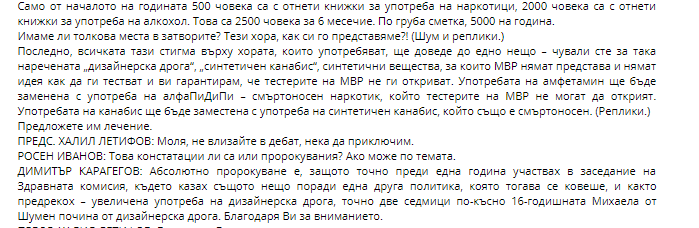
Transcript of the transport committee meeting from 07.2017.
Even during the meeting of this committee, MP Rosen Ivanov asked us if we were trying to predict more health problems for young people. It turned out that this is exactly what happened… The experience of other countries with similar legislation also categorically shows the causal relationship between increased prohibition and increased use of “designer drugs”. An example of what awaits us is Poland. Poland has almost as bloodthirsty legislation as Bulgaria – as a result, Poland is the European record holder for young people who used NPS. In just one year, between 2014 and 2015, the number of hospitalized young people similar to the case from “Pirogov ” in Poland tripled, reaching over 7,000. In just one day, in one city, over 500 people were hospitalized after poisoning with an unknown “designer drug”.
In countries where we have a liberalized regime for the cultivation and possession of cannabis, use is lower, as in Portugal, where we have had decriminalized possession for 17 years.alldrugs. Here the grave error of the policy of "Let's protect children by adopting draconian measures against drugs.". It's probably not because they love getting high, conservative Portuguese Catholics agree with decriminalized drugs, and for the 17th year now, literally no one wants to go back to the old regime. It's just that their children are safer that way... and they know it. And they know it because their drug politicians listened to civil society and the experts who pointed out this avant-garde, bold, but also successful approach.
The Czech Republic followed 9 years later, and Western Europe is slowly but surely moving in that direction. It remains for us to walk our path towards realizing obvious factual truths, unpleasantly admitting mistakes, taking responsibility, and completely rethinking our drug policy. When it will happen and how many young lives will be lost by then remains to be seen, but one thing is clear – these problems with children must torment the conscience of an entire generation of politicians and rulers, and the responsibility for getting things right lies with the current government. It is high time to start a real dialogue about the real problems of our drug policy, or the “Pirogov” case will only be a harbinger of even more terrible incidents…
-----
Footnote: The article was written hours before it became clear that the young man had died. Condolences to his family...
Header image source: Monitor.bg