EKIP– Expert Club for Economics and Politics A Different Opinion

Author: Nikolay Filibev
With the arrival of April, a change in the tax system in Scotland came into effect. The existing system of income tax in the UK is being complicated by adding two new rates and changing their scope. The main argument with which the minority government of the Scottish National Party was able to attract the Green Party (and gain sufficient support for the proposal) is that the majority of the population of Scotland will pay less. You can clearly see in English the graph presented by the BBC:

Workers earning over £26,000 will see their tax burden increase. This is likely to further weigh on the country's economic development, given that it creates a difference in taxation between Scotland and the rest of the UK. This in itself creates an opportunity for businesses to simply move their registration of activities outside of Scotland, thus making the original idea of increasing tax collection in the country's budget questionable.
These changes are being made to offset the loss of funding from the so-called “Block Grant” from the government in London, as a result of the “ Scotland Act 2012” and the increased decentralization of tax powers introduced by the “ Scotland Act 2016”. This tax change risks tarnishing Scotland’s investment image, especially given the uncertainty surrounding Brexit. When you take into account other taxes and fees due - VAT, Council Tax, excise duties on cigarettes and alcohol, air passenger duty and others - it turns out that income tax in Scotland is precisely unfair, “anti-social” and uncompetitive.
What kind of tax reform does Scotland need?
One way to address these problems is to change the structure of the tax system. An alternative income tax system is the so-called flat tax. This tax system is based on the idea of a single tax rate that does not depend on the amount of income. Although the original idea included a non-taxable minimum, this is a subject of debate and opinions differ. A flat tax is a step towards reducing the tax burden on each individual, increasing competitiveness and stimulating the economy, especially in times of uncertainty. Of course, this should go hand in hand with reducing government spending. Ultimately, a gradual reduction in the overall tax burden is a step in the right direction towards reducing government intervention in economic processes and subsequently towards an unencumbered and completely free market.
Historically, income tax has been applied in Europe for the last 200 years, with the exception of Italy, where it was introduced in 1864, but is not taken into account because it was not paid. 1 It was gradually introduced in the major European centers to finance expensive military campaigns. 1 Until the final introduction of the income tax in 1907 by Nicholas II Alexandrovich, Russia had tried to avoid this form of taxation because of the expert consensus at the time that a thorough assessment of businesses and households was practically impossible. 2 The income tax proposals of the Russian Finance Minister in the 1880s were defeated in Paris, where Paul Leroy-Beaulieu wrote in Économiste français that income taxation was the new instrument of personal repression and “a veritable fiscal terror.” 3
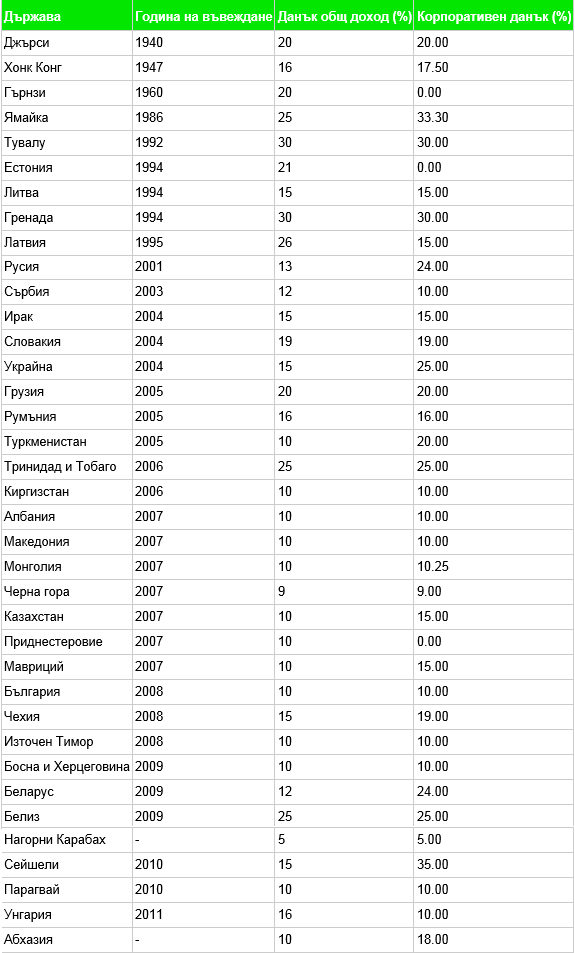
The flat tax was first described in 1985 in the book of the same name by Hall and Rabushka, “Flat Tax”. 4 The flat tax is not new nowadays, as in 2010 37 countries in the world used this tax system (Rabuska included disputed and UN-recognized countries). 5 Bulgaria is among these countries, introducing a 10% corporate tax in 2007 and an identical rate for income tax the following year. Interestingly, this happened during the mandate of the Triple Coalition, which included the Bulgarian Socialist Party. The proposal even included the absence of a non-taxable minimum, the so-called “Personal Allowance” in the UK. With the exception of Russia, where an empirical study was conducted to determine the “correct” percentage of the income tax rate - 13%, and partly in Bulgaria, where this percentage was found to be optimal according to the Laffer curve, 6 in all other countries no analysis has been conducted to determine the flat tax rate.
Table 1: Flat taxes around the world
What would be the effects of introducing a flat tax in Scotland?
In their book, the Tax Payers' Alliance proposes a combined flat rate of 30%. Although it may seem high at first glance, its introduction goes hand in hand with the elimination of a number of taxes and fees: 7
- Health Insurance - Employer (Employers' National Insurance)
- Health Insurance - Employee (Employees' National Insurance)
- Corporation Tax
- Capital Gains Tax
- Inheritance Tax
- Stamp Duty Land Tax
- Stamp Duty on shares
- Air Passenger Duty
As a result of the new tax rates in Scotland, a worker with an average income from 2016 ( £22,918 ) will be taxed as follows per year:
- Scottish Income Tax and National Insurance 2018/2019
- £2193.40 for income tax
- £1770.96 for Health Insurance (worker)
Such is the direct tax burden under the new rules. Although not directly taken from the gross salary of the employee, what the employer "pays" in addition must also be taken into account - in this case health insurance (employer). Let's not be fooled - this amount is part of the labor costs and in the absence of this rate can serve as an increase in salary.
- £2036.60 for health insurance (employer) per year
- Total is £6000.96
If we apply the same tax-free minimum of £11,850 that is used in the Scottish tax system in 2018/2019 to the Alliance proposal, at a 30% flat rate, we get the following results - £3,320.40 less tax per year, which is a significant reduction in the tax burden. Another example with a more modest income of £14,094 (based on 37.5 hours/week and a minimum wage of £7.83 ) gives us the following for the year:
- Scottish Income Tax and National Insurance 2018/2019
- £428.6 for income tax
- £712.8 for health insurance (worker)
- £818.9 for health insurance (employer)
- £1960.3 total
- The Alliance's proposal
- £673.2 total
Thanks to the 2020 Tax Commission report, we can see how the tax burden on every resident of Scotland is noticeably lower, and so not only the majority, but absolutely every taxpayer is better off. These proposals are fiscally sound, as you can see for yourself in the report. As proposed, this system is many times better than the one adopted by the Scottish government. Analysis by the Alliance shows that if the UK implements it, GDP will increase by 9.3% in 2030 and completely eliminate the deficit within 10 years. 8 This would give the UK the necessary competitive advantage over the EU, would inspire confidence in the business environment and would improve the country’s economic performance after Brexit.
Bibliography
- Kotsonis, Y. (2014). States of Obligation: Taxes and Citizenship in the Russian Empire and Early Soviet Republic, pp. 154-162
- Kotsonis, Y. (2014). States of Obligation: Taxes and Citizenship in the Russian Empire and Early Soviet Republic, pp. 57
- Kotsonis, Y. (2014). States of Obligation: Taxes and Citizenship in the Russian Empire and Early Soviet Republic, pp. 91
- Rabushka, Alvin, Robert E. Hall. (1985). Flat Tax
- Rabushka, A. Flat Tax Countries and Jurisdictions, 1 September 2010
- Angelov, G. et al. (2016). Flat Tax in Bulgaria: History, Implementation and Results. Institute for Market Economics, pp.15. Original in Bulgarian: “Flat Tax in Bulgaria: History, Implementation and Results” Institute for Market Economics, pp.15
- Tax Payers’ Alliance (2012). The Single Income Tax: Final Report of the 2020 Tax Commission, pp. 51
- Tax Payers’ Alliance (2012). The Single Income Tax: Final Report of the 2020 Tax Commission, pp. 29-30