EKIP– Expert Club for Economics and Politics A Different Opinion

The pain in emerging markets may be an indicator of future problems facing the US
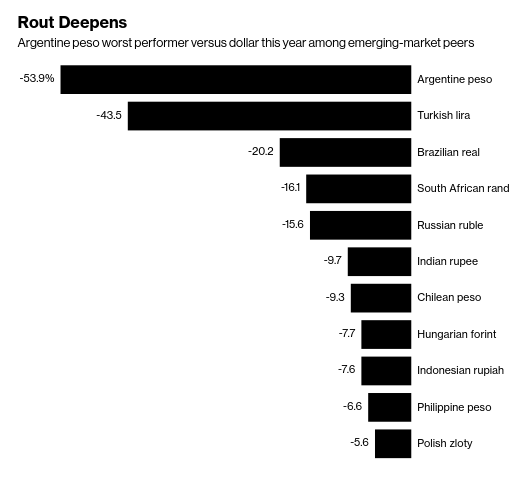
Emerging markets are on fire. In the past week, Turkey’s currency crisis has been joined by similar financial conflagrations in Argentina and Indonesia. The central bank of the gauchos raised its key interest rate to 60% (the world’s highest) from 45% after the peso lost half its value against the dollar since the start of the year.
The Indonesian rupiah, on the other hand, is at its lowest level against the dollar since the Asian financial crisis in 1997. The reason is that the equatorial country is one of the few in the region, along with India and the Philippines, that maintains a traditional current account deficit (it imports more than it exports). Indonesia is extremely dependent on external capital flows to finance the difference. In total, 40% of the government debt is held by foreigners, most of which is in dollars, because in frontier markets with a history of hyperinflation, no sane investor will lend to them in their own currency. The same is true, to a much greater extent, for Turkey.
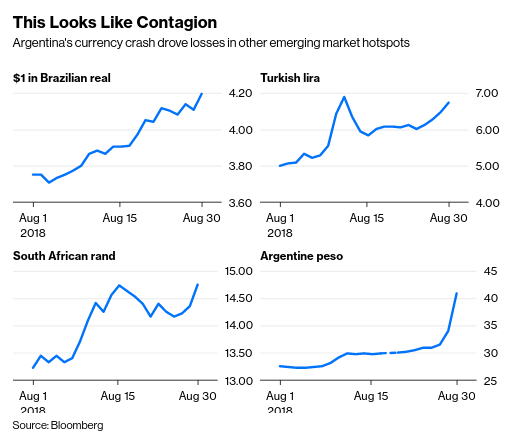
However, Indonesia has much better fundamentals than Turkey and Argentina and is basically just a victim of the overall risk aversion seen in recent days. The same is true of South Africa and Brazil, although in the former there were reasonable concerns about the nationalization of land from white farmers without compensation by the government:
Indebtedness is no longer a disease only of Westerners
During the Fed’s tight monetary policy, these loans were cheap because investors were looking for higher than the zero and even negative yields offered by the developed world. As a result, governments, but also private citizens in emerging markets, borrowed heavily, in foreign currency. From $21 trillion in 2007 (145% of GDP) to $63 trillion in 2017 (210% of GDP).
Since then, their foreign currency debt has doubled to $9 trillion, most of it in short-term debt. $1.5 trillion is due in 2019, and another $1.5 trillion in 2020. Many don’t earn enough to meet those payments.
However, if these are long-term trends, what exactly triggered the panic last week? One event related to US monetary policy went unnoticed. It was the revision of US economic growth for the second quarter of the year upwards to 4.2% annually. This effectively confirmed the tendency for interest rate hikes by Fed Chairman Jerome Powell.
Taking away the punch bowl
But that's not all. The Fed plans to start reducing its balance sheet by $50 billion per month, to $2.5 trillion by 2021, down from the current $4.2 trillion. The US central bank is starting to withdraw liquidity from the system. The European Central Bank and the Bank of Japan are still injecting liquidity, but at a slower pace, with the former scheduled to stop this year.
All of this is evidence that there will be no easy way out of the policy of easy money. By printing money, the Fed has infected not only the American but also the global economy. If the Fed continues to tighten, this could put multitrillion-dollar expanses of the global economy into a recession that would spread to developed markets, cutting off their cash flows and supply lines, collapsing the entire house of cards. On the other hand, easy money could not last forever, because there is no way that Americans can endlessly give paper covered only with promises in exchange for real goods and services from the rest of the world. At some point, the dollar will have to be sacrificed and the US will enter the first hyperinflation in its history or go through a recession much worse than the one in 2008/2009.
America is the real Turkey
Yet this policy is rightly disliked by those in power. Raising interest rates in the US will increase the cost of servicing the huge $21 trillion federal debt, for which the government will find it increasingly difficult to find money. It is no coincidence that Trump expressed his disappointment with Powell, saying that “every time we take a step forward, he takes us two steps back.”
The paradox is that the markets are punishing Indonesia, which has smaller deficits – both budget and current account – much more severely than the US. America is simply resting on its laurels in the eyes of investors only because of the dollar’s status as the world’s reserve currency. That’s why their tricks still work. But nothing that is unsustainable can last forever. There will come a time when it will have to be paid and then the Americans will have to either reform or lose their empire.