EKIP– Expert Club for Economics and Politics A Different Opinion
The world put out the fire with debt that will have to be paid sooner or later
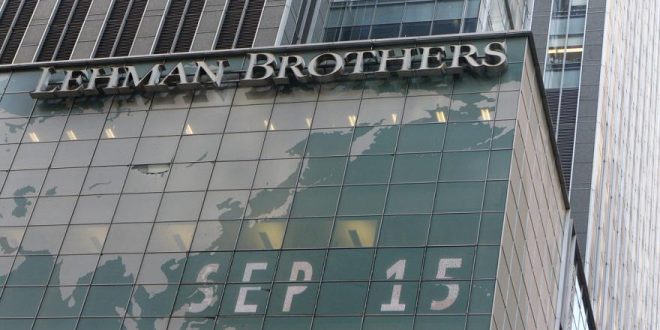
On September 15, 2008, the United States woke up to the bankruptcy of its fourth largest investment bank, Lehman Brothers. With assets of $639 billion (at least on the balance sheet) and $619 billion in debt, it was the largest bankruptcy in human history. Even bigger than Enron in 2001. Due to the great interconnectedness of American banks, it turned out that the others would also go bankrupt if Lehman failed, because through a number of financial instruments they had exposure to the fourth largest American investment bank. For this reason, in the following months, Congress, the Federal Reserve, and the Treasury Department voted an emergency rescue package of $800 billion to help their banks, in order to save their financial system from a chain reaction and total collapse.
But the bankruptcy of Lehman Brothers was not without consequences. It set off a series of events that caused the worst global economic crisis since the Great Depression of the 1930s. The US financial system is not only interconnected, but also tied to the corresponding systems in other countries around the world, on which the real sectors there depend. Cash flows dried up, and many companies along the chain, relying on future cash receipts, were unable to service their loans. In turn, they also went bankrupt. Tens of millions around the world found themselves on the streets.
How did this come about?
In the years before the housing bubble, Lehman Brothers had loaded itself with a lot of mortgage-backed securities. These instruments earn interest on the monthly payments of people who have taken out mortgages for their homes. As long as the borrowers service their mortgages, they will have value. If they stop, the instruments become worthless.
Naturally, in their pursuit of profit and in the conditions of ever-rising property prices, at some point lower-income individuals began to take out mortgages – the so-called subprime mortgages, counting on this being a good investment. When the housing bubble burst in 2007, however, many chose to default on their mortgages rather than pay relatively expensive constant interest on a depreciating house. And so the banks ended up with a whole pile of worthless houses and a lot of bad, non-returnable securities. Lehman Brothers was the worst affected of all American banks by this type of assets. And that is why the government let it fail while it saved the other, healthier ones. It was a hopeless, unsalvageable case.
This is not a failure of capitalism.
The leftist thesis is that this crisis is an example of the unstable nature of the free market and the human greed unleashed by the deregulation of the financial sector in the 1980s. And that the private sector needs to be more heavily regulated, reducing its profits, because otherwise it will drag the whole of society into regular crises. In reality, the crisis happened because we didn't have enough capitalism, not because we had too much.
The notorious policy of easy money did not start in 2008.
In an effort to protect the economy from recession, the Federal Reserve cut its key interest rate from over 5% before the crisis to 0.25% to stimulate spending and investment. But in fact, the policy of easy money did not begin then.
Chart 1: Federal Reserve interest rate dynamics
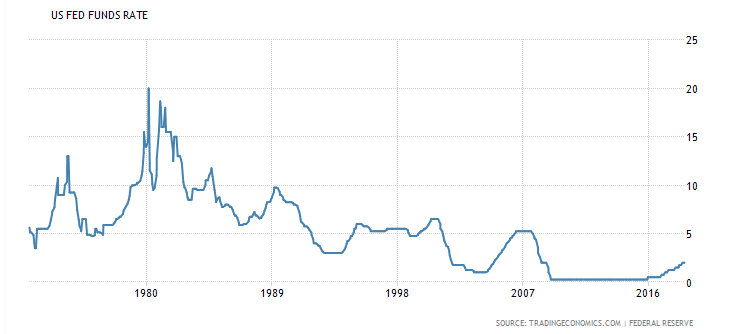
The Fed first cut interest rates to near zero in 2003-04 to deal with the aftermath of the dot-com bubble burst and the ensuing bankruptcies. These low interest rates, combined with the US government’s fetish for increasing homeownership in the US (through policies that subsidized those who took out home loans), led to the inflation of the housing bubble. Let’s be clear – this bubble, from which everything starts, is not a product of the free market, but of government intervention in it. By offering us more regulation, the leftists promise us only more bubbles and painful pops later.
The economy was poisoned by easy money that fueled investment projects that were never supposed to be funded. The inflation of the economic boom is the problem, not the recession that followed it – it is the sobering up and cleaning up of the balance sheets of these bad investments. The problem is that since 1990 the US has not had a real recession, only semi-recessions, because the Fed does not allow interest rates to rise after the boom when they should. Because politicians do not want unemployment, even temporary. And so the bad balance sheets constantly accumulate in the system to this day, but they are not unblocked. Every "cure" of the recession by printing money by the Fed leads to the next bubble.
Sweeping the 2008 crisis under the rug
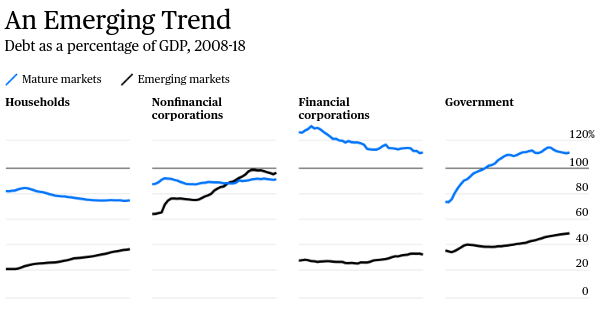
To deal with the crisis, governments around the world have embarked on an unprecedented program of borrowing and printing money, which has sharply increased their indebtedness. This means that the crisis is not over, but will simply be truly endured by future generations.
Chart 2: Dynamics of the debt level as % of GDP
All this mess comes from Keynesianism, which is an intellectual weapon of mass destruction. This economic ideology gives politicians an excuse to pursue selfish goals at our expense, seemingly helping us. All these ever-increasing artificial bubbles and their accompanying bursts do not remain without consequences in the long term. For 30 years, real incomes in the United States have hardly budged with an ever-growing GDP. The difference goes to the senseless investments of the boomers. They will not end until this intellectual trend goes to the garbage dump of ideologies with its older brother - Marxism and does not let the world live in true freedom.