EKIP– Expert Club for Economics and Politics A Different Opinion

Source: NSI
Comment:
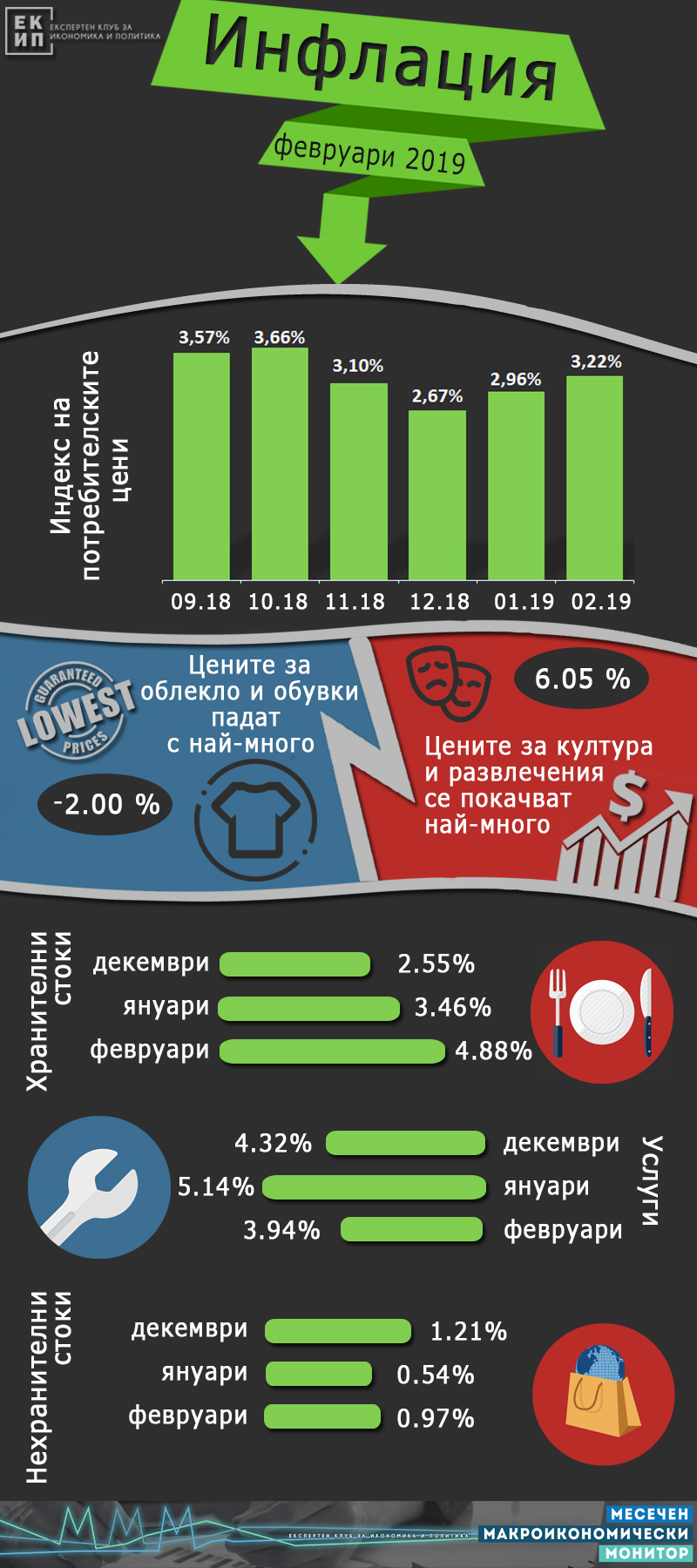
In February, consumer price inflation accelerated to 3.22% year-on-year from 2.96% in January, according to the latest NSI data. The most serious growth continues to be reported by prices in the "entertainment and culture" category, although in February there is a slowdown compared to the inflation reported in the previous month - 6.05% compared to 8.35%. The prices of clothing and footwear fell the most - down 2.0%. The alternative breakdown of the NSI by major categories shows that food prices grew the fastest in February, with an acceleration in inflation also reported in non-food goods, but there it remains relatively low.
Transport prices continued to fall in February, but at a slower pace of 0.42%, compared to 2.55% in January. This was due to the increase in gasoline and diesel prices by about 12 stotinki. The decline in clothing and footwear prices is not unusual, the prices of these types of goods have actually been falling continuously since mid-2016. The media often exaggerates the impact of inflation on the prices of some basic products, such as food, but regularly fails to mention positive developments for consumers, namely the constant decline in clothing and footwear prices. The prices of food themselves are growing at the fastest pace since April 2017, but this acceleration is largely due to a purely statistical effect. At the beginning of last (2018) year, inflation for this type of goods slowed sharply to unusually low rates of below 1%. This unusually low base for the period makes the growth at the beginning of this year look more impressive than it actually is.
Although inflation has been accelerating for two consecutive months, we do not expect 2019 to see higher inflation than 2018. In its latest more detailed economic commentary, the BNB mentioned that interest rates on loans are expected to start rising towards the middle of the year. When this happens, consumption growth and, accordingly, prices will start to slow down, due to more expensive consumer credit. In addition, wage growth is already slowing down anyway and the most recent NSI data indicate that labor market growth has already passed its peak. These are additional factors that will lead to slower growth in consumption and, hence, in prices.
Infographics: Natalia Chomakova
Commentary: Georgi Vuldjev