EKIP– Expert Club for Economics and Politics A Different Opinion
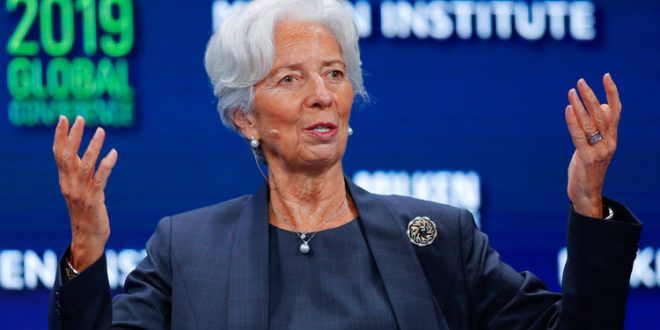
After three days of secret meetings and oath-taking in Brussels, European Union leaders emerged from the conference rooms with consensus candidates for the most important political posts in the bloc. The biggest surprise of the four nominations is that of the current head of the IMF, Christine Lagarde, who is set to succeed Mario Draghi as president of the ECB. Although formally, the European Parliament will hear and discuss the candidacy of the new ECB president, as Ms. Lagarde seems well-positioned among MEPs and will probably have no problem taking office.
Unlike her predecessors, the new governor is not an economist, has no academic background and is above all a typical representative of the French political class. So much so that in 2016 she was convicted in her home country for the role she played, as finance minister in Nicolas Sarkozy's cabinet, in providing 400 million euros of French taxpayers' money to a major businessman who promised support in the elections. However, she did not suffer any real punishment and continued her rise, now in international politics, to the top of the IMF, where she succeeded another French politician with problems with the law, Dominique Strauss-Kahn. The IMF board did not ignore the problem with the conviction and elected her for a second term.
Ms. Lagarde’s professional history is important for context, especially when it comes to central banks. With the election of such a political figure, the last vestiges of the ECB’s patina as an “independent institution” have already been relegated to the channel of history. The traditional search for governors who are either academic economists or bankers has been replaced by a selection headed by a convicted politician. From this we can judge that the fiction of independent expertise governing central banks is either too expensive to maintain, i.e. there are no real bankers willing to continue the current policy of credit expansion and negative interest rates, or we have reached such an end of the road that decency has long ceased to be a priority.
We can say with a high degree of certainty that the new governor will continue the artificial stimulus from Mario Draghi's mandate. Big business, financial institutions and the entire political class are worried that a more realistic ECB policy would stop the artificial breathing of the suffocating European economy with a new recession and a dramatic continuation of the masked debt crisis, removing the illusion that there has been any real recovery. It is no coincidence that the normalization of interest rates, which the strata of the German school in the person of Jens Weidmann, governor of the Bundesbank, wants, was pushed into a corner at the expense of promises of (more) quantitative easing and negative interest rates.
In fact, Lagarde's choice is yet another proof of the historic mistake of German politicians and central bankers who embarked on the path of the single currency in the early 1990s. Thinking they could impose fiscal and monetary discipline outside Germany and paying the political price for unification after the fall of the Berlin Wall, they succumbed to decades of pressure to create the euro.
Today, their failure is twofold, first in maintaining fiscal and secondly in maintaining monetary discipline in the eurozone. In recent months, we have seen a fresh example of weakness in fiscal matters - Italy, with an expected debt of 135.2% for 2019, more than twice the requirements of the Stability and Growth Pact, cannot be put into an excessive deficit procedure. We also see the ECB, consistently ignoring the positions of the Bundesbank, now led by a French politician with the intention of continuing and even deepening the "interest rate winter" for the foreseeable future. Instead of the euro turning the dissolute and spendthrift French into thrifty and disciplined Germans, it has made the Germans French.
Easy-credit-hungry markets reacted immediately to the news of the new governor – 10-year German bonds fell below the ECB’s base rate of -0.40%, while 20-year bonds fell below zero, bringing the total amount of negative-yielding global debt to $13 trillion, doubling from September-October 2018. The distortion is complete, with Italian 10-year bonds trading below 2% last week, and Spanish and Portuguese around 0.20%. At the same time, the pressure is on Lagarde to continue with stimulus through quantitative easing or further cuts to the base rate.
Fiscal stability, reforms for a more flexible business climate, limiting public spending, addressing the tangled social systems and stifling regulations have been forgotten as too complicated by governments. The only solution is seen in the artificial stimulus with decree-cut interest rates and a readiness to "rescue" the struggling economies with trillions of euros still printed by the ECB. At the same time, all indicators of the performance of the real economy show a slowdown, and the Japanese scenario of a decade-long stagnation no longer leaves the lips of many analysts.
Ultimately, Christine Lagarde was chosen to continue Mario Draghi’s “whatever it takes” approach to maintaining the artificially unstable construct of the eurozone. Regardless of the cost, the euro and the established financial order will have to be preserved, Angela Merkel herself warned that the entire project of today’s European elites is inextricably linked to the single currency. Two still unclear questions remain: will the swelling contradictions of the unfinished monetary system be quelled, and if they do, will the result be worse than the collapse that has been so diligently avoided?
The article was originally published by Money.bg