EKIP– Expert Club for Economics and Politics A Different Opinion
This week, Greek government debt yields fell to record lows. The yield on the country’s 10-year government bond fell below 1% for the first time in history on Wednesday, and later to below 0.9%. This is a particularly significant development, given that Greece was the country that suffered the most during the eurozone crisis and was on the brink of bankruptcy by 2015. The entire eurozone was then forced to raise hundreds of billions of euros in financial resources to save Greece from bankruptcy.
How come less than 5 years later, Greek government bond yields have reached historic lows? In principle, these rates are a key indicator of how financial markets assess the level of economic and fiscal risk in a country. When there is high demand for a country's debt, its price rises and interest rates fall - the relationship between the two is inversely proportional.
Obviously, especially in the last year, when Greek 10-year bond yields fell by about 75%, investor demand for Greek debt has been very high. The question is – what is this high demand due to? A real improvement in the economic and financial situation in our southern neighbor or... another bubble inflated by the monetary policy of the European Central Bank?
How much has the Greek economy improved recently?
The Greek economy is definitely improving. The government is complying with the requirements of external creditors, maintaining a large budget surplus of over 3.5% of GDP, and meeting annual targets for reducing the government debt-to-GDP ratio. In the meantime, it has initiated an ambitious reform program that includes a number of tax cuts, especially for businesses, and the privatization of state-owned enterprises in financial difficulties. In addition to all this, the government is also trying to help banks accelerate the reduction of their non-performing loans. All this with the aim of stimulating investment and raising the level of economic growth.
Indeed, unemployment is falling and GDP growth in Greece is accelerating. But that doesn't mean that everything is rosy. Our southern neighbor is still only at the beginning of its path to full economic recovery from the severe economic and fiscal crisis it was in just a few years ago. The banking system is still fragile and full of non-performing loans, the state treasury is burdened with billions of euros in debt accumulated by unprofitable public enterprises. The level of public debt to GDP is still over 170%, making it the second highest in the world. And to top it off, Greece's sovereign debt credit rating, although improving, is still at "junk" level, according to all rating agencies.
In much more stable economies, debt is much more expensive.
It is therefore extremely strange that interest rates on Greek government debt have fallen to historically low levels, lower than those of countries in a far better economic and fiscal situation. For example, the interest rate on 10-year government bonds in Poland is more than twice as high – 2.157%. Poland’s GDP is growing by between 4% and 5% per year, while Greece’s is only 2-3% and its credit rating is A2 with a stable outlook, which is 4-5 notches above Greece’s. The government debt-to-GDP ratio is 49%, while Greece’s is over 170%. Yes, Poland’s government budget is far from Greece’s surplus, but it is also far from the levels of non-performing loans in our southern neighbor’s banking system – 39.2% of all loans according to the latest data.
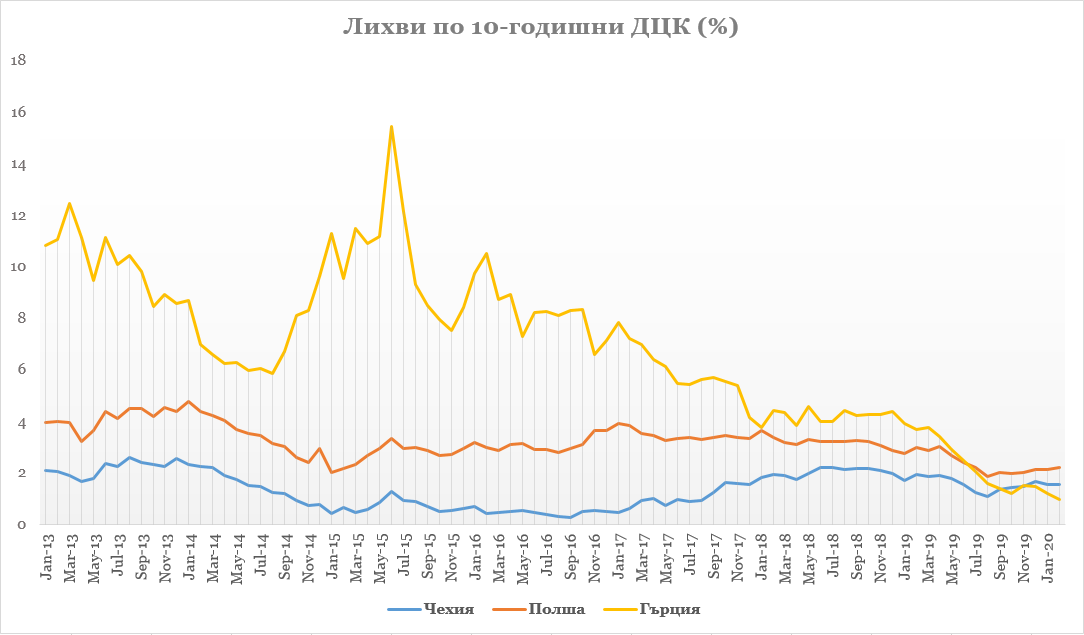
The comparison with the Czech Republic is similar – a country that has an even lower level of public debt – 32.6% of GDP and an even higher credit rating of Aa3, a fiscal surplus and GDP growth similar to that of Greece. But here too, the interest rates on public debt are significantly higher – 1.520% on 10-year bonds, which is about 33% higher than that of Greek bonds. And the level of non-performing loans in the banking system? In the Czech Republic it is below 5%, i.e. nearly 10 times lower. The graph below shows the dynamics of interest rates on public debt in Greece, Poland and the Czech Republic since 2013.
Chart 1: Interest rates on 10-year government bonds of the Czech Republic, Poland and Greece, %
Source: Investing.com
Italy's national debt – the same bubble
By the way, Greece is not the only puzzling "anomaly" in this regard. Italy, which is actually in a worse economic and fiscal position than Greece at the moment, has similar levels of interest on its government debt – close to 0.9% for 10-year government bonds. The reality is that their debt should be more expensive even than that of Greece, let alone far more financially stable countries like the Czech Republic! Not only does Italy have a government debt equal to over 130% of GDP, not only does it still suffer from chronic budget deficits, but its banking system is so fragile that every year at least one bank has to be saved from bankruptcy with taxpayer money.
Spain and Portugal are better off, but their government debt is also overvalued. For example, the interest rate on Portugal's 10-year government bonds is around 0.25%, given that the country has nearly 120% government debt to GDP, only in 2019 was it able to completely clear the budget deficit, the credit rating is BB+ (a bit better than Greece's). In Spain, which still suffers from budget deficits, where government debt is close to 100% of GDP, the interest rate on 10-year bonds is around 0.28%. But at least the credit rating there is at a better level "A".
The reason why interest rates on the government debt of countries like Greece and Italy are so low is the policy of the European Central Bank and the fact that these countries are in the eurozone. Being part of the EU countries that share the common currency of the euro, Greece and Italy are also part of the common stability mechanism, the banking union and other mechanisms of the eurozone that exist to financially support countries that are facing bankruptcy. Of course, the ECB is also relied on to help by printing money.
Table 1: Comparison of different fiscal and credit indicators

Source: Deloitte, TradingEconomics, official statistics of the countries themselves
Markets are completely distorted by ECB policy
The ECB's money printing is another major factor at work. In addition to keeping deposit rates negative, the central bank last fall restarted its "quantitative easing" program, which simply means buying government bonds of eurozone member states. Interestingly, this program does not currently include Greece, but as you can see, that does not prevent it from benefiting given the huge drop in interest rates on its government debt that has been achieved.
The ECB's aggressive monetary policy keeps interest rates on the government debt of all eurozone member states extremely low. Especially when it comes to countries like Germany and the Netherlands, which are in a far better fiscal and economic position than southern member states like Italy. There are other factors, however. Institutional investors such as pension funds are practically forced by current regulations (including in Bulgaria) to buy a certain minimum level of government debt of EU member states.
Banks also have a very strong incentive to buy government debt because, according to the generally accepted regulatory framework for the sector, Basel III, government debt does not require risk weighting, unlike other bank assets. That is, if you are a bank, you can "accountingly" improve your level of capitalization by buying government debt because regulatory institutions do not classify it as a risky asset. How adequate this presumption is in view of the history of the eurozone and its fiscal crises, I leave to you to judge.
How long can the balloon be inflated?
The data suggests that we are witnessing the inflation of yet another colossal bubble in the eurozone sovereign debt market. The situation in Greece is improving, but not enough to justify such a serious drop in interest rates on its sovereign debt. Not to mention Italy, which has been on the brink of recession for more than a year, with a large budget deficit and the local government still having to bail out banks on the brink of bankruptcy.
The scary thing is that the next economic crisis in the eurozone is already knocking on the door, judging by the latest GDP data for countries like France, Italy, and Germany, none of which managed to achieve growth in the last quarter of 2019. Of course, the ECB and eurozone politicians will try to do everything they can to postpone the crisis, thus inflating the bubble even more. The question is – how long can they continue to do so, and how severe will the long-term consequences be for the European economy?