EKIP– Expert Club for Economics and Politics A Different Opinion

Highlights:
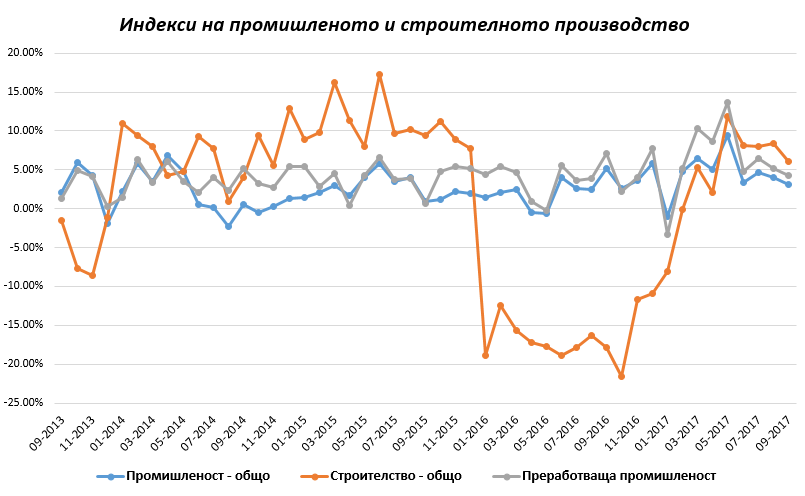
- Growth in construction production slows slightly but remains significantly above the average levels for recent years
- According to the EC, a bubble is forming in the construction sector, which is being stimulated by cheaper mortgage lending
- Consumer inflation continues to accelerate, producer goods inflation remains unchanged
- Industrial production and sales are growing at a slower pace, the same applies to retail trade
The construction boom continues at a more moderate pace
Growth in the construction sector slowed to 6.04% in September from 8.43% in August. This is the lowest level of growth in construction output since April. Growth in building construction slowed from 16.25% to 12.31%, but remains much higher than the average level over the past 10 years. However, output in urban/engineering construction continued to decline, and at a faster pace. In September, it fell by 1.10% compared to 0.31% in August.
Overall, the construction sector continues to be in a flourishing state, perhaps even too flourishing. We have previously mentioned concerns about the formation of a bubble in the sector and it seems that the European institutions are already afraid of such a development. Last week, the European Commission explicitly warned that a property bubble is inflating in Bulgaria in its latest report on countries with excessive macroeconomic imbalances. According to Eurostat, in the second half of 2016, residential property prices increased by 12% and in the first and second quarters of 2017 by over 8%.
Source: NSI
These are levels of price growth not seen since before the bursting of the housing bubble and the onset of the crisis in 2009. This increase in prices is most likely due to the record low interest rates on newly issued mortgage loans, which are on average 4.2%-4.5%. So in fact, the concerns of some financial analysts that the banking sector is not lending enough may turn out to be completely wrong. Quite the opposite – the banking sector seems to be lending too much, specifically in mortgages, and this is creating serious imbalances.
What does this bubble mean in the long term? Like any bubble, it means that when it bursts, many businesses and households will suffer severely financially. We can expect mass bankruptcies in the construction sector when this happens, similar to the consequences of the bursting of the last property bubble. And every bubble bursts sooner or later. We have no way of knowing exactly when, because it depends on a combination of factors.

Source: NSI
The most important factor is, of course, the dynamics of lending and its price. The moment mortgage interest rates (and loans to construction companies) start to rise, we will begin to notice a cooling of passions in the property market. When this will happen largely depends on the European Central Bank. Although Bulgaria has not adopted the euro, the money supply and, accordingly, the banking sector in our country are very dependent on the ECB's policy, because our currency is pegged to the euro. This means that when the ECB starts tightening its monetary policy and raising interest rates, this will lead to an increase in the cost of lending throughout Europe, including in Bulgaria.
Once this happens, businesses will not be able to bear the more expensive investment credit on the one hand and the lower demand on the other (due to the rising cost of mortgage loans), and then the property bubble will burst.
Industrial production and sales stagnate
Source: NSI
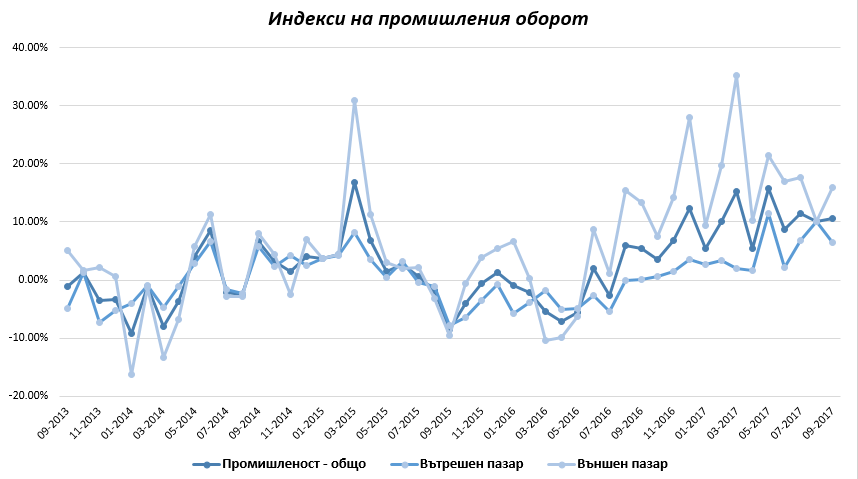
Meanwhile, the industrial production index grew by 3.16% year-on-year in September, marking a slowdown from the level reached in August. This was due to both a weaker level of production growth in the extractive and manufacturing industries. Production growth in the extractive industries slowed by over 5 percentage points to 7.66%, in the manufacturing industry to 4.32% from 5.19% in August. With this slowdown in September, the growth rate of industrial production in our country falls below the EU average for the first time since January. In September, the average growth rate of industry in the EU is 3.6%, with the highest levels being reached in Romania and the Czech Republic.
Turning to industrial sales, we see that their growth rate remained relatively stable in September. There was only a very slight acceleration in growth to 10.56% year-on-year. This is due to slightly higher levels of sales growth in the mining and manufacturing industries. In the mining industry, sales growth of 25.88% was recorded in September, which is the highest level since February, while in the manufacturing industry the growth reached 11.18%. In view of the slowdown in production in the mining industry, there may also be a slowdown in sales in October, so it is uncertain whether the current high level of growth in this subsector will be maintained.

Source: NSI
The NSI's geographical breakdown shows that domestic industrial sales growth slowed in September, while it accelerated in the external market. The sector's turnover grew by 6.42% in the domestic market, compared to 10.10% in August, when it even outpaced external growth, which now reaches 15.86% after the slowdown at that time. Overall, the data indicate a stabilization of sales growth in the industrial sector in September, and we believe that we are likely to see a slight slowdown in October.
Consumer inflation in Bulgaria is accelerating, in the EU it is stagnating
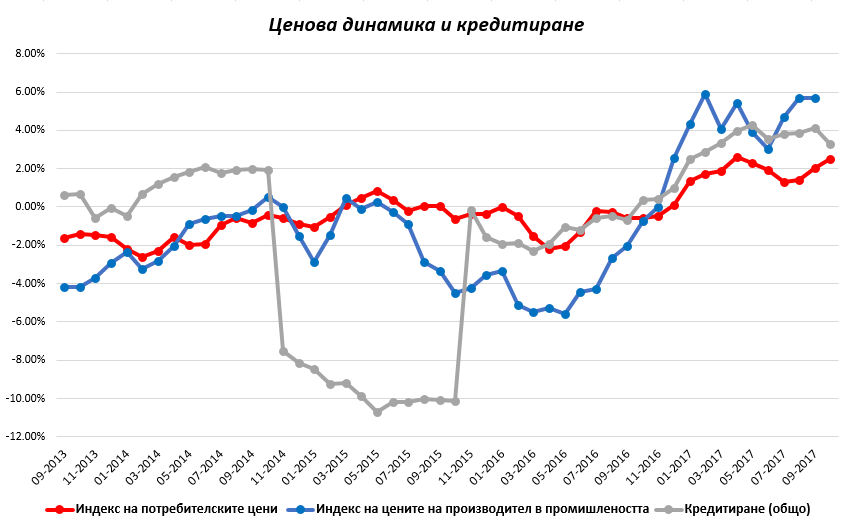
NSI price data show that the inflation rate in consumer goods continued to accelerate in October, while that in manufactured goods remained at the same level. The consumer price index increased by 2.49% on an annual basis in October, while in September it increased by 2.06%. Meanwhile, the producer price index in industry was 5.70% in September, which is practically the same level as the previous month. Consumer price inflation in our country continues to accelerate against the background of stagnating inflation in the European Union as a whole.
Source: NSI, BNB
The largest contribution to the higher consumer inflation in October was again made by non-food prices, which increased by 3.94%, compared to 3.72% in September. However, non-food and service prices also grew at a faster pace, which is an indication that the upward trend in consumer prices is not the result of the isolated influence of food products, but an overall trend. There are some exceptions, however, such as transport prices. Their growth slowed to 1.95% in October, from 2.25% in September. A similar slowdown was also observed in the growth of education prices. However, in most categories of consumer goods, faster inflation was observed in September.
As we have said, prices of manufactured goods generally stagnated in September and at the sectoral level this is mainly due to a slowdown in inflation in the extractive industry. It is 9.94% in September, compared to 11.64% in August. At the same time, however, inflation in the manufacturing industry continues to accelerate and reaches 4.07%. However, this is a slight increase compared to the level of 3.91% in August and not enough to compensate for the impact of lower inflation in the extractive sector.

Source: NSI
The NSI's more detailed breakdown also shows a slight slowdown in the pace of inflation in energy, investment, and consumer durables in the industrial sector. Energy prices rose by 9.73% year-on-year in September, down from 10.36% in August, while investment prices rose by 0.68%, down from 0.86% previously. At the same time, however, prices of intermediate goods rose by 6.40% in September, marking an acceleration compared to the inflation rate recorded in August – 5.66%. An acceleration is also observed in the inflation rate of consumer durables.
Higher housing lending stimulates the property market
Let us now turn our attention to lending. BNB data show that overall lending growth slowed to 3.29% year-on-year in October from 4.14% in September. This is also the lowest level of lending growth since February. This is mainly due to much slower growth in lending to non-financial corporations. It slowed to 1.47% year-on-year in October, while in September it was 3.08%. Meanwhile, lending to households and NPISHs continued to accelerate, reaching 6.34% - a record level for the last 5 years.

Source: BNB
The higher growth in lending to households is due to both higher consumer and housing loans. Consumer loans grew by 6.37% year-on-year in October, and housing loans by 6.44%. Growth rates in both categories were below 6% in September. These data clearly show that consumer lending in our country is on a serious upward trend.
There are many factors contributing to this – we can broadly categorize them as the economic environment has been improving significantly over the past year. The most significant is likely to be the impact on the labor market – as the economy approaches full employment, wages are starting to grow at an increasingly faster pace. This allows consumers to spend more and therefore take out more credit because they feel they can now afford it and because they expect the good economic conditions to last.
The upward trend in consumer credit is also a major factor behind the faster growth in consumer prices. The same applies to housing credit – higher demand in the housing market is certainly a major factor behind the significant acceleration in construction output growth this year. As these two types of credit continue to grow at an ever faster pace, we can expect the same to happen with consumer goods and property prices.
Retail growth continues to slow
Source: NSI
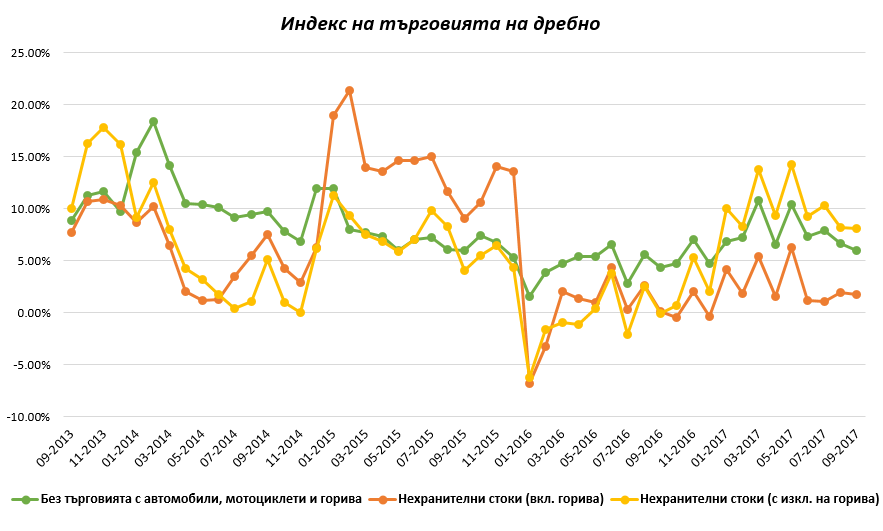
Retail trade growth excluding motor vehicles, motorcycles and fuels slowed down once again to 5.95% year-on-year in September. Already, trends in our country are starting to diverge from those in the EU, because in September the average retail trade growth rate for the union accelerated and reached 3.9% from 3.1% in August. However, as can be seen, retail trade in our country continues to grow at a level above the average.
Trade in non-food goods (excluding fuels) in our country slowed down slightly to 8.08%. The same applies to trade in non-food goods + fuels. The detailed breakdown of the NSI shows that in September, compared to August, retail trade through mail order, telephone or internet grew the most – by 3.0%. Retail trade in miscellaneous goods and retail trade in pharmaceutical goods ranked lower, with sales increasing by 0.9%. Overall, in each category of goods, the growth reported compared to August is very low, if any at all.

Source: NSI
Overall, these data show that retail growth in our country is stagnating, a trend that has continued throughout the summer. There is unlikely to be a significant improvement in October, but we can expect one towards the end of the year in November and December, mainly due to promotional discounts around Black Friday and of course – the Christmas holidays.