EKIP– Expert Club for Economics and Politics A Different Opinion

Highlights:
- Construction production accelerates sharply in January, reaching record levels for the last 10 years
- Consumer inflation is accelerating, industrial goods inflation is slowing down
- Housing lending continues to accelerate and is also growing at record levels for recent years
- Industrial sales and production grow at a faster pace in January
- Consumption growth is expected to slow after the end of the holiday season
Construction is growing at the highest rate since 2007
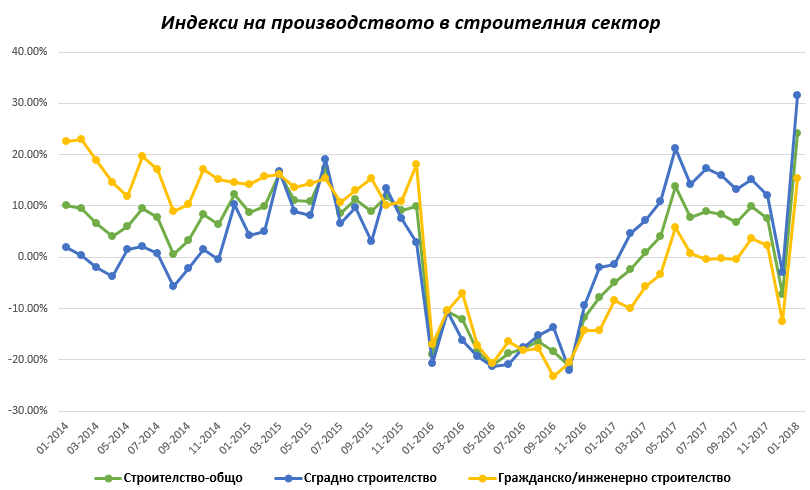
After temporarily declining in December, construction output growth shot up sharply in the first month of 2018. The overall construction output index rose by 24.18% year-on-year in January, the fastest pace of growth since 2007. Building construction grew by 31.62% in the same month, also the fastest pace of growth in a decade. In the civil/engineering construction category, growth was more moderate and not as record-breaking at 15.45%, the highest since late 2015.
In light of these latest data, it appears that the decline in construction output in December was only temporary and we are now returning to the strong upward trend that has been going on for more than a year. It is noticeable that the pace of growth in the sector is already reaching the levels of the last major construction boom a decade ago, which is positive on the one hand, but worrying on the other hand, because, as we have been warning for some time, it is an indication of the bubble in the property market and the construction sector.
Source: NSI
You may have already grown tired of our constant warnings on the subject, but they are not compressed air. If we take a look at the price dynamics of real estate in the country and compare it with the movement of wages, we see clear indications that a bubble is inflating in the real estate market. Since the end of 2016, real estate prices have begun to outpace the average salary in terms of growth rate. The longer this trend continues, the more overpriced real estate will become in relation to the levels of wages of the population and, accordingly, the solvency of property buyers.
In a situation where property prices are growing faster than wages, what allows demand in the property market to continue to grow, despite the increase in prices, is cheaper housing loans. If interest rates on housing loans fall, this allows Bulgarian citizens to buy more and more properties, even though the prices of these properties are growing faster than their wages and, accordingly, their ability to pay their price is deteriorating. Of course, while the market demand for properties is growing thanks to cheap lending, this pushes prices up, which in turn stimulates record levels of growth in construction. Everything is tied together.

Source: NSI
The problem is that the longer this trend continues, in which property prices grow (ever) faster than wages, the more overvalued the property market becomes relative to the fundamental solvency of consumers, which depends on their wages. As long as mortgage rates continue to fall, this "problem" does not materialize any real negative consequences for the property market and the economy as a whole. However, when interest rates start to rise, there is nothing left to compensate for this difference between the growth of property prices and wages, and the solvency of property buyers sharply deteriorates. The lack of increasingly cheap credit to compensate for the discrepancy between prices and wages leads to a sharp contraction in market demand and a collapse in property prices.
This collapse, accordingly, leads to a contraction of investments in the construction sector, a decline in construction production, the cessation of investment intentions, layoffs of labor and wages, and similar negative macroeconomic consequences. For now, interest rates are still going down, which allows the boom to continue. However, in view of the fact that the European Central Bank (on whose monetary policy we are most dependent) is giving indications that it will start raising interest rates at the end of this year, we must be careful. Let's put the construction and real estate market data in a broader context by paying close attention to the overall price dynamics and lending.
Price dynamics are mixed in January and February
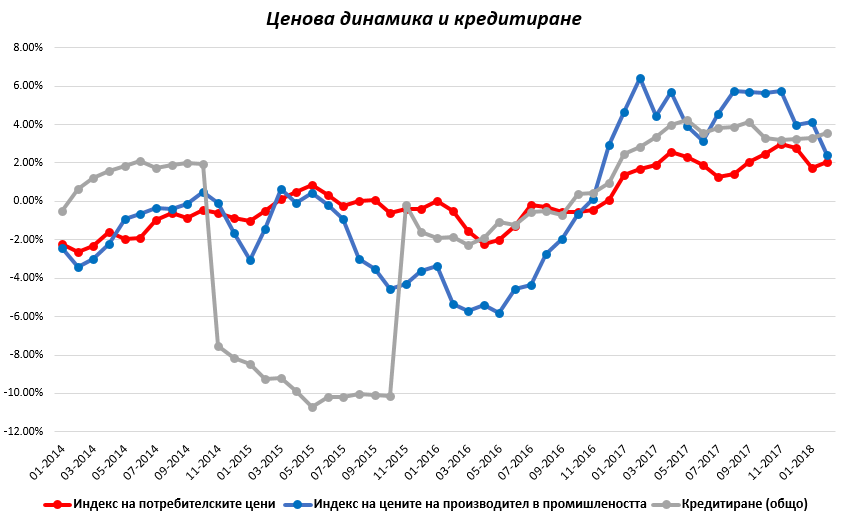
According to the latest NSI data , the consumer price index rose by 2.05% year-on-year in February, accelerating from the 1.76% recorded in January. Meanwhile, industrial producer price inflation slowed to 2.41% in February, from 4.14% in January.
Source: NSI, BNB
The detailed breakdown of the NSI shows that the acceleration in the consumer inflation rate is mainly due to the prices of services, which increased by 4.11% in February, compared to 3.23% in January. The inflation rate in the other major categories - food, non-food goods and catering - remained almost unchanged. A sharp acceleration in the inflation rate was recorded in the categories "communications" and "entertainment and culture". Prices in the first category increased by 2.71% in February, compared to 0.05% in January, and in the second by 4.03%, compared to 2.05% previously.

Source: NSI
Meanwhile, the slowdown in industrial goods inflation is spreading to both manufacturing and mining. Producer prices in the mining industry rose by 0.14% in February, after rising by 1.72% in January. Prices in the manufacturing sector even fell by 0.09% in February, after rising by nearly 2% in the previous month. NSI data also reported a slowdown in the rate of energy price inflation to 7.40% in February from 9.83% in January. Overall, this decline in industrial goods price inflation is most likely due to a temporary decline in demand for industrial goods and will subside in the coming months.
Housing lending continues its meteoric rise
While inflation showed mixed dynamics in February, lending remained strong across all sectors. Overall lending grew by 3.56% in February, up from 3.29%, and the BNB breakdown shows that lending to non-financial corporations rose by 2.02%, while lending to households and NPISHs rose by 6.07%.
Housing lending continues to grow at the fastest pace, reaching new record levels for the last decade. Housing lending in February grew by a full 8.50%, compared to 7.37% year-on-year at the end of December. This is a very significant acceleration in just two months. Meanwhile, consumer lending growth has also accelerated significantly in the last two months – reaching 6.95% in February, compared to 5.77% in December.

Source: BNB
With housing loan growth rates similar to those seen in the past few months, it is not surprising that the construction sector is also growing at a remarkable pace (and house price inflation is outpacing wage growth). Given that the European Central Bank (on whose monetary policy our banking system is directly dependent) does not seem to be planning to start seriously tightening its monetary policy until the fall, this housing loan growth is likely to continue to accelerate in the coming months and remain at record high levels throughout 2018.
The effects of these increased lending levels will accordingly continue to spill over into the property market where they will stimulate ever higher levels of price inflation, which in turn will stimulate more and more construction. But, as we have noted before, this trend is in danger of abruptly reversing once the ECB changes the direction of its monetary policy and starts tightening it. When this happens (most likely next year, at the earliest by the end of this year), the bubble that is forming in the property market will burst, because the influx of liquidity that is currently stimulating the demand for property will disappear. Be prepared for such a development in the property market in the medium term and be careful with property purchases.
Industrial production and sales are improving
Source: NSI
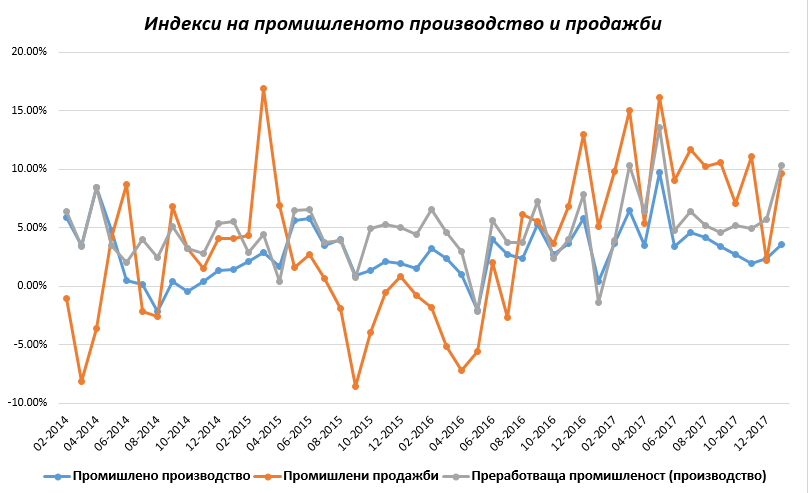
Turning to the industrial sector, NSI data show a strengthening of production in the first two months of the year. In January, the industrial production index grew by 3.55% year-on-year, accelerating from 2.23% in December. We recall that in December, industrial production growth fell to the lowest levels since May 2016.
The accelerated growth in January was due to improvements in both mining and manufacturing output. Mining output continued to fall by 4.59% in January, but this was still an improvement on the 7.00% decline in December. Manufacturing growth rates in January were 10.30%, compared to 5.71% in December. The growth rate recorded in January is the highest in this subsector since the beginning of 2011.

Source: NSI
Overall, these data indicate that industrial production is improving significantly in early 2018, especially in the manufacturing sector. Given the generally very positive macroeconomic environment both in Bulgaria and globally and in Europe in particular, we can expect industrial growth to remain at high levels and even continue to accelerate in the coming months. The decline in mining production is most likely only a temporary seasonal phenomenon and growth in the sector will recover in the spring months.
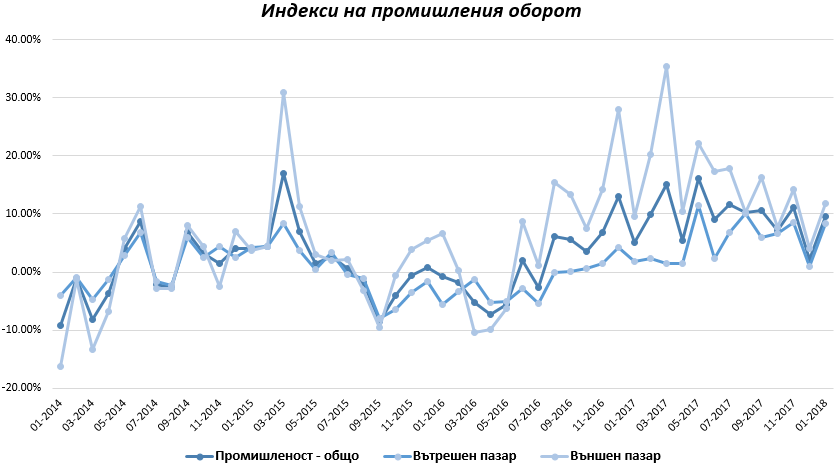
If we look at the NSI data on sales turnover in the industrial sector, we see that there is also a significant improvement at the beginning of the year. In January, sales growth in the industrial sector reached 9.61% on an annual basis, which marks a significant acceleration compared to December, when sales increased by only 2.23%. The most serious improvement in the growth rate was recorded in the manufacturing industry, where sales increased by as much as 15.98% in January, compared to only 3.18% in December. An improvement was also recorded in the mining industry, with sales there increasing by 5.31% at the beginning of the year.
Source: NSI
The geographical breakdown of the NSI indicates an improvement in the level of sales in both the domestic and foreign markets. The growth of sales in the industrial sector in the domestic market was 8.30% in January, and in the foreign market it was 11.83%. For comparison, in December the growth rates were 0.92% and 4.04%, respectively. Overall, the first month of 2018 marked a significant improvement in the growth rates in the industrial sector, both in terms of production and sales. Sales in the sector, although often varying significantly from season to season, are likely to continue to grow at even higher rates in the first half of 2018 due to the rising growth and consumption levels of the major European economies (such as Germany), which are our main trading partners.
Consumption slows in the post-holiday season
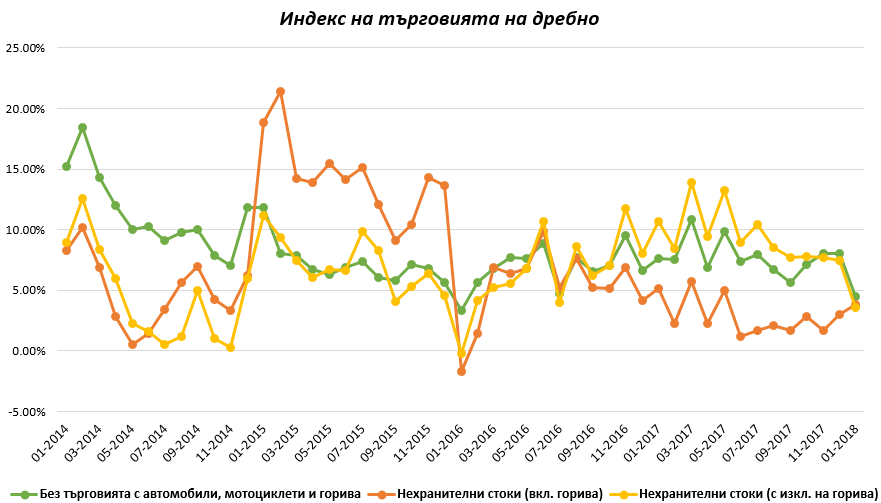
Moving from the industrial sector to retail trade, the situation is different in January. While the first month of 2018 was very positive for the industrial sector, retail sales at the same time slowed down. Retail trade excluding motor vehicles, motorcycles and fuels grew by 4.46% year-on-year in January, compared to 8.04% in December. This slowdown was largely expected, given that retail trade usually grows faster in December (and November) than in other months, due to the holiday season (and Black Friday promotions at the end of November).
Source: NSI
However, non-food sales (including fuel) improved in January, growing by 3.82% compared to 2.96% in December. This is an indication that fuel sales are growing at a higher rate in the first month of 2018, as the non-food category (excluding fuel) reported a growth rate of 3.57% in the same month, which is significantly lower than the 7.43% growth reported in December.

Source: NSI
The detailed breakdown of the NSI shows that in January, retail trade in computer and communication equipment returned to the top position in terms of growth with 5.7% year-on-year. In second place are retail trade in household appliances, furniture and other household goods and pharmaceutical and medical goods - both large categories of goods reported 5.5% growth in sales. The only category of goods that reported a decline (by 10.1%) is retail trade in textiles, clothing, footwear and leather goods. Overall, in the first months of the year, retail trade is likely to grow at a similar slower pace, but we can expect an improvement around the next holiday season related to the Easter holidays.