 EKIP– Expert Club for Economics and Politics A Different Opinion

A number of proven patterns in economic science indicate that restricting cash payments would not have a significant effect on the size of the shadow economy. The latest report by the European Commission on the effectiveness of restrictions on cash payments in the European Union unequivocally confirms that this type of regulation fails in its objectives.
Statistical data show that there is no negative correlation between the implementation of cash payment restrictions and the size of the shadow economy. That is, the implementation of such regulations is most likely ineffective in achieving the desired goal.
Other studies, specifically on the situation in Bulgaria, indicate that in order to have tangible effectiveness against the shadow economy, the ceiling on cash payments must be lowered to extremely low levels, which would seriously hinder consumers and businesses in Bulgaria and would create too great obstacles to the normal functioning of the economy.
As an additional consideration, the right of citizens to freely and anonymously manage their personal finances, which is accepted as fundamental by every democratic state, must also be taken into account. The free use of cash is also a buffer against totalitarian and authoritarian regimes that would try to seize
citizens' wealth and could do it far more easily through a financial system that depends entirely on electronic payments.
Restrictions on cash payments also exacerbate various types of liquidity crises in the financial system and impede the restoration of the normal functioning of the economic process after such crisis episodes.
Based on the data and arguments presented in this analysis by the EQUIP, we recommend the removal of the current cash payment ceiling of BGN 10,000 and the complete elimination of the "Law on Restricting Cash Payments".
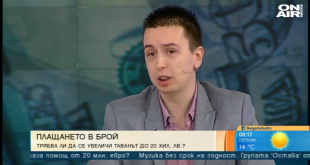
As a test measure, the current ceiling could be increased to BGN 20,000 and the impact of such a change assessed. If the assessment is that the weakening of the restriction has a positive effect, then a move towards complete deregulation could be made.
Read more information in our detailed report on the topic.





2 коментара
Pingback: It's time to remove the cap on cash payments
Pingback: The death of ScoMo’s cash ban is welcome | The Spectator Australia