EKIP– Expert Club for Economics and Politics A Different Opinion
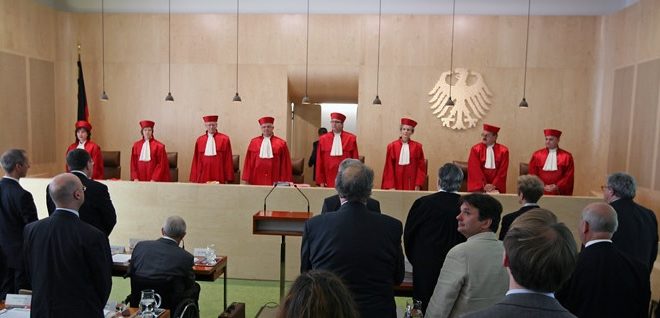
The German Constitutional Court in Karlsruhe created one of the most serious problems simultaneously for the European Court of Justice and the European Central Bank in the entire history of their existence.
This happened through a decision examining the legality of the ECB's main asset purchase program, or so-called quantitative easing, called the Public Sector Purchase Programme (PSPP). The decision defined it as partially illegal and gave a three-month deadline to prove that it complies with the rules. If this does not happen, the Bundesbank will no longer be able to participate in this program. The decision of the German judges conflicts with the decision of the European Court of Justice from 2018 and in practice sharply points out problems in the work of both institutions of the European Union.
Another shake-up in the stability of the eurozone, this time the most serious we have ever seen. Without the participation of the Bundesbank, any asset purchase program undertaken by the ECB would seem unjustified and even impossible. The question arises with even greater force – why is our country rushing to the eurozone at such a moment?
In this text we have selected the most direct and interesting criticism from the German Constitutional Court's decision. Keep in mind that when talking about “PSPP”, “quantitative easing” and “the program” in context are the same thing.
Criticism of the European Court
"The review undertaken by the CJEU with regard to whether the ECB’s decisions on the PSPP satisfy the principle of proportionality is not comprehensible; to this extent, the judgment was thus rendered ultra vires (exceeding the competence) "
The review undertaken by the European Court of Justice as to whether the ECB's decision on the PSPP satisfied the principle of proportionality was not exhaustive; therefore the judgment (of the European Court) becomes ultra vires (exceeding its powers).
"Yet if the Member States were to completely refrain from conducting any kind of ultra vires review, they would grant EU organs exclusive authority over the Treaties even in cases where the EU adopts a legal interpretation that would essentially amount to a treaty amendment or an expansion of its competences "
However, if member states completely refrain from undertaking any reviews of ultra vires policies, this would give the EU institutions exclusive power over the Treaties, even in cases where the EU adopts a legal interpretation that essentially constitutes a change to those Treaties or an extension of its competences.
"even under the Lisbon Treaty, the Member States remain the ‘Masters of the Treaties’ and the EU has not evolved into a federal state "
Even under the Lisbon Treaty, member states remain "Masters of the Treaties" and the EU has not evolved into a federal state.
"ECJ judgment manifestly fails to give consideration to the importance and scope of the principle of proportionality and is simply untenable from a methodological perspective given that it completely disregards the actual economic policy effects of the programme. "
The European Court's ruling clearly fails to take into account the importance and scope of the principle of proportionality and is simply untenable from a methodological point of view, given that it completely ignores the real effects of the program on economic policy.
"ECJ’s self-limited standard of review allows the ECB to gradually expand its competences on its own authority; at the very least, it largely or completely exempts such action on the part of the ECB from judicial review."
The European Court of Justice's self-restricted policy review standard allows the ECB to gradually expand the scope of its own powers; or at least largely or entirely exempts these ECB actions from judicial review.
"The German Court is not bound by the ECJ’s decision but must conduct its own review"
The German court is not bound by the European Court's decision and must conduct its own review.
Criticism of ECB policy
"the ECB QE programme must be qualified as ultra vires acts, despite the CJEU’s judgment to the contrary"
The ECB's quantitative easing program (PSPP) must be qualified as an act outside its powers, despite the European Court of Justice's ruling to the contrary.
"the PSPP’s negative effects increase the more it grows in volume and the longer it is continued"
The negative effects of PSPP increase the more it grows in volume and the longer it lasts.
"The volume and duration of the PSPP may render the effects of the programme disproportionate"
The volume and duration of the PSPP may make the effects of the program disproportionate.
"The economic policy effects of the PSPP furthermore include its economic and social impact on virtually all citizens, who are at least indirectly affected, inter alia as shareholders, tenants, real estate owners, savers or insurance policy holders"
The effects of the PSPP as an economic policy also include economic and social impacts on virtually all citizens who are at least indirectly affected, including shareholders, tenants, property owners, savers and insurance policy holders.
"there are considerable losses for private savings."
There are significant losses to private savings (as a result of the ECB program).
"PSPP and lower interest rates allow economically unviable companies to stay on the market."
The PSPP and low interest rates allow economically unviable firms to remain in the market.
"the longer the programme continues and the more its total volume increases, the greater the risk that the Eurosystem becomes dependent on Member State politics as it can no longer simply terminate and undo the programme without jeopardising the stability of the monetary union."
The longer the program lasts and the more its total volume increases, the greater the risk that the Eurosystem will become dependent on the policies of the member states, since it can no longer simply stop or reverse the program without endangering the stability of the monetary union.
"No balance of the economic effects of the programme neither when the programme was first launched nor at any point during its implementation."
There is no balance in the economic effects of the program, neither at its launch nor at any other point in its implementation.