EKIP– Expert Club for Economics and Politics A Different Opinion
Author: Stefan Antonov
On July 10 (the day before the elections) it will be one year since Bulgaria and Croatia were admitted to the waiting room of the eurozone and the banking union. GERB’s decision to push in this direction became a fact despite legitimate and well-founded concerns that the state was taking unacceptable risks. The past period, in turn, was saturated with events that showed that the banking union is not a panacea, and the dangers are far from virtual. An overview of these events and their interrelationship will be the subject of this article.
As a mandatory step on this path, the national currency – the lev – was joined to the European Exchange Rate Mechanism 2 (ERM-2). This is a procedure during which our country is assessed for the fulfillment of five criteria for macroeconomic and fiscal stability – low inflation, stable interest rates, low debt and budget deficit, as well as a stable exchange rate. The criteria are included in the Stability and Growth Pact, and are popularly known as the “Maastricht criteria”. The requirement is to show that we can comply with them for two years, continuously, and thus create confidence that the implementation is sustainable over time. Precisely because of the waiting and evaluation period, participation in this phase is called the “euro area waiting room”.
For the first time in the history of the monetary union, however, candidate countries (Bulgaria and Croatia) were required to surrender sovereignty over the banking system and the exchange rate. Such a requirement was not imposed on any of the countries that joined earlier. It is true that when the latter countries adopted the euro, there was still no Banking Union, but the disproportionate power that supranational institutions acquire and with which they can influence the financial systems of Bulgaria and Croatia is unprecedented. It is within the powers of the Eurogroup (the eurozone countries, those already in the waiting room and the ECB itself) to request and impose changes in the exchange rate of the Bulgarian lev and the Croatian kuna against the euro. The European Central Bank, through the Single Supervisory Mechanism and the Single Resolution Mechanism, can at any time impose the restructuring of Bulgarian banks, and even their closure.
For Euro-idealists, this is not a problem, because they assume that our country is joining a club of like-minded people who share the same ideals. How true this is will become clear later in this article. For now, we only mark the sacrifice of sovereignty as the price of admission to the waiting room of the eurozone.
This situation was reached inexplicably. In the spring of 2018, when Bulgaria hosted the rotating European presidency, the intentions of the government were completely different. The synchronicity between the Bulgarian National Bank and the Ministry of Finance tended to prevent membership in the banking union before we adopted the euro. At that time, Finance Minister Vladislav Goranov believed that the country should join the waiting room and, during the two-year assessment period for compliance with the Maastricht criteria, the country would adapt its banking legislation so that entry into the banking union would coincide with admission to the eurozone. A few months later, Finance Minister Vladislav Goranov again abandoned this strategy and declared unconditional surrender to the requirements of the Eurogroup, allowing membership in the banking union as a prerequisite that must be met in order to enter the waiting room.
No debate
To this day, it is unclear what prompted this change in positions, as well as why our central bank, which is legally independent, uncomplainingly complied with the will of politicians. The central bank's conformism will also be discussed later in this article.
The fact is that previously, in numerous publicly documented statements, its leaders have indicated [1] that this strategy is wrong and risky.
The public was not presented with an analysis of the benefits, the risks involved, and their dimensions. In the absence of expert debate, the messages from politicians and their spokespeople in favor of this venture were superficial:
- This was a natural continuation of our European integration.
- The banking system would become much more stable
- Interest rates would be lowered, as would some bank fees.
The list of dangers that could arise was much longer and far more specific:
- The ECB could take a line towards consolidation, allowing and even incentivizing parent banks to convert their subsidiaries into branches, withdrawing their capital and reserves.
- Access to easy credit financing would reduce Bulgaria's fiscal discipline, pushing it towards irresponsible accumulation of budget deficits and their financing with cheap external debt.
- As a member of the eurozone, Bulgaria would be obliged to allocate about 4 billion euros to rescue other countries with a shaky financial system in the event of one of the worst-case scenarios.
The disguise of political decisions in concrete actions took place in a no less scandalous manner. The most fundamental change – that in the Bulgarian National Bank Act, was inserted into the transitional and final provisions of amendments to the Currency Act. In essence, it allowed the Eurogroup to require Bulgaria to change the lev-euro exchange rate, practically rendering meaningless one of the main functions of the currency board. The provision can be seen in Art. 29 of the Bulgarian National Bank Act.
I was the first journalist to report this change. [2] The subsequent spin on the news forced the government to adopt a special Resolution of the National Assembly, which prohibits the Minister of Finance and the Governor of the Bulgarian National Bank from submitting to pressure to change the lev-euro exchange rate without parliamentary sanction.
The unfolding crisis caused by the novel coronavirus in the following weeks initially forced Prime Minister Borisov to back down from efforts to have Bulgaria join the banking union. However, fears about the scale of the economic contraction, as well as the potential consequences for the financial system, changed his mind.
February and March were months filled with idleness and monitoring of the situation from a fiscal perspective. No budget update was prepared, nor was any new government debt issued to strengthen fiscal reserves. Although at least one former finance minister, Petar Chobanov, predicted that the corona crisis would cause a shock greater than the Lehman Brothers bankruptcy, back in February. GERB behaved as if they were above the situation.
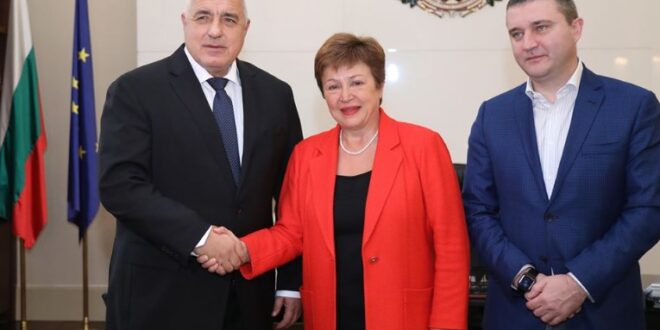
The fear of the ruling party was only evident in April, when the public learned about the Prime Minister’s sporadic conversations with Kristalina Georgieva, now president of the International Monetary Fund. The few statements about the content of these conversations and her knowledge of the language of diplomacy give reason to assume that Georgieva had rejected Borisov’s demands for the IMF to somehow guarantee that we would receive assistance in the event of an earthquake. All Bulgaria could count on were its own fiscal buffers, which the Prime Minister began to call “fat”. Then the idea of connecting to the “pipeline” of the European financial system also began to circulate. The fear of the ruling party also pushed them to conclude a currency SWAP agreement with the European Central Bank, which, on top of everything, raised the interest rates on newly issued government debt, because the absorption of the funds is impossible under the conditions of a currency board.
At that time, the only case of debate about the price that our country will pay for its monetary integration into the eurozone also occurred. On April 21, 2020, the only briefing of the Finance Minister dedicated to financial topics for the entire first half of the year was held. Perhaps because of the tragic death of journalist Milen Tsvetkov, or simply because of his innate vanity, the Prime Minister decided to join the briefing, bringing with him the Minister of Internal Affairs Mladen Marinov.
After the first 40 minutes of the briefing were spent discussing all sorts of topics other than financial ones, the government faced critically thinking and speaking interlocutors for the first time. Together with TV 7/8 journalist Stanislav Balabanov, completely unsynchronized and spontaneously, we raised the issue of the benefits of joining the eurozone and the price we will pay as a society.
I asked the Prime Minister whether this is not the wrong moment to deepen integration, since our banking system is twice as well capitalized as that of the eurozone. Also, whether the risk of Bulgaria becoming a donor to bail out the financial systems of richer countries such as Italy, Greece, Spain is not being underestimated, for the simple reason that each member state must contribute to the stabilization mechanisms. The estimate of the price that Bulgaria would pay in the worst-case scenario is 4 billion euros, not counting the risk of capital and liquid reserves being withdrawn from Bulgarian banks to their parent companies (the mechanism is described below).
The prime minister's response was an escape from the topic: "Don't you want us to leave the European Union," he asked. For the first time in a long time, the prime minister heard a remark from a journalist that this was not an answer. However, the prime minister could not offer more as an answer, and therefore Finance Minister Vladislav Goranov came to his aid, adopting the tactic "if you can't convince them, confuse them." Not that he succeeded, but he ensured the prime minister's withdrawal from the discussion, taking the "fire" upon himself. You can watch the full conversation on the recording here, but the essence is that expert arguments in favor of the government's actions were missing. After this briefing, Borisov gave only one more press conference with the opportunity for questions from journalists and then switched to the genre of monologues from the jeep.
Weeks after this briefing, The Economist magazine ceased publication.
The match is played.
By the end of spring 2020, it was already clear that there was no hope for the odyssey to fail unless something else was decided from the outside. The state-owned Bulgarian Development Bank bought 18.5% of First Investment Bank, giving 145 million leva (almost double the stock exchange price). This fulfilled the last condition for joining the union – the two banks (with Bulgarian owners), which the stress tests showed to be most at risk in the event of a deterioration in the economy, to increase their capital. By the way, BDB is also very interesting from the point of view of banking, which is taking place with impunity in a country from the banking union, and this will be discussed later in the article. At this stage, it should be emphasized that the purchase of shares in Fibank was a pure form of support for state policy. Approved by the European Commission as permissible state aid, it is an example of how BDB fulfills the will of the government. If any of the managers on the bank's management or supervisory board had objected, they simply had to leave, because ultimately the bank belongs to the state and it has the right to use it as an instrument for its political goals. Another question is whether the state also views the bank as a paternal one.
A separate issue is that the operation replicates the vicious model of the eurozone – institutions that have made mistakes are financed with public resources. The difference is that in the eurozone this is done by printing money, and in Bulgaria with taxpayers' money. Overall, however, this is a return to the model of the 1990s, which led Bulgaria to bankruptcy, and there are many experts who believe that something similar could happen to the eurozone.
Thus, in the conditions of crisis, after a controversial state aid on July 10, 2020, on the day of the first major anti-government protest, Prime Minister Boyko Borisov announced that we have become part of the white world of banking, CorpBank cannot be repeated, and a number of other nonsense that he himself will prove has nothing to do with the truth. The direct consequences are several.
Since October 1, 2020, Bulgaria has been monitored as a country preparing to adopt the euro, whether it complies with the criteria for sustainable economic development (the so-called Maastricht criteria of the Pact for Development and Growth). Since the same date, Bulgaria has been part of the European Banking Union and in this capacity has an advisory vote, which does not count in the Single Supervisory Mechanism and the Single Resolution Mechanism of the European Central Bank.
What changed this?
I promised to analyze whether, by entering the banking union and the waiting room under the new conditions, Bulgaria and Croatia fall into an alliance of like-minded people sharing common ideals. Here is an example that will serve as an answer.
In his January 2020 article, one of the heads of European banking supervision, Andrea Enria, advocated the creation of liquidity between banks in the same group, or their merger [3]. The idea is that in this way, “champion banks” will be created – parent banks strengthened with the capital and liquidity of their subsidiaries, which are transformed into branches. The hypothesis that, with their size, European banks will become comparable in financial power to their American competitors is worthy, but someone’s dirty intentions can also slip past it.
For example, a banking group headquartered in a financially unstable country (Italy, Spain, Greece, Portugal and recently France) may hold too large a share of its government's bonds, which could at some point depreciate and shake it. In this scenario, the capital and liquid reserves accumulated in countries like Bulgaria, where at least the fiscal system is relatively stable and the banks are well-capitalized and highly liquid, will be transferred to the headquarters. Bulgarian savers will take on another risk – the risk that the parent banks are burdened with. Currently, banks are forced to cooperate with the countries in which they operate and therefore they buy government debt that they would not write down if the government did not prompt them.
By empowering the European Central Bank to be the supreme regulatory authority for the banking system in Bulgaria, our state makes the parent banks operating in our country more independent from the Bulgarian National Bank and the Bulgarian government. They will be in a much stronger position to twist the hands of the Bulgarian governments when they need urgent debt financing (such as in the summer of 2014, but not only). At the same time, the savings of Bulgarians will be in branches of institutions that comply with governments in countries that have a reputation for chronic wastefulness. Ultimately, the money of Bulgarian savers can be used to lend to richer countries that are used to living luxuriously on loan.
Today, almost a year after our entry into the banking union
The more significant external risks that we exposed ourselves to by entering the banking union and the waiting room are present. There is no sign of solving the old problems – corruption in the banking sector, docile banking supervision and the dependence of the central bank on Bulgarian governments.
Before the banking union, the architecture of the Bulgarian banking system was – foreign banks, which are pushing to maintain high capitalization and liquidity, plus Bulgarian banks, some of which are rotten apples. Banking supervision, in turn, monitors the prudent (prudent) management of foreign banks and grumbles at the outrages in institutions with Bulgarian ownership, due to pressure from the government. The latter connection is proven by the outrages in the Bulgarian Development Bank, which have been happening for five years, but despite this, the BNB pretends that the smell comes from someone else's house, and does not bear responsibility.
And maybe she is right. When almost 100% of the bank's direct loans are concentrated in 20 companies or groups, and 50% of the loans are distributed to 8 companies covered by suspicions of corruption, and the entire time the bank was supervised by deputy ministers who later became full ministers, the dubious loans receive the stamp of state approval. And if they are granted in conditions of corruption, then the corruption also begins to be perceived as approved by the state.
However, the Bulgarian Development Bank is also an example of another vicious interaction between the executive branch and the central bank.
Against this background, the European Central Bank refuses to deal with the Bulgarian Development Bank because it is less significant and as such remains the responsibility of the Bulgarian National Bank.
The ECB's hand-washing may seem scandalous to us, but it is actually very practical. Officially, because the BBR is small, but the real reason is most likely a reluctance to get involved with Bulgarian corruption, and also because it benefits from it.
On July 10 last year, when the ECB announced that it was adding Bulgaria and Croatia to the waiting room of the eurozone, it indicated that our country would have to continue with reforms and the fight against corruption [4]. However, there is no such agreement with regard to Croatia [5]. If Bulgaria enters the eurozone, it will have the right to an equal vote with everyone. While we are only in the waiting room, our vote is only advisory and nothing depends on us. In such conditions, and especially while the eurozone is unstable, it is good for the ECB and the Eurogroup countries that Bulgaria does not become part of the eurozone, while it is useful for us to either join sooner or to give up the pressure and leave the banking union.
The ECB's refusal to deal with the dependencies in the supervision of the BNB and the suspicions of corrupt lending to the BDB is a trump card that it will be able to play at any moment when it benefits from it. For example, when we eventually meet the formal criteria and the failure in the fight against corruption suddenly becomes a new reason for refusing to enter the eurozone.
However, the sum of everything so far leads to several sad conclusions:
- Joining the banking union did not improve the supervision carried out by the Bulgarian National Bank
- It did not help to increase the independence of the Bulgarian National Bank.
- Suspicions of corruption in the management of Bulgarian state-owned companies and in general have not disappeared. In fact, it seems that they are also affecting the Eurogroup.
- Besides not solving a single internal problem, by joining the European Banking Union and the waiting room of the eurozone, Bulgaria only exposed itself to a number of external risks from which it was previously protected.
If one seeks logic behind Bulgaria's decision to rush to the eurozone at this moment, and this logic excludes corruption motives, then the arguments will certainly not be economic. An argument may be our country's desire to become more closely attached to the political bloc that we have chosen. For example, we may receive more protection against potential pressure from other great powers - Russia, China, the USA. In this regard, Europe does not hide that it is looking for opportunities for emancipation and hedging of its relations, including against attempts to influence the USA, which is officially considered an ally. Even if it is a complex of considerations that go beyond purely economic logic, they again require an analysis of Bulgaria's preparedness, an assessment of the historical moment and the price we pay.
For example, with its actions this spring, the GERB government has started to run excessive budget deficits that have nothing to do with the crisis. The spending and over-indebtedness that we were worried about when we entered the eurozone began with our entry into the waiting room and the banking union. This means that with the combination of a corrupt administration and easy access to financing, our country could end up in the role of Greece a decade ago or Bulgaria in the 1990s. A country on its knees, in debt, with a population that impoverishes when it comes time to pay the price of corruption and with a broken financial system. In other words – by entering the eurozone, we risk causing ourselves what we are seeking protection from.
[1] https://www.bnb.bg/PressOffice/POStatements/POADate/03_HRISTOV_20180427_BG
[2] https://bglobal.bg/101760-%D0%93%D0%95%D0%A0%D0%91-%D0%B8%D0%B7%D0%BB%D0%B0%D0%B3%D0%B0%D1%82-%D0%BD%D0%B0-%D1%80%D0%B8%D1%81%D0%BA-%D0%BA%D1%83%D1%80%D1%81%D0%B0-%D0%BB%D0%B5%D0%B2%D0%B5%D0%B2%D1%80%D0%BE-%D0%B2-%D0%BF%D1%80%D0%B5%D0%B3%D0%BE%D0%B2%D0%BE%D1%80%D0%B8%D1%82%D0%B5-%D0%B7%D0%B0-%D0%B5%D0%B2%D1%80%D0%BE%D0%B7%D0%BE%D0%BD%D0%B0%D1%82%D0%B0
[3] https://www.reuters.com/article/us-ecb-banks-idUKKBN1ZT0SO
[4] https://www.ecb.europa.eu/press/pr/date/2020/html/ecb.pr200710~4aa5e3565a.en.html
[5] https://www.ecb.europa.eu/press/pr/date/2020/html/ecb.pr200710_1~88c0f764e7.en.html