EKIP– Expert Club for Economics and Politics A Different Opinion
The inflation crisis in the country (and the world) is deepening and looks set to continue to deepen in the coming months. The war in Ukraine and the economic sanctions imposed by the European Union on Russia have reinforced the already strong inflationary trends and are leading to a shock increase in the prices of a number of raw materials – food, energy and industrial (for more information on the potential inflationary effects of the war and sanctions, see this article ). It is not surprising that in this context, concerns about price inflation have seriously increased in Bulgaria.
Alas, in the current crisis situation, the government is slow to take adequate measures. At times, it even seems as if it itself has panicked, periodically talking about “speculation” and imposing price controls – a measure that would be absolutely counterproductive in the current situation and would even worsen it, potentially causing shortages of key goods (see Prof. Pencho Penchev’s wonderful material on speculation). Let us calm down, soberly analyze the situation and think about what adequate measures the government can take to alleviate the inflationary pressure on Bulgarian society.
Threats of a price cap only make the situation worse
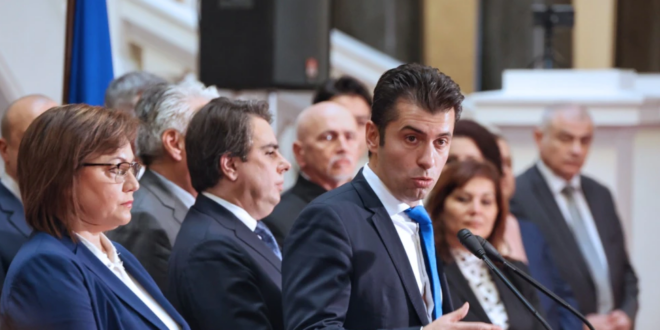
First of all, the government must stop its constant talk of “speculation” and threats that a price ceiling will be imposed on some essential products. Here I am referring in particular to the Minister of Economy, Kornelia Ninova, and the Minister of Finance, Assen Vassilev. There is no such thing as “speculation” in economics. Or rather, practically everything can be defined as “speculation” in some sense, which makes the term meaningless. Every economic process involves the assumption of financial risk by entrepreneurs over a certain period of time.
Entrepreneurs' expectations about future economic circumstances are key - based on these expectations, the production process is planned and expenses such as paying salaries to workers are incurred in the present. If these expectations turn out to be wrong, the entrepreneurs concerned may not be able to cover the costs already incurred and end up at a loss.
With price ceiling threats, ministers can have a very bad influence on these expectations, in a direction they certainly do not want. If traders and producers start to expect a price ceiling to be imposed in the near future (within 1-2 months), they may try to raise the prices of their production before then. Why? Because imposing a price ceiling means certain losses for them.
Inflation hits businesses even harder than consumers
It should be realized that in the current economic context, producers and traders are in an even worse situation than consumers, in terms of inflation. According to the most recent NSI data, the producer price index in industry on the domestic market increased by 42% year-on-year in January, accelerating from 38.6% in December. The producer price index in agriculture increased by 26.7% in the fourth quarter of 2021. These are huge levels of inflation, many times higher than consumer inflation – the consumer price index grew by 10% in February, from 9.1% in January.
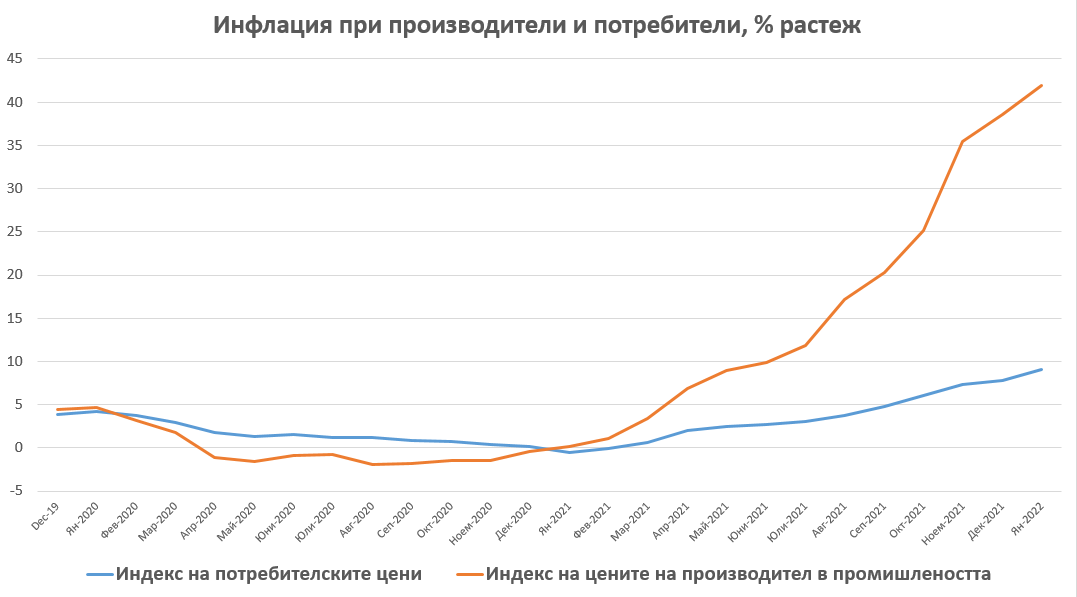
As is clearly visible, inflation is currently hitting producers much harder. Their costs are skyrocketing, but they are not able to pass on all this burden to their customers, because this could threaten their income. Instead of thinking about how to threaten their income even more, with measures such as price ceilings, we should think about how we can alleviate the costs of producers in parallel with those of consumers. And in no case should we present the interests of one as opposed to the interests of the other. In the current situation, both producers and consumers are suffering very badly under the pressure of inflation.
Let's cut VAT on food and excise taxes on fuel
One way we can alleviate the situation is by reducing the tax burden. Removing excise duties and VAT can help both consumers and producers and traders. It should be borne in mind, however, that this would be the measure that is most likely to help business, so we should not have false expectations about its effects. Removing VAT on some goods by 10 percentage points will not necessarily lead to an identical drop in price. Although we are used to thinking that VAT works in this simple and straightforward way, pricing is a far more complex process.
The VAT rate for essential goods, which are consumed the most and the inflation in them weighs the most heavily on the consumer's pocket, could be lowered tomorrow. Currently, for most such goods, it is 20%. In 2020, it was decided to lower it to 9% only for baby food. I think it is high time that the scope of this measure be expanded to all essential foods. In the European Union, many countries had differentiated lower rates for such products even before the current inflation crisis and even before the pandemic.
The excise tax on fuels is also a good idea to reduce, because these are another type of goods that are currently experiencing very high levels of inflation. The main theoretical obstacle to reducing the excise tax is that the EU has a regulated minimum level, and in Bulgaria, excise taxes are already at this minimum level. Theoretically, there is no way we can fall below it without Brussels' permission, but in reality, some countries have done exactly that. In Hungary, they temporarily reduced the excise tax on fuels below the minimum EU level. In the current severe crisis, the government there estimates that the European Commission will most likely retroactively approve these tax cuts and will not punish them for violating the directive.
The government can help poor households directly
Beyond tax measures, as far as consumers are concerned, the most effective way the government can help them cope with the current inflation is by subsidizing them directly. As I mentioned, tax cuts should be seen primarily as a measure that will help businesses. For households, the most effective assistance is in the form of emergency social payments, especially for the poorest part of the population. These emergency payments will be temporary relief until inflation calms down and may be differentiated by income.
If such a measure is introduced, the government must be very careful not to lead to an acceleration of inflation. Subsidizing household consumption should be done only to the extent that it compensates for a collapse in their purchasing power and a potential collapse in the country's domestic consumption. Such measures in an inflationary crisis are risky because they can easily lead to an acceleration of inflation if approached carelessly, and this is certainly not the desired effect at the moment. Therefore, if the state supports household consumption, it must do so very carefully and in a targeted manner, focusing on the groups most at risk of poverty.
How will these measures be financed?
Given the insanely high capital expenditures that were set in the 2022 Budget and the higher tax revenues that the NRA collects due to inflation, there is certainly capacity to implement at least some of these measures. As I wrote a few weeks ago, the capital expenditures that were set in this year's budget border on the absurd - they are simply impossible to implement. Accordingly, there is a possibility that some of them will be transferred to more urgent measures in response to the inflationary crisis. In any case, in the current context, it is advisable for the state not to increase its spending.
This is very important. If the total amount of spending increases, this will add to inflationary trends and to a large extent will make all these measures meaningless. It is even highly recommended that the opposite happens – that the state reduce its total spending as much as possible. Either way, the state spending set in the 2022 Budget is a historical record – over 44% of GDP.
As I mentioned, due to inflation, the state is currently collecting higher revenues. By cutting taxes and providing temporary emergency aid, the state can practically “return” part of these unusually high tax collections back to society and thus alleviate it in the context of the inflationary crisis. The above proposals do not have a specific political bias – they include both measures traditionally perceived as “right-wing” (tax cuts) and measures perceived as “left-wing” (social assistance). I believe that such a combination of measures can be adopted very easily by the current “motley” ruling coalition in parliament. It is a matter of desire for this to happen.
Image source: BTA