EKIP– Expert Club for Economics and Politics A Different Opinion
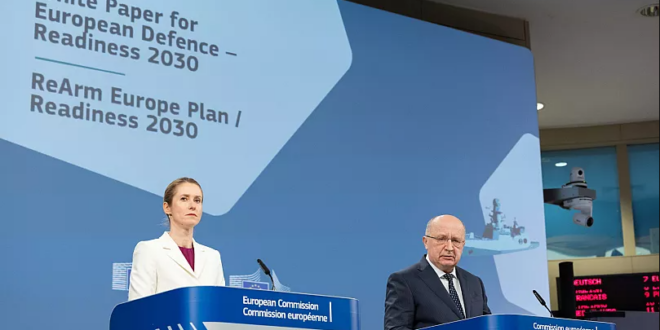
The arrival of the new government in the US and its signals that the US military presence in Europe may be about to be withdrawn have caused violent reactions on the old continent. On March 4, the President of the European Commission (EC) Ursula von der Leyen officially announced the “ReArm Europe” initiative with a budget of 800 billion euros to improve European defense capacity. As part of this initiative, it was also decided that the member states of the European Union must increase their defense spending by at least 1.5% of GDP. To this end, the EC even provides an exception to the fiscal deficit rule - deficit spending that goes to defense will simply not be taken into account when assessing whether a country is complying with EU rules.
But exceptions to the formal rules (which are hardly followed anyway) do not change the financial realities. Even if the EC selectively does not report a part of the deficit, this does not apply to the debt markets. If your deficit grows, investors will certainly want higher interest rates. Fiscal deficits among EU member states are already deep anyway. Even in Germany, the traditional fiscal “excellent performer” among large countries, the budget deficit is close to 3% of GDP. For the entire eurozone, the average budget deficit was 3.6% of GDP in 2023, and on average for the EU – 3.5%. There are no final data for 2024 yet, but the expectations are that the average deficit in both will not fall below 3% of GDP.
Defense spending
are current expenses, and such cannot be maintained through debt financing in the long term. These are not one-time expenses only for investments in armaments. Someone has to use this armament - a huge increase in defense capacity, inevitably means a huge increase in the number of the army. The necessary salaries are a current expense, which if you finance with a structural (permanent) deficit, this means permanent indebtedness, i.e. a debt spiral. And at the bottom of the spiral, the next debt crisis awaits.
Let’s do some quick and conservative math. The current estimate is that to be able to defend itself, Europe needs to spend an additional 1.5% of GDP on defense on top of what it currently spends. On average, defense spending in the union needs to rise to 3.4% of GDP, up from 1.9% now. First, I think this is probably not enough, and that spending will balloon. But even if it is enough, in the current situation, this would mean that the EU’s overall budget deficit would reach 4.5% of GDP. This is well above the levels of economic growth that the EU can hope to achieve. Current projections suggest that EU GDP growth will be no more than 1.5% over the next three years.
Dreams of growth
In some circles, there are wishful thinking stories about how defense spending will boost growth in the EU and almost pay for itself. In Germany, there is a particularly strong hope that this will save its dying industrial sector and help the economy emerge from the stagnation of the last few years. But these are empty hopes. Economic research on the subject shows that when it comes to developed economies (such as those in central and western Europe), 1% of GDP defense spending fails to generate 1% growth, i.e. fails to “pay for itself”. In fact, a number of studies show that in developed economies (such as Germany) higher public defense spending pushes out more productive private investment and thus even slows down economic growth.
There is no need to fantasize that higher defense investments will lead to some kind of innovation leap and save Europe's digital lag, for example. The glory days of DARPA in the US, from which the military agency that gave birth to the prototype of the Internet was born, are long behind us. In the US, over the past 2-3 decades, all significant innovations have come from the private sector. The EU spends as much public money on research and development as the US anyway. The key is private investment – that is where Europe's lag is concentrated and this will not be improved by more public spending.
In short, an additional 1.5% of GDP in defense spending is unlikely to raise EU GDP growth by even 1%, let alone the additional 3% needed to offset the increase in debt. Even if we allow for an additional 0.75-1.0% GDP growth per year due to higher defense spending, with a budget deficit of 4.5% of GDP, the debt-to-GDP ratio in the EU will grow by at least 2.0-2.25 pps per year. In 10 years, the average level in the EU will increase from nearly 82% to 102-105%, which would be more than 10 pps above the previous record! And these are optimistic calculations for the EU as a whole. If we look at the situation at the level of individual member states, the situation is even more difficult. Some, like France and Italy, are already so indebted that any increase in their budget deficits and public debt levels would be almost unaffordable.
What does all this mean?
So, in order to significantly increase defense spending, spending elsewhere will inevitably have to be cut. Sooner or later, this reality will have to be acknowledged. But where will the savings come from? Will social spending be cut? Is that possible in a country like France, where the capital erupts in protests every time the government tries to raise the retirement age? Maybe the costs of the transition to green energy? Is that possible in a country like Germany, which will enshrine “green” priorities in its constitution? Will something else be cut? What?
Or maybe it will rely on faster economic growth to raise budget revenues? But how will it be achieved? This will not happen with defense spending alone. Reforms will be needed. But what? Maybe the strangulation of the digital sector will finally stop? Regulatory disasters like GDPR will be repealed? Will the energy policy that has led to the highest energy prices in the developed world be fundamentally rethought? And in parallel, will the EU create a common capital market to facilitate the growth of productive companies? These are not rhetorical questions. Beyond the high-flown speeches about "strategic autonomy" and "protecting the free world", these are just some of the difficult questions that need to be answered if European politicians are truly serious about their plans for an "independent and secure" Europe. And it must be clearly understood that postponing addressing them means risking a second debt crisis in the eurozone.
What do you think would happen to defense spending if it came to that? Will it sustain at its higher level or will it be cut back very quickly when it is realized that due to the lack of fiscal space, a choice must be made between it and, for example, pension spending? What will Europe do if it has to choose between defense and the welfare state? Precisely to ensure that increased defense spending can be sustained in the long term, we must now do the math and foresee how and where we will compensate for the additional hole that it opens in the continent's public finances.
The article was originally published in "Manager" magazine.