 EKIP– Expert Club for Economics and Politics A Different Opinion
Gregory Brasiger
Over the past 80 years, governments have been expected to provide more and more social services. This means ever-increasing costs to taxpayers, both ours and future generations yet to be born. Since governments have been almost constantly in the red, they have become like cocaine addicts desperately seeking their next fix. The fix, in this case, is the eternal need for money, no matter how much wealth the engine of a strong economy may generate.
One of the fallacies of any democratic government is the “someone else will pay” syndrome. Typically, in mature social democratic countries, lawmakers look at the election cycle and realize that they never have enough money to fulfill their promises. So they postpone financial problems to the future by printing money and issuing bonds that will not mature until the next election is won.
But for most democracies, to quote former football coach George Allen, “the future is now.” Tens of millions of people in the United States, Europe, and Japan are retiring now after a lifetime of paying taxes that sink into state pension funds. Democracies face the problem of keeping all the promises of former politicians, most of whom now enjoy fat state pensions, while taxpayers struggle to cover the debts that lawmakers have left behind. So paying off debts is a perennial problem that politicians face before new elections.
For example, in the US “trust” funds for Social Security and Medicare, surpluses have been embezzled by both left-wing and right-wing governments. They have used them to pay political debts and make the deficit appear smaller. But President Bill Clinton implicitly admitted the fraud. At the end of his presidency, he urged lawmakers to “save” Social Security. Why does it need to be saved? Where did the money from the years of high premiums go?
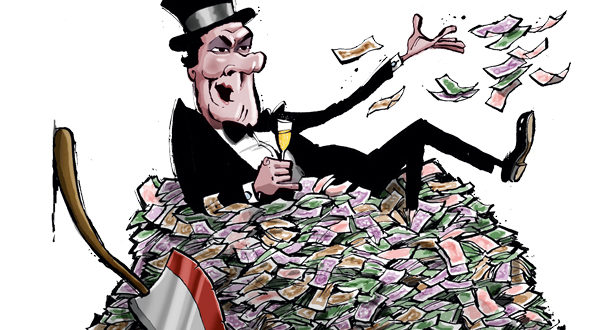
Fortunately for politicians, most voters don’t seem to understand that the huge spending of the past threatens their way of life and their currency today. The deception continues as governments seek new taxes to fulfill the promises of their predecessors. So the fiscal tricks used today are a repetition of an old scheme: “the rich will pay.”
The result of this game is that the rest of us will enjoy free or cheap “travel” [1], while the vast wealth of the rich goes into the state treasury. Government services – everything from supposedly free medical care to free quality education, superior transportation services, and so on – will be provided at little or no cost, thanks to the rich, because whoever they are, will pay.
Here in New York, the new mayor, who is strongly connected to the teachers union, wants to extend pre-K public school programs by imposing higher taxes on those earning $500,000 or more a year. Nationally, President Obama has emphasized that those earning $250,000 or more a year should pay higher taxes. The argument is also based on the idea that government should address the problem of “income inequality” and fix it.
With this mindset, one could forbid certain sports teams from winning more championships (New York Yankees, Real Madrid, Boston Celtics, etc.) because they have already won many more titles than the rest of the clubs, and that is so unfair. The logic that the rich should pay politicians is the same as that a sports league or government should correct inequalities. But inequalities between people are many and impossible to define, since each individual is unique. Moreover, these types of policies not only do not work, but they harm our economy. They have already been discussed in the past, and some of them have been tried. In the end, they say to the successful: “You are doing too well. We need to do something for you.”
This reminds me of tax policy after World War II. The system was progressive, before the Kennedy administration cut taxes in the early 1960s. In the United States, in the 1940s and 1950s, we actually had marginal tax rates of 94%. Think about it. Once you reach a certain level of income, you can only keep six cents of every extra dollar you earn. Why would you earn that extra dollar? That's what happens in the 1940s and 1950s. High-income earners will stop working later in the year, when they start to get close to that 94%.
How has this helped anyone?
Obviously, this is hurting our economy, as talented people retire for part of the year in a modified version of “Atlas Shrugged.” What about the rich? I want the same from them as I want from everyone else. I want them to continue to spend and invest as much as they want, without worrying about what J. S. Mill called a “success tax.” Whether they consume or help produce goods by starting businesses, they create the “jobs” that our politicians keep barking about in the current situation of high unemployment and slow job growth.
What about the rest of us—those who make $250,000 or less? I argue that raising taxes on the wealthy, who make up a small percentage of society, would make a big difference. Think of many Western governments running deficits of hundreds of billions of dollars every year. The whole concept of squeezing the rich is stupid and counterproductive. First, let's look at the people who are already rich. If governments continue to raise taxes, these people will stop working just before they reach the level at which the penalty rate kicks in. Unlike the rest of us, the wealthy don't have to work for taxable wages. They already have a lot of wealth.
And for the rest of us – the middle- and low-income earners – does anyone really think that since the government has collected even higher taxes from the rich, the new revenue will go to our central governments, which will exempt us from taxes?
You can stop laughing now.
The counterargument to the “rich will pay” syndrome is: first, even the highest marginal tax rates on the rich will never generate the amount of money the government expects. When taxes go up, people don’t work as hard or, in the case of low-income earners, they will work “under the table.” This is a huge problem in high-tax countries like Spain. Second, the history of many central government programs shows that even when they generate a lot of taxes, a huge portion of the revenue is eaten up by administrative costs.
Bureaucrats in the upper echelons of government are damned expensive to maintain. This is true whether it’s aircraft carriers or health insurance. I once heard the economist Jeffrey Burnham say at a conference that whenever Social Security has had a big surplus, governments have benefited from it. Here’s another example of the “you give it to us, we’ll spend it” philosophy that prevails in democratic governments. In the 1980s, there was a demand in the United States for the cleanup of toxic waste dumps. The government, through its taxing power, collected hundreds of billions of dollars. What happened to the waste dumps? Some of them were cleaned up.
What happened?
Most of the money was spent on administrative expenses. The government shouldn't be taxing the rich or the rest of us. It should be cutting taxes by closing all government agencies and selling off government assets. It should be letting people, all people, keep more of their hard-earned money. With Social Security and other government welfare programs running incredible deficits, it's more important than ever for people to have private savings and investments. That means assets under their control, not dependent on government programs whose payments can be changed at the whim of a politician.
Let people not depend on each other or on vote-hungry politicians to pay their bills. Let people create their own assets and take control of their lives through a remarkable system – more private property.
Translation: Silvia Yanakieva
Editor: Daniel Vassilev
Source: Mises Institute
[1] Free riding – a situation in which an individual consumes goods or services, the costs of which are paid for by others – editor's note.





Incompetent administrators moved the educational services related to the training of motor vehicle drivers from the Ministry of Education to the Ministry of Transport? In addition to the existing regional departments of the Ministry of Education for the control of vocational training centers, a duplicate structure was created in the IAAA-Sofia for the regulation and control of training centers with a permit for training motor vehicle drivers? In addition to the increase in administrative costs, there followed accusations, arrests, convictions, constant layoffs and changes of management, of civil servants, they even called the extortion of private companies in their honor a "peace tax"?