EKIP– Expert Club for Economics and Politics A Different Opinion
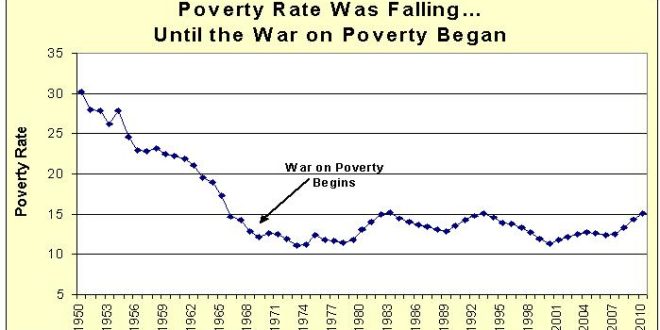
In the last months of his life, US President John F. Kennedy pushed through his cabinet the idea of a massive political campaign – a war on poverty in the country. His successor in the White House – Lyndon B. Johnson – further developed the plan and presented his vision of the “Great Society” to the US Congress. As is often the case with the good intentions of political elites, the series of programs launched in the 1950s and aimed at helping the poor led to an unprecedented increase in problems for people receiving social handouts.
According to the prominent political scientist Charles Murray, author of “Losing Ground: American Social Policy 1950-1980,” the whole mess began with the publication of the book “The Other America” by Michael Harrington in 1962. The book made bold, if ill-founded, conclusions that capitalism, as it evolved, had a natural tendency to increase poverty levels for certain groups of the population. Soon after its publication, a number of similar articles by sociologists, political scientists, psychologists, and other public intellectuals who traditionally gravitated toward the bankrupt collectivist ideas of the left, came to light.
Slowly, the fortress of free enterprise and market capitalism is being eroded from within. The corrupting tendencies that began with the establishment of the Federal Reserve by W. Wilson and the “New Deal” by F. D. Roosevelt are accelerating. A growing part of the population is beginning to place its hopes for economic security in the central government and to view economic freedom with suspicion. The opinion is increasingly heard that a system based on private enterprise suffers from structural defects, due to which economic growth is unable to create conditions for success for tens of millions of elderly and disabled people, men with low professional qualifications and single mothers.
This process of changing public opinion and the subsequent implementation of the Great Society programs led to the worst social tragedy in the United States since the introduction of slavery in Virginia. The reason is simple: social engineering ignores human nature and the laws of the market. The idea that poverty is a natural product of specific economic structures leads to the homogenization of the poor and the promotion of socially destructive desires and behaviors.
It is indicative of the counterproductiveness of political “solutions” to our problems that, once the government begins to pour enormous resources into poverty reduction, the natural trend of previous decades toward a decline in the poverty rate is interrupted. Fortunately, to this day, the majority of Americans retain to a large extent their traditional spirit of competition and an extremely strong desire to succeed in life. While they seek new and improved ways to utilize their personal talents and available resources, it is considered politically incorrect to show curiosity about the reasons for the failure of specific individuals.
In an attempt to build a society greater than that inherited by the Founding Fathers of the American Republic, the federal government deliberately removed the sense of shame felt by those forced to live on handouts. Through an agency called the Office of Economic Opportunity and a series of taxpayer-subsidized public programs, the poor gradually began to perceive access to other people's money as their inalienable right, along with the right to life and liberty. Laziness was not seen as a vice by the bureaucrat—all the poor were treated as a homogeneous group of victims of capitalism.
“If you want peace, fight for justice,” Pope Paul VI observed. The welfare state systematically violates the principle of justice, in which everyone spends their own money. Politicians have short-term interests and are not interested in the long-term consequences of institutionalizing a system of violent robbery in the form of taxes and redistribution in the form of “social assistance.” Today’s economies are quite productive, and there are enough individuals in the world who happily share their personal goods with people who suffer for reasons beyond their control (seriously ill, orphans). In these voluntary human relationships, we need the mediation of the welfare state as much as we need a third tonsil.
*professor at Northwood University in Midland, Mich.