 EKIP– Expert Club for Economics and Politics A Different Opinion


Private enforcement agents (PEAs) are even ahead of banks on Ms. Manolova’s list of enemies. [i] A closer look at her arguments reveals that “PEAs” are blamed for fees and procedures that are neither their fault nor their income, but are often one of the few options for debt collection.
Private enforcement agent as the enemy of the Ombudsman
According to Art. 2 of the relevant law, "the Ombudsman shall intervene... when the rights and freedoms of citizens are affected or violated by action or inaction by state and municipal authorities and their administrations, as well as by persons entrusted with providing public services."
In the case of a private enforcement officer, we have exactly such an assignment. A private enforcement officer is “a person to whom the state assigns the enforcement of private claims” and it and its bodies may assign them “also the collection of public receivables”. This is done by virtue of Art. 2 of the Private Enforcement Officer Act. In the performance of these duties, a private enforcement officer “is independent and … is subject only to the law”. Therefore, he “may not be detained during and in connection with the performance of his official duties” (except in the event of a serious crime). This has been the regulation of enforcement since ancient times and in various cultural and legal traditions.
Anyone who wishes can check the meanings of the terms analogous to PEA: "huissier de justice", "officier ministériel", "officier de judicature", "judicial officer", "Gerichtsvollzieher" or "private bailiff", "private enforcement officer" and "certified enforcement agent".
The general meaning of these terms is that a PEA is an "executor of the law."
The correct definition of a private enforcement agent can be formulated as follows: "a private person who has the right to public authority to enforce the law, in particular the collection of claims of other private persons or state bodies, - a right assigned to him by law by the legitimate state authorities (most often the Ministry of Justice)".
Similar to the Bulgarian private enforcement officers is the position of bailiffs in Belgium, Estonia, Latvia, Lithuania, Luxembourg, Macedonia, Moldova, Poland, Romania, Slovakia, Slovenia, Hungary and France. "Private" in the case of a private enforcement officer means that he is simply not "state", i.e. his work is not financed by the state budget, by taxpayers.
State bailiffs (SBAs) are subject to the same principles, procedures and fees as private enforcement agents. The special feature here is that Bulgaria is the only new EU member state (apart from Croatia and the Czech Republic) with parallel work of private enforcement agents and SBAs.
A basic overview of the work of the ombudsmen (or similar institutions) of these countries shows that nowhere are private enforcement agents subject to attacks from them. Moreover, the rights and obligations of private enforcement agents are in principle the same, and the fees they collect are higher. Private debt collection companies also operate in all countries (some of them have branches in Bulgaria).
Another feature of Bulgarian private enforcement officers is that they are much more effective than DUI.
Why are such attacks absent in these countries? In my opinion, the reason is the simple fact that:
- PEAs perform a public function that protects the interests of taxpayers as creditors of the budget and of citizens as creditors of banks;
- They do this at their own expense, but they do not make a profit in the strict sense of the term;
- Unlike other debt collectors, their activities are strictly regulated, monitored by the public authorities that appointed them, and subject to sanctions.
Unlike the practice in other countries, the Bulgarian Ombudsman prefers to advocate for debtors. But mainly attacking private enforcement agents and banks. He obviously has the right to do this precisely by attacking the law. For example, the Civil Procedure Code, which has already been discussed.
Private enforcement agents and other debt collectors
One might suspect that Ms. Manolova does not accept the adjective “private.” But as we saw above, the work of PEAs is not private, they do not have the freedom of private entrepreneurs and the right to set their own prices and remuneration.
There are probably some complaints about the work of private enforcement officers and there is much to be desired. But here are some basic statistics that show how private enforcement officers enforce the law and do their job.
Cases submitted for enforcement and concluded by private enforcement agents, with amounts refunded (2011-2015)
| Year | Cases (thousands) | Dynamics (%) | Completed cases (thousands) | Dynamics (%) | Amounts collected (billion BGN) |
| 2011 | 180 | 40 | 0,7 | ||
| 2012 | 220 | 22,2% | 60 | 50,0% | 1 |
| 2013 | 185 | -19,0% | 66 | 10,0% | 1,14 |
| 2014 | 173 | -6,9% | 72 | 8,3% | 1 |
| 2015 | 220 | 21,3% | 90 | 20,0% | 1,2 |
Source: Chamber of Private Enforcement Agents; *data are not final.
The annual number of enforcement cases received by the Private Enforcement Officer for the last five years is on average three times higher than the number of cases in 2007-2010, the number of cases concluded is on average more than twice as high, and the amounts collected per year are on average twice as high as those for the previous period.
A competitor of private enforcement agents are collection companies. Their work also has an important social dimension, but it is difficult to assess its effectiveness. The annual reports of their association show that last year and this year they purchased receivables, the total value of which is approximately equal to the amounts recovered by private enforcement agents from creditors (banks, budget organizations, companies and citizens). The purchased receivables for last year and this year are approximately 1 and 1.1 billion leva. The profit of the companies collecting receivables is the difference between the price at which they acquired them and the value they managed to collect.
September 1 marked ten years since the law on private enforcement agents came into force. From 2006 to the end of 2015, they have refunded 6.310 billion leva to citizens and businesses. In recent years, the share of funds collected in favor of the state and municipalities has increased. Compared to 2011, their growth is 100%. Banking cases - at the beginning almost half - now account for 16% of all newly filed cases (a 45% drop compared to 2012). Cases in favor of citizens are increasing. But it is precisely this segment of the activity of private enforcement agents that is in the sights of the Ombudsman.
Based on older data, colleague Zornitsa Slavova constructed the following comparison of DUI and PEA: "while a DUI completes an average of 168 cases in 2013, a PEA completes 435 cases or nearly three times more..., the difference in the efficiency of the work of DUI and PEA has become increasingly greater over the years." Presented visually, things look as follows.
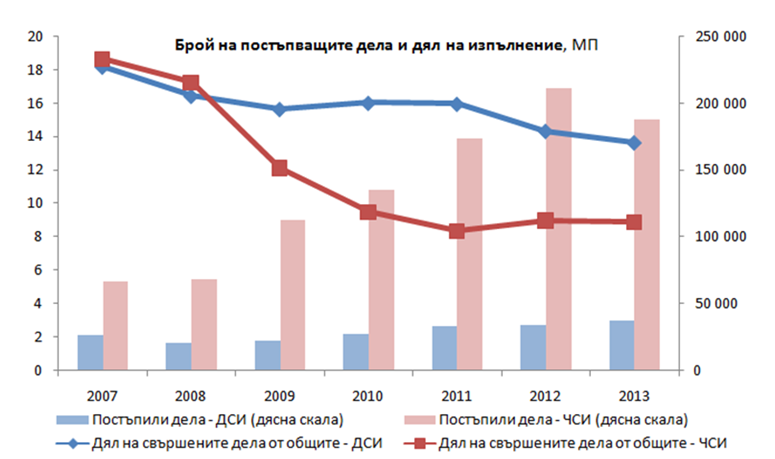
Data on collected receivables in 2013, Slavova continues, show that “PIEs collected BGN 1.210 million, and DUIs – BGN 80 million, or 15 times less.” “This makes an average of BGN 7.4 million collected by one PEI and BGN 0.4 million – by one DUI, or a difference of nearly 20 times.” [ii]
Unlike a private enforcement officer:
- Collection companies are a private law phenomenon, operating under commercial law and controlled by their own code of ethics; in fact, comparing a private enforcement agency to any normal business is not entirely correct, even from a microeconomic point of view;
- Collection companies do not publish detailed reports and their ownership is the business of the owners – and this is normal;
- These companies and DUI are not required to insure their activities;
- DUIs are regulated in the abstract (mostly in the sense that they are appointed according to the same requirements and procedures as PEAs);
- DUI are more numerous and are supported by the budget (through the budget of the district courts), with an average salary of about 2,000 BGN per month and with a decreasing workload, taxpayers separately pay their expenses, rent, etc.;
- PEAs use the service staff of the courts (about 2,100 people work in the offices of PEAs);
- Until May 2013, DUI did not pay VAT on their activities;
- The DUI Association does not publish any reports and it is not known whether and how it controls and sanctions its members;
- Among collection companies, the share of receivables purchased from banks is increasing (up to 53% in 2016), while among private enforcement agents it is decreasing (up to 16% in 2015).
To this it should be added that compared to lawyers, notaries and other regulated "free" professions, PEAs are the only ones whose prices have not been updated upwards since 2006.
Accusations[iii]
A typical accusation for Ms. Manolova against the private enforcement agents and banks is that they are monopolists, that they exercise arbitrariness. Announcing her legislative ideas, she shares that they were developed in August of this year, because, you see, while the "people" were resting, their enemies continued their "harassment", their "arbitrary actions" against them.
From the above, it should be clear that PEAs do not have a monopoly and that their arbitrariness is fully regulated. Together with banks, insurance and pension companies, they are the most regulated legal entities in the legal world of Bulgaria.
The monopolies are elsewhere. The solution to the problem of monopolies such as district heating companies is not in the regulation of debt collection, but in liberalization and privatization.
"Only" since the beginning of 2016, the Ombudsman has received 413 complaints against private enforcement agents, three mayors called and complained that money "for kindergartens" etc. had been seized, in one case in Smolyan, a private enforcement agent sold the apartment of an unfortunate mother with many children, which should not be subject to seizure under Art. 444 of the Civil Procedure Code. For comparison: the Communications Regulation Commission received over 2,000 complaints this year.
With 200 thousand debt collection cases, it is almost impossible not to have problems and injustice. But the experience of previous years shows that a) the Chamber sanctions and causes the revocation of the permits of non-compliant private enforcement agents and b) only in isolated cases do inspections by the Inspectorate of the Ministry of Justice establish violations of the law.
Suggestions and comments
In this "situation", the Ombudsman proposes the following.
- Reduce "P.E.A. fees."
There has been some development in Ms. Manolova's statements on this topic. Previously, she claimed that private enforcement agents are the initiators of the high fees for enforcement. Now she continues to suggest the same, but in practice she has accepted the correct calculation that in fact the cost of enforcement swells mainly due to two factors: lawyers' fees and the fees of other state institutions. They account for about 60% (in some cases even more) of the costs.
To change this situation, the Ombudsman proposes not to charge "legal counsel fees" in debt collection cases, which are not only those of private enforcement agents, but also of all other collectors. The proposal is correct within the framework of current law. But the devil is in the following details.
- This has been a proposal by the PEA for at least four years and is supported by the banks (because it increases costs and reduces the efficiency of enforcement).
- The problem has been practically solved by the "bad banks" In May 2015, when MP Manolova was again fighting banks and private enforcement agents and pushing the interests of lawyers to seize the "business" of notaries (through changes to Art. 32 of the Bar Act), Violina Marinova, CEO of DSK, attacked in court the fees of legal consultants and lawyers in defending an interest over 10,000 leva with the argument that in many cases, for example, a non-performing mortgage or consumer loan, there is no "factual and legal complexity, [but] it can lead to extremely large costs for legal representation". The Supreme Administrative Court, in my opinion - on dubious grounds, rejected the claim because the decision of the bar association to increase the fee was not the correct administrative act. But it explicitly ruled that the fees charged to legal consultants had no legal basis.
- The Supreme Administrative Court canceled the minimum attorney's fee in cases over 10,000 leva in July this year.
- The problem is in the attorney fees and the way they are determined. When they have been “updated” three times upwards, the current ombudsman is a member of parliament and a lawyer. She doesn’t even stutter on this occasion. In May this year, the prosecutor’s office attacked the latest increase in the minimum attorney fees. But the previous ones remained. Now the ombudsman presents them as a scourge of God for debtors, but as a 630 leva remuneration for the “legal consultants” (not the lawyers).
As for the other "fees of private enforcement agents", they most often feed the budgets of other state bodies and liberal professions. Since 2011, private enforcement agents have been pushing for electronic seizure and other similar technological solutions. But they are not accepted.
- To introduce the possibility for the debtor to choose whether his own repayment should go through a judicial (compulsory) procedure or voluntarily
The Ombudsman is knocking on an open door again. Such an opportunity exists now. The problem is that the vast majority of debtors do not take advantage of it. Then the proceedings become forced. If the fees for it are rejected, limited or reduced, the process of collecting the receivables will either not start, or will be carried out with incentives for the debtor to wait until he "earns" from the reduced fees. For these reasons, the Supreme Administrative Court rejected an amendment to the tariff of private enforcement agents from 2014.
- When betting on real estate, the market price should be applied or a valuation regulation should be introduced, including the possibility of challenging it in court, and the properties were offered at a bargain price.
Refraining from politically incorrect commentary, the bankruptcy of this proposal is as follows. First, there are administrative, but legally established rules for property valuation. Second, when you offer real estate at auction, you give a starting price. Third, a high starting price at the auction will make the pledge unsellable. Fourth, the final price of realizing the interest depends on the market situation - the year before last and last year the selling prices were one, now they are different. Fifth, current practice takes into account these market peculiarities. Sixth, electronic auctions, seizures and other techniques are a more adequate measure for reducing the cost of the process.
- "Proportionality to the amount of debt."
Ms. Manova says: "Now, in addition to garnishment of wages, garnishments are often imposed on all movable property of the debtor, the car, his home, and there are even cases on all agricultural land; every garnishment, every seizure is a fee."
Obviously so, but it is also obvious something else. In this list, there are those documented assets of the debtor that are documentary provable and, if they are dropped, will make the compulsory proceedings unfeasible. And they will introduce incentives for irresponsible borrowing and, of course, ultimately – for limiting lending. In a number of cases, these assets are registered as collateral for loans, which gives grounds for compulsory execution. In this case, only the hypotheses of non-sequestrability under Art. 444 of the Civil Procedure Code can work.
- The non-sequestrability of income should be updated according to the current MRP.
Under the current system, this mechanism should operate automatically. It probably requires some minor legal and technical action. But at the current level of the MRL (relative to the average), this is a luxury for the debtor and a problem for the creditor.
- Introduce fee limits for small claims.
Private enforcement agents offer a better solution: to collect money out of court.
- The idea of the three mayors: non-sequestration of public-private funds of municipalities (kindergartens, hospitals and polyclinics, donations and joint financing).
This idea comes at a time when the funds collected by private enforcement agents for municipalities and the state are increasing. The incentives for fiscal irresponsibility of municipalities are becoming countless. It will be interesting to see how the Minister of Finance will look at these things.
If someone is looking for a shortcut to fiscal or banking system instability, they can follow the ombudsman's lead and further develop these and other ideas shared by her before this August at the behest of monopolies and similar structures.
Personal note
I express my deep gratitude to the Ombudsman for the many ideas on how to formulate student exercises in regulatory and constitutional economics, impact assessment, and public choice theory.
[i] See the attitude specifically towards banks in the previous overview of the Ombudsman's ideas: http://www.manager.bg/komentari/ombudsmant-sreshchu-interesa-na-mnozinstvoto-gpk-banki-i-tuti-kvanti?page=0%2C2
[ii] See: Zornitsa Slavova. Why do we still have state bailiffs? IME, Economic Policy Review, issue 760, December 4, 2015. More data on the effectiveness and socio-economic significance of the activities of private enforcement agents can be found in my article in this issue “Regulatory Murders or Once Again on the Meaning of the Effectiveness of Private Enforcement”, as well as on the website of the Chamber of Private Enforcement Agents on the Internet ( http://www.bcpea.org/articles.php ), including the annual reports of the Chamber.
[iii] See: Ombudsman Maya Manolova: Reins must be put on private enforcement agents, monopolies and banks, August 29, 2016: http://www.ombudsman.bg/news/4179#middleWrapper, including the recording of the press conference on YouTube (the link is given at the end of the article).






The statement in the article that there is a possibility for the debtor to pay voluntarily without being charged with enforcement costs is incorrect. I have actually had cases where a case was brought not because of the claim, but because of the costs. I was unable to save the client from costs and the only option was to put the creditor in jail and then sue for damages, which took a year and a half. There is no such possibility, except for the debtor paying before initiating enforcement proceedings. In the event of an initiated enforcement proceeding, the debtor also owes the costs thereof, even if he pays within the period for voluntary enforcement or even directly to the creditor without having been served with an invitation for voluntary enforcement. The requirement for proportionality of the attachment is also reasonable, since it is common practice for invitations for voluntary enforcement to be served by sticking them on a piece of paper and for the debtor to find out about the enforcement proceeding from the attachment, even from the arrival of a potential participant in a public sale of the property, when he is already burdened with the costs thereof, which may significantly exceed the amount of the claim.