 EKIP– Expert Club for Economics and Politics A Different Opinion
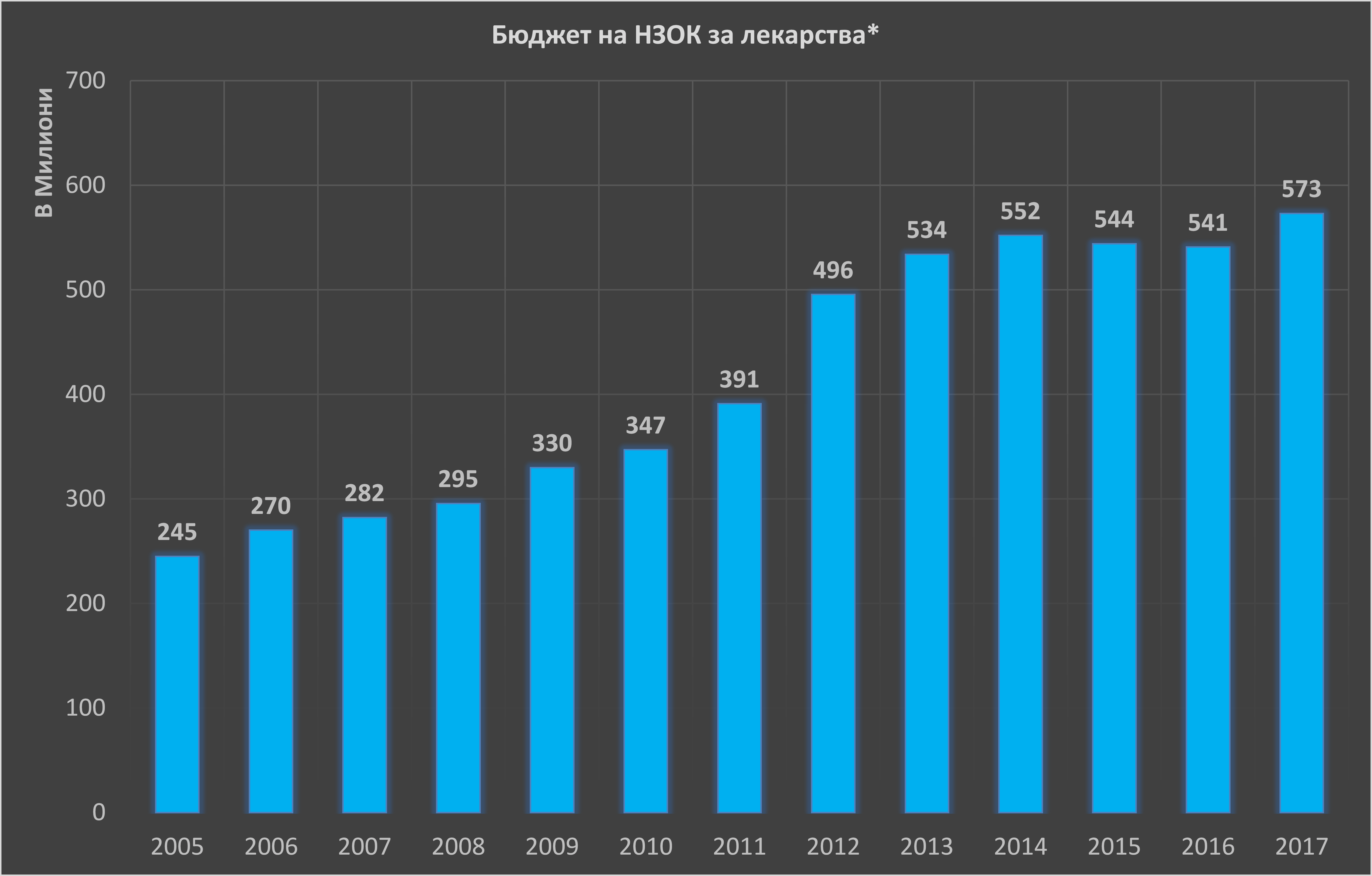
As we have already understood, the budget of the National Health Insurance Fund (NHIF) grows annually and unjustifiably. On the other hand, mortality is increasing, while diseases are showing a constant trend. Theft through referrals has been a known fact for years and is easily noticeable in regional statistics. Since we have begun to unravel the healthcare system, we must focus on each of the aspects of state insurance, including drug policy. In this article, we will focus on the spending of public funds by the NHIF on pharmaceutical products.
Why is the topic of medications important?
The way in which the National Council on Prices and Reimbursement (NCPR) determines which medicines and at what percentage should be paid by the NHIF is fundamental when we want to understand why the NHIF budget is growing. The policy of the NCPR is to reimburse the cost of medicinal products from the positive medicinal list between 25% and 100%. This list includes both original and generic medicines [1]. The difference here is that instead of the NCPR partially or fully reimbursing the existing cheaper generic, it prefers to partially reimburse the expensive original, and the patient should pay the rest . However, there is a difference in whether you will pay 1.50 leva for a generic or 15 leva for an original. In the end, the patient decides, and he is homo economicus above all - he would prefer to stop a drug therapy if its price is high, and this naturally entails negative effects on his health.
Hence the mantra developed in the public sphere that the prices of medicines are high, on the contrary, compared to the European Union they are the lowest, it's just that in Bulgaria patients pay about 50% to 55% extra for them. At the same time, there is hidden lobbying pressure from various interest groups (pharmaceutical companies from Big Pharma [2] - through doctors, patient organizations and various NGOs) on which medicines should become part of the Positive Medicines List (PML), and this is also one of the main reasons why the NHIF's budget for medicines grows annually.
How is it chosen which medicines to be financed?
According to the Law on Medicinal Products in Human Medicine, the state regulates the maximum prices of medicinal products dispensed by prescription and the prices of medicinal products included in the PLS and paid for with public funds in accordance with the lowest reference prices in EU Member States. Financing in this way has a major problem - the reference price policy currently applied is too restrictive, leads to excessively low prices of medicines, and from there to their withdrawal from the market due to economic inefficiency. The first thing to take into account is the volume of the markets in the reference countries. Second, to look for countries with similar drug pricing systems.
What is the problem?
The main problem, as with all centrally planned state budgets, is the lobbying pressure under which they are formed. That is why we sometimes witness protests like “Sufferers of (insert name here) syndrome protest because the NHIF does not pay for drug X (usually a very expensive original) [3]”. When you see such a headline or event, the lobbying pressure light immediately comes on. In order not to be declared murderers and swindlers, the NHIF is forced to negotiate with the National Council of the Republic of Bulgaria to add drug X to the Positive Drug List and ensure its financing.
Everyone has the right to access adequate healthcare under the existing healthcare system in Bulgaria. The problem is, without downplaying the illnesses and misery of the people, that these patients are used as a front for certain interest groups, funded directly by the company that manufactures the respective medication.
What are the possible solutions?
- Under the existing model, the NHIF finances both originals and generics. The opportunity for budget optimization, as well as reducing NHIF costs, appears with an active pro-generic policy of the government. The price of generic drugs, compared to original drugs, is between 20% and 90% lower, according to BGFarmA. According to data from the American Generic Pharmaceutical Association (GPhA), while the average price of an original drug in 2007 was $119.51, the price of a generic drug was $34.34.
- The demonopolization of the NHIF, which would lead to the emergence of competing players offering the same service, but at a much lower price, because a private insurance fund would not purchase an expensive original if it could find an equally effective and equivalent generic for 3 to 4 times less.
- VAT on medicines in Bulgaria is 20%, while the average for countries in Europe is 7.7% (EFPIA 2016). If the Bulgarian government wishes to encourage consumption and exempt this key healthcare sector from tax, this would lead to easier access to vital medicines for patients, as well as an expansion of the market demand and supply.
Few meaningful recommendations from the European Commission on the issue of sustainable budget optimization?
In its report on Bulgaria, the EC recommends that health authorities consider additional measures to improve the rational prescribing and use of medicines, such as information and education campaigns, monitoring of prescriptions, and a clearer policy to encourage the use of generic medicines. Such policies can help improve the health of the population, reduce high levels of patient co-payments, and improve access to cost-effective new medicines while saving public funds (EC 2016).
Sources:
- National Health Insurance Fund Budget Act (2005-2017)
- European Commission. 2016. Joint Report on Health Care and Long-Term Care Systems & Fiscal Sustainability – Bulgaria.
- The European Federation of Pharmaceutical Industries and Associations. The Pharmaceutical Industry in Figures. Key Data 2016.
[1] A generic is a familiar drug with a different name, the same composition, but at an affordable price.
[2] https://en.wikipedia.org/wiki/Pharmaceutical_lobby
[3] http://www.novinite.bg/articles/67129/NZOK-shte-plashta-za-originalni-lekarstva-za-transplantiranite





Very well structured and reasoned position - bravo to the author!