 EKIP– Expert Club for Economics and Politics A Different Opinion
Author: Frank Holenbeck, Mises.org
The gap between the rich and the poor continues to widen. In 1975, the top 1% of the US population owned 8% of the economic wealth. Today, they own more than 20%. This is a striking change from the 1950s and 1960s, when the top 1% owned just over 10%. A study by Emmanuel Saez showed that between 2009 and 2012, their real incomes jumped by 31.4%. The top 10% now receive 50.5% of all income, the highest level since records began in 1917.
The richest are getting richer, faster. Much of the literature on income inequality is written by university sociology professors. They attribute the unequal distribution of wealth to technology, the declining role of unions, the decline in the real value of the minimum wage, and everyone’s favorite scapegoat: the rising importance of China.
These factors may play a role, but others are the real drivers of income inequality. One factor is necessary, the other is not.
In a capitalist economy, prices and profits play a crucial role in allocating resources to where they are most needed and in using them to produce goods and services that best meet consumer needs. When Apple took the risk and launched the iPad, many commentators expected it to be a complete failure. But the result was success and profits, while at the same time sending a signal to other manufacturers that people wanted more of this product. The profits were a reward for the risk taken.
Profit is the motive that gives us a multitude of new products and a constantly improving standard of living. Yet profit and income inequality go hand in hand. We cannot have one without the other, and if we try to eliminate one, we will eliminate, or greatly reduce, the other. Income inequalities are an inseparable result of the profit and loss characteristic of capitalism; they cannot be separated.
Margaret Thatcher understood this indivisibility well. She once said that it was better to have large income inequalities and everyone near the top of the income ladder than to have small differences and everyone near the bottom.
Yet the middle class is sinking into poverty—it’s not climbing the ladder. Between 1979 and 2007, the incomes of the middle 60 percent rose by less than 40 percent, while inflation was 186 percent. According to the Saes study, for the bottom 99 percent, real income rose by just 0.4 percent between 2009 and 2012. But that doesn’t help to make up for the 11.6 percent loss that occurred between 2007 and 2009—the biggest two-year decline since the Great Depression. When adjusted for inflation, minimum wage workers actually earn less now than they did 50 years ago.
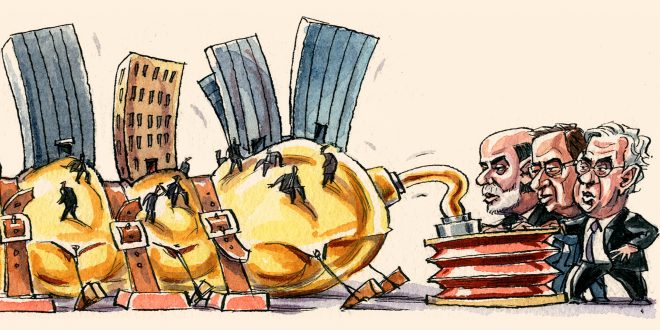
This brings us to the second unwanted and unjust source of income inequality: the creation of money out of thin air, or the legal counterfeiting of money by central banks. It should come as no surprise that the growing income gap coincides with the adoption of fiat currencies around the world. Every dollar that a central bank creates benefits the first holders of the money—the government and the banking sector—at the expense of those it reaches later—wage earners and the poor . [1] Since the creation of the unsecured currency system in 1971, the dollar has lost 82% of its value, while the banking sector has grown from 4% to 10% of GDP.
The central bank does not create anything real – neither resources nor goods and services. When it prints money, it causes the cost of transactions to increase. The original quantity theory of money associates it with everything that can be bought with it, including assets. When the central bank creates money, traders, hedge funds and banks are the first to benefit from the increasing volatility and the upward trend in asset prices. Also, futures and other derivatives on exchange rates and interest rates were unnecessary until 1971, because then there was no need to hedge (against monetary policy). The central bank is responsible for this added risk – by printing money it creates volatility and a jump in asset prices that is not justified by the fundamentals.
As a result, the banking sector is able to significantly increase its profits or claims on products and services. However, more claims for the financial-banking sector means less claims on real goods and services for everyone else. Therefore, the central bank plays a leading role as a “reciprocal Robin Hood”, increasing the economic pie going to the rich while slowly plunging the middle class into poverty.
Janet Yellen recently said, “I am grateful that…inflation will return to near our long-term 2 percent goal,” demonstrating her commitment to the institutionalized policy of wealth theft and redistribution. The European Central Bank is no different. Its LTRO strategy [2] consisted of lending long-term loans to banks on questionable collateral so that they could buy government bonds, with the funds quickly deposited back into the central bank to be lent more cheaply to buy government bonds.
This had nothing to do with liquidity, it was all about increasing bank profits. That's why every euro the central bank creates is a tax on everyone who uses euros. It's a tax on cash balances. It takes from working people to give to rich European bankers. It's a clear backdoor monetization of debt, with the banking sector acting as an intermediary and getting a nice, juicy cut. The same logic applies to the redistribution created by paying interest on reserves to American banks.
Worried about income inequality, Democrats have proposed even higher taxes on the wealthy and an increase in the minimum wage. They are wrongly focusing on the outcome, rather than the cause, of income inequality. If they are serious about reducing inequality, they need to focus on the main cause: the central bank. In 1923, Germany returned to its prewar currency and gold standard with almost no gold. It did so by vowing never to print again. We should do the same.
[1]– This is the so-called Cantillon effect. Those who are closest to the money-issuing process are in a favorable position at the expense of those who are furthest away.
[2]– The ECB provides long-term liquidity to commercial banks through so-called long-term refinancing operations (LTROs) with the aim of stimulating lending.






Only 4-5 central banks are not owned by the vile Rothschilds, no more explanations needed!!!!