 EKIP– Expert Club for Economics and Politics A Different Opinion

This article is not for people who believe in the power of government and authorities to make decisions for a person and navigate their future and destiny. This article is for people who are not afraid to make mistakes, learn from them, and raise their children by giving them a good example to follow, not slaps.
We will talk about what value added tax is and the good intentions with which our politicians implement certain tax policies. Let me clarify that I do not believe in global conspiracies, but rather that the bad effects that are achieved by bad policies are dictated by incompetence or statism.
But let's start with the basics:
What is value added tax or VAT and where does the money for it go?
The short explanation is that the value added tax is a tax on consumption, and the money from it goes directly to the budget, which allows the government to increase its revenues. Historically, this tax arose in response to the acute problem of the complicated tax system in Germany after the First World War. The author of this tax is called Wilhelm Von Siemens, and his idea was to come up with a simplified tax that would eliminate the complicated accounting that arose from the introduction of the gross turnover tax and the sales tax. On the other hand, at about the same time, the idea also appeared in the head of Thomas S. Adams, as he tried to come up with a tax that would replace and improve the complicated corporate income tax in the United States. However, a real VAT tax has not been introduced in the United States anyway, and a sales tax is applied to this day.
But what exactly does VAT tax?
I present to you an excerpt from the legal text, which you can read in full here:
"Value added tax is levied on the taxable supply of goods or services for consideration, ...
the receipt of goods on the territory of the country by a taxable person for the purposes of his economic activity, …
the intra-Community acquisition of new vehicles for consideration with a place of performance on the territory of the country,…
the import of goods; the distance sale of goods with a place of performance on the territory of the country."
In short: Economic agents are punished for performing their main function, namely to create, acquire or exchange value for a fee. And if you acquire value for a fee, this means that you are playing by the rules of the law and are not stealing, but paying the price voluntarily agreed upon by both parties. I would use the following comparison: If in school good students are rewarded with A's, then excellent students in economics are punished with 20%. What does it mean to be an excellent student in economics, well, it means finding a problem, creating a solution and initiating the right channel of communication so that people who need it can choose to solve their problem thanks to you. And if in school they teach you that if you find the right answer to a test you get an honor, then the state later decides that you should not be too arrogant and therefore will slap you on the hands with 20% of the market-assessed price.
But what are you asking me? When we apply a tax on economic activity, we actually reduce this economic activity by 10% (income tax for people or profit tax for companies in Bulgaria). When we apply 20% on the value of a good, we actually manage to buy only 5 of such goods instead of 6. In this way, the purchased economic output is only 5 instead of 6. On the one hand, the people who sell have 1 less good sold. And on the other hand, the buyers choose to buy 1 less good or postpone the consumption of the additional quantity, because the price of the good or service they want is higher than the one they would pay.
Think about a simple everyday example? If the price of beer was 1.80, not 2 lv., when buying 10 beers, instead of 20 lv., I would spend 2 lv. less on them and I would buy that expensive spice that is not vital to me, but I would actually make a meal tastier or more varied. I am sure that you can also think of a product that you do not buy in the store because you have no money left. Now think about it, if you buy a new car that costs 25,000 without VAT, the tax added on it will be 5,000 lv., which will make the price of the car 30,000 lv. Realistically, this money is a new kitchen or furniture for a small to medium-sized apartment. VAT tax is a tax that punishes economic agents for behaving like economic agents at all. I will also tell you why I think this is detrimental.
Let's take the example of buying a new car. If there were no VAT, then I would only spend 25,000 BGN, which means I would have 5,000 BGN more with which I could choose to: 1) start a new business; 2) save and invest it, thereby increasing it; 3) simply satisfy other needs, such as furniture, a new certificate that will promote me at work and increase my salary, or treat myself to a great experience and go on an exotic vacation. And in some cases, even the lower price of the car will simply put us in a more favorable position and we will commit to less debt for its acquisition. Which situation is better for everyone?
On the one hand, for us as consumers, to be able to buy a car at a better price and have less debt, which automatically means that we will experience less financial stress, and we will not be so dependent on a specific job/salary/state of our business. On the other hand, as car sellers/manufacturers, we will be able to offer the product without a tax burden, meaning it will be more accessible to more buyers and we will have more turnover and, accordingly, profit, to continue creating/offering new quality cars that people want to buy.
And if we are the state, let's have fewer people who are tied to loans, that is, more people who can accumulate and accumulate wealth. This automatically means higher revenues from profit tax without the need for the tax rate itself to be high. From this point of view, the lower the rate of a tax, the less desire economic agents have to hide it. Here we must ask ourselves what we as economic agents believe in? Does the state exist to tax us or does the state exist so that we can behave as economic agents? I think the correct answer is obvious.
What does adding VAT to governments' tax revenues actually lead to?
One thing is certain – VAT contributes to a higher tax burden. This is evident from the graph showing the increasing % of tax revenues to GDP in France (in purple), Germany (in blue) and the OECD average (in black). On the other hand, the % of revenues to GDP in the USA (in red) at the beginning and end of the period under consideration (1965 / 2015) is relatively the same. This means that especially after 1975, the European administration “eats more as a % of the real sector”, while in the USA, this share to the real sector remains within relatively the same limits.
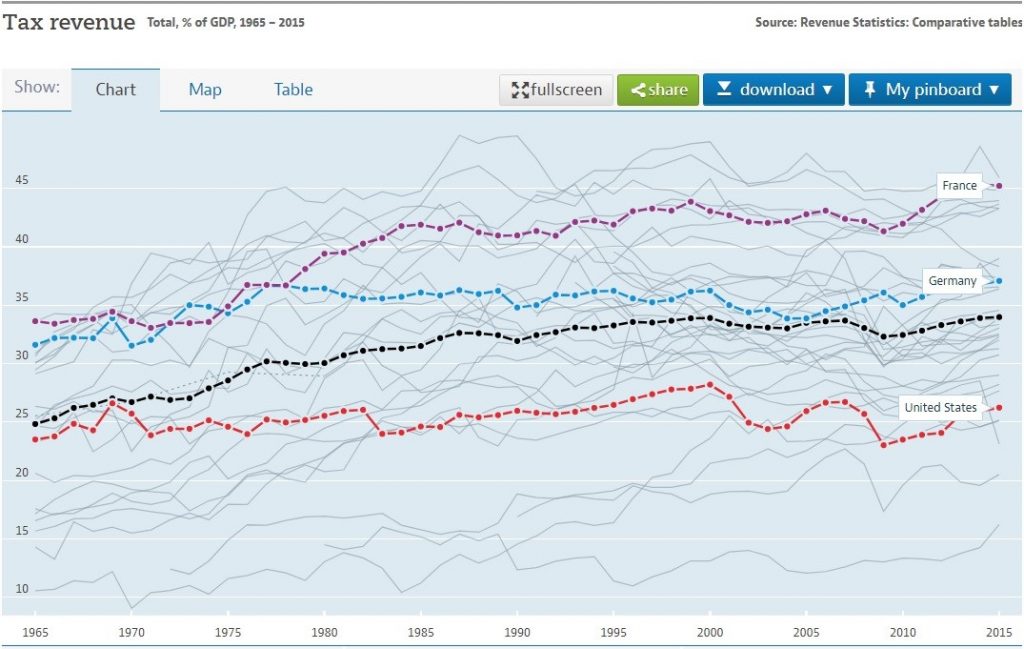
Source: Tax Revenue % of GDP, OECD
After the end of the 60s and the beginning of the 70s and the introduction of VAT in Europe - a percentage increase in tax revenues to GDP is clearly visible. And if the % of tax revenues to GDP (real sector) is higher, this means that we have a "eaten" real sector or a very prevented potential. This practically means that we live in an economic union that is losing competitiveness.
If you are interested in comparing VAT rates in European countries, you can check out this link. However, there is always hope and it is:
The absence of VAT as a comparative advantage in trade
VAT advocates believe that it is great for international trade, because when exporting, the VAT is refunded. Value added tax is imposed only on imported goods, which limits the flooding of the Bulgarian market with Greek tomatoes, for example. Lest we forget the main axiom of VAT – that it is a punishment for being a market exceller; I will remind the dear reader that VAT is also applied to all goods that are produced and sold in the local economy. That is, the only thing that happens in the whole situation is that the consumer is harmed by 1 less good out of every 6 (possible to buy) regardless of their territorial origin. In “two words” all market participants are screwed, even the “Byzantines”.
What do the statistics of the institutions show?
Looking at the monthly revenue bulletins in the Bulgarian Budget as of December 2017 and seeing that VAT revenues are 45.9% of it – we can imagine how dependent our country’s budget is on just one item – VAT. At the end of 2017, 9,320.2 (million BGN) were received. Looking at the figures, I can’t help but wonder where all the money I haven’t spent on myself goes. Don’t you wonder? But this is an occasion for another article. The uncollected VAT or the so-called VAT Gap, the difference between what is collected and what should actually be collected, represents 21% for Bulgaria. This statistic was taken from the European Commission (EC), the information for Bulgaria is on page 22.
Here we are only talking about the difference between what was expected and what was actually paid. Statistics on VAT fraud are more difficult to measure and there are only assumptions about the amount of hidden taxes. According to texts that I found on the website of the same institution, member states lose about 150 billion euros in VAT revenue per year, and about 50 billion euros are due to the exchange of goods between them. Unfortunately, what the commissioners are proposing is to introduce a single VAT rate, which would facilitate the "accounting" and application of VAT.
This is not a good idea, because of the obvious interference in the sovereignty of countries to decide what laws and taxes to apply. On the other hand, it is not a good idea, because it does not attack the problem at its source - hiding and tax fraud, but simply tries to collect more money from those who are currently paying themselves anyway. This is like punishing the whole class with pairs because 3 "slackers" did not come to the test.
Instead of encouraging the "slackers" to come to the test, you will simply demotivate the others who showed up anyway and they will not come next time, because whether they study or not, they are always punished. In other words, if you punish me with a higher rate, or take away my choice to vote for myself, then economic agents will be more motivated to hide VAT, because in this way they become responsible for someone else's "bad actions".
VAT as an opportunity for the "bad guys" to make (hide) money and profit
Let's look at VAT collection with different eyes and remember that the desire to avoid this tax leads economic agents to come up with the following creative methods:
- A chain of phantoms or "missing trader". A socially weak or propertyless person is used as a responsible one to conceal the illegal actions of a number of companies. One of them accumulates tax liabilities, while all the others exercise their right to use a tax credit and refund the tax.
Result: An illiterate person, or one who is pressured by circumstances, is used as a front, VAT is drained instead of being paid into the budget.
- Carousel fraud - The circle is spun by at least three suppliers from different countries, with multiple cross-border purchases and sales of the same product, which is taxed at a zero rate. At the end of the chain, the product is taxed at the lowest VAT rate for the group of countries. This makes it difficult for national tax authorities to trace the chain and conceals the tax actually owed.
Result: The actual tax owed is concealed, if any is paid at all.
- Fictitious export - In this scheme, goods are exported only on the basis of documents. This usually happens with the complicity of a customs officer.
Result: We are refunded 20% of the value of the goods and we sell it a second time.
- X-shaped - A large number of individuals participate, including those not registered under the VAT Act. The organizer of the scheme uses a tax credit, and the funds from the VAT account are redirected to a counterparty trading in fast-moving consumer goods, which are then sold at retail.
Result: A tax credit is misused and the intersection in the chain is used to conceal the tax liability.
Here it is appropriate to ask ourselves what our intentions are with the introduction of VAT and what are the real results of this action? Our real goal is to secure easily measurable and relatively constant revenues in the budget. In countries with more complex income taxation, we also aim to make it easier to calculate the taxes due.
But what happens in practice?
- Increased tax burden for economic agents who wish to conduct their activities in the legal sector.
- The price we pay for the state to have a relatively constant cash flow collected from taxes, so that there can be peace of mind when distributing spending for the next draft budget - is actually the creation of a billion-dollar market for tax evasion and embezzlement.
- Considering that conscientious economic agents will pay their income tax obligations anyway, VAT only takes away their resources for:
-the opportunity to save more;
-to invest more and grow the real economy;
-simply consume more at the moment;
As for the economic agents who try to make money through fraud – the state actually manages to create real conditions for them to commit such. On top of that, this same state will spend money to prevent fraud. Doesn't it seem excessive to you to impose such a burden on people who intend to use their money for real economic activities and play by the legal rules?
Additional advantages that I can highlight from the abolition of VAT is that since it is a tax on consumption, there will actually be more money left in the hands of economic agents to spend and stimulate the economy. Viewed at the local level, the advantage is that the uncertainty of the size of the expected cash flows entering the government budget will have a disciplinary effect on its creators. They will be forced to have more conservative forecasts for expected and actual tax collection compared to the previous year. To achieve results with less and not to spend money unnecessarily that does not need to be spent.
This would also lead to stricter compliance with legislation, more planning and stricter actual implementation of government projects and orders. This would lead to a more efficient way of working of the government and its agencies, because the option of increasing the budget through taxes would be eliminated. Then the goal of bureaucrats would be to really add value so that the real sector could derive positive from it and produce more real value and, accordingly, more revenue in the future budget.
Looking more globally, when importing from another country and selling a product on the local market, there will be no need for sellers to bear the VAT rate on this product at their own expense, since they intend to sell it on the local market. In this way, trade between EU countries will be facilitated, the volumes of consumed goods will be larger, due to their lower prices. Economic agents that operate on more than one local market will have fewer costs, easier accounting and tracking of real market prices, rather than those distorted by the rate of the product relative to the local market.
In this way, as a producer of a good or service, the agent will receive more real information about the “liking” of his product on the local market. The most important thing in the whole picture is that billions of euros will not be stolen by the “bad guys”, that is, the agents who do not intend to play by the legal market rules. In this way, they will be eliminated from being able to finance other activities of theirs – be it the purchase of weapons, the commission of other criminal and terrorist acts that harm the civilian population or the “good guys”, who play and intend to play by the legal rules.
In conclusion, I would say that the abolition of VAT would have a beneficial effect on all those who want to see more progress and “create” value, instead of acting destructively and “destroy” value. Let us be encouraged to be market excellers, and for those who do not want to play fair anyway, let us be deprived of the opportunity to use the rules of the game at the backs of others.





2 коментара
Pingback: Are We Playing Against Ourselves When We Give Up Economic Freedoms? - Part II
Pingback: Are We Playing Against Ourselves When We Give Up Economic Freedoms? – Part II – ThinkPinkBG