 EKIP– Expert Club for Economics and Politics A Different Opinion

Last week, Reuters reported that the government had selected the managers for a new government debt issue worth a total of 3.9 billion leva. As a right-wing economic thinker who views debt-financed budget deficits as extremely harmful to an economy, I could not pass this news by without comment.
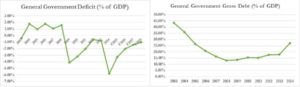
(Data are from Eurostat, and forecasts are from the updated medium-term budget forecast for the period 2016 - 2018 of the Ministry of Finance)
It would be good if this loan were used to refinance old debts, thereby reducing the cost of servicing these old debts. Unfortunately, however, for another year, the new debt will be spent on financing the projected budget deficit and for liquidity buffers in case banks need financing after the upcoming AQR (stress tests) of the banking sector. There are doubts that if banks do not have to be rescued (which is the more likely scenario) this money will be used to repay maturing debt. If we follow this thesis, this liquidity buffer is a blank check that the government will be able to spend at its discretion.
One might ask, why do we need to take on new debt when the media constantly repeats the mantra that we have huge increases in tax revenues?
The reason for this is that government spending is constantly increasing, which offsets the positive effect on the budget balance from higher excise tax revenues. The long-term negative effects on the state economy from higher debt levels can generally be systematized as follows.
1. Economic theory clearly shows that increasing government debt has long-term negative effects on the economy, mainly through the “crowding-out” effect. This means, in general terms, that increasing public spending leads to a decrease in private sector investment, due to the fact that higher prices at which the government is financed increase interest rates in the real sector. This in turn leads to a decrease in the competitiveness of the economy, labor productivity and employment – key factors that limit sustainable economic growth.
Manmohan Kumar and Jaejoon Woo (2013) find that developed economies with high debt-to-GDP ratios (>30%) have experienced 1.3 percentage points lower economic growth than those with government debt-to-GDP ratios of less than 30%. Stephen Cecchetti, Madhusudan Mohanty, and Fabrizio Zampolli (2011) reach similar conclusions about the harms of indebtedness on economic growth, especially after passing levels of 85% debt-to-GDP. The structure of Bulgaria's GDP in the last quarters of 2015, as well as the European Commission's forecast, also indicate a negative trend in the dynamics of gross capital formation. This indicator is of utmost importance for an economy like ours, because capital investments have a direct, positive impact on its competitiveness, and hence on exports, which are the main drivers of growth.
2. The rising level of public debt invariably increases the cost of financing that the state pays on the debt markets. This in turn is a direct cost to us taxpayers through higher financial costs for the budget in the future. According to an analysis by the Ministry of Finance for the period 2016-2018, the ratio of public debt to projected GDP is expected to reach around 28.9% by the end of the period. It remains to be seen whether this forecast will come true, but based on previous experience there is good reason to believe that we will see a much more serious increase.
3. The rising levels of indebtedness will inevitably lead to a jump in the tax level sooner or later, so that the state can more easily cover its financial commitments. At the same time, the two main factors that generate foreign investment in Bulgaria are the low tax burden, as well as low labor costs. Unfortunately, in the last year there has been talk of increasing taxes in municipalities, and even the economically illogical "weekend tax" was introduced. At the moment, the possibility of introducing a "harmful food tax" by the Ministry of Health has not yet been ruled out, although the Ministry of Economy and the Ministry of Agriculture and Food have already expressed their criticism of the draft law. Even commenting on the possibility of introducing such taxes has a negative impact on both the investment programs of existing foreign investments and potential new investors.
4. A major problem with public spending is that our taxes are spent in an extremely inefficient manner. An example of this is the awarding of public contracts worth billions to companies that are quite close to Bulgarian parties at extremely high prices, which directly damage the budget. On top of that, these public contracts are implemented in a poor-quality manner, often requiring repeated repairs shortly after the opening of some sites.
5. Another factor that increases the deficit, and hence the level of public debt, is the lack of much-needed structural reforms. Over 30% of the planned public spending in 2016 will be spent in unreformed systems, such as the National Social Security Institute, the National Health Insurance Fund, and the Ministry of Interior and the Ministry of Defense. Here, I am not even commenting on the potential need for public spending for municipalities, as well as for sectors of the economy, such as transport (BDZ) and energy (NEK).
Currently, the main ulterior motive of economists close to the cabinet is that the state has very good intentions to shrink the budget deficit and reduce the debt in the coming years. In general, intentions are a good thing, but Milton Friedman said it best:
"One of the biggest mistakes is to judge policies and programs by their intentions rather than their results."
http://papers.ssrn.com/sol3/papers.cfm?abstract_id=1653188
http://www.bis.org/publ/work352.pdf





Milton Friedman also talks about negative tax, that is, progressive family taxation, and I have explained it - https://www.facebook.com/atanas.shalapatov/posts/1713491132262447
Simply put, if for the physical survival of one person in our country you need 300 leva (according to the NSI, although it is little, but I am talking about the principle) and a family of 4 receives less than 1200 leva per month, the state gives them energy vouchers and food coupons, just like in the USA for over 50 million Americans
and there should be a referendum that the state will assume these obligations up to three children so that childbirth does not turn into a business.
In our country, 2,500,000 have an income below 296 BGN. ???? which from a legal point of view is a violation of the Constitution and GENOCIDE, period.
I agree 100% that there needs to be total transparency in budget spending because about 5 billion BGN are stolen annually (with public procurement, bloated state administration and fake pensions and sick pay, etc.)
but let's not forget that roughly
The shadow economy damages the budget by 5,000,000,000 leva annually
and with the even flat tax
What does 2,500,000 with an income of up to 296 BGN mean, except that it is a violation of the Constitution and GENOCIDE?
From an economic perspective, according to IMF economists, "a 1% increase in the incomes of the poorest 20% in these economies leads to a 0.38% increase in growth" - http://www.investor.bg/drugi/338/a/mvf-povishavaneto-na-neravenstvoto-zabavia-ikonomicheskiia-rastej-196827/
I'm not interested in the economic point of view, but I say it explicitly because some economists should give up their economics degrees, even though it's not their fault alone, that is, the professors at the universities are also to blame for the fact that ignorant and indoctrinated economists emerge.
,and I wonder if it is a question of incompetence or intentional actions - or simply a combination of everything plus some form of psychopathy, sects and indoctrination of consciousness is a big topic, and it is easily done in economic science using what Friedrich Hayek said - there is no point in trying to change the opinion of the entire population, the Austrian economist claims, it is enough to change the beliefs of the elites. Hayek means journalists, university professors, public intellectuals, writers. After which they will become the people who, through their appearances, will convince society that there are no better ideas than those praising the market and privatization.
Hayek believed that the involvement of state structures in the life of society should be minimized and that everything should be left to the "invisible hand of the market."
BUT capitalism in the USA achieved its greatest successes between 1950 and 1970 because there were high taxes and regulations.
Milton Friedman has industrial capitalism in mind when he talks about the free market, not financial capitalism, that is, financial capitalism requires strict regulations.
Milton Friedman - The American economic system is socialism for the rich and free enterprise for everyone else. If the average person can't pay his debt, he's forced to live in his car. If a banker can't pay his debt, he relies on the taxpayers to bail him out.
World-renowned Chicago School economist Milton Friedman is absolutely adamant that the Federal Reserve caused the Great Depression by sharply restricting the money supply at a time when life-and-death markets were struggling for liquidity.
Congressman Ron Paul stated in the same context: “From the Great Depression, through the stagflation of the 1970s, to the bursting of the dot-com bubble last year (his speech was delivered on September 10, 2002), every economic collapse suffered by our country in the past 80 years can be traced directly to the policies of the Federal Reserve. The Reserve has persistently pursued a policy of flooding the economy with easy money, leading to misallocation of resources and an artificial “boom,” followed by a recession or depression when the bubble created by the Reserve bursts… The 2008 crash, this time with mortgage loans, is again entirely 100 percent the Federal Reserve’s fault.”
Professor Carol Quigley, Bill Clinton's mentor at Georgetown University, wrote in his 1964 book Tragedy and Hope:
''The forces of financial capitalism had another grandiose goal, to create a truly global system of financial control, held in private hands, capable of dominating the political system of every country and the economy of the world as a whole.
According to their plan, the system was to be controlled in a feudal style by all the central banks operating under a common leadership, through secret agreements negotiated at regular private meetings and conferences. The apex of the system was to be the Bank for International Settlements in Basel, Switzerland, a private bank owned and controlled by the world's central banks, which were themselves private corporations.
Each central bank … attempts to dominate its government through its ability to control government credit, manipulate foreign payments, influence the level of economic activity in the country, and influence cooperative politicians through subsequent economic benefits in the business world.''
that is, all of this was part of a masterminded plan by a group of international financiers.
It's about deliberate actions from making them too big to fail to repeal the Glagg-Steagall Act of 1933 to separate banking from derivatives, which set things up so that they had a domino effect, meaning they had to be bailed out by the state and continue to do whatever they wanted, but they got caught in their own webs and proved themselves that the system was wrong.
Thomas Jefferson, 3rd President of the United States (1801-1809): “I believe that banking institutions are more dangerous to our liberties than a standing army.”