EKIP– Expert Club for Economics and Politics A Different Opinion
Business forecasts about the future state of the economic climate have a significant impact on investments in an economy. Theoretically, increased economic uncertainty invariably leads to a decrease in investment activity (Bloom 2014 and Jurado et al. 2015). However, its quantitative measurement is a difficult undertaking. Economics uses an extremely diverse set of methods for analyzing and forecasting economic uncertainty. Some of these methods include the increase in the standard deviation of stock prices, unexpected deviations in the forecasts of key macroeconomic indicators, significant differences in the forecasts of different institutions and the frequency of articles in the media about economic uncertainty. The term “economic uncertainty” itself includes a wide range of factors that can be systematized into the following main categories:
- Uncertainty related to the state of the global economy;
- Uncertainty related to geopolitical factors;
- Political risk. Broadly speaking, it encompasses the possibility of forming a coherent political majority that can pursue consistent and predictable policies;
- Lack of consistency in the management of key sectors of the economy, such as:
- Economic and fiscal policy;
- Labor market;
- Healthcare;
- Energy;
- Security and defense;
- Justice.
- Policies related to easing administrative burden and improving the business climate in Bulgaria.
All of the above factors have a significant impact on the process of making any reasoned investment decision, both by foreign and local investors. A number of empirical studies clearly support the thesis that economic uncertainty has a negative impact on investments in machinery and equipment, R&D costs and hiring new workers. The main reason for this is the likelihood of a significant deviation of previously forecasted cash flows from the actual ones. When negative factors such as those listed above systematically accumulate in an economy, this cannot but lead to an increase in economic uncertainty in it, and hence to a logical decrease in investments.
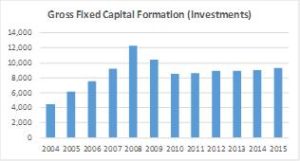
Gross capital formation is one of the most important macroeconomic parameters that influence growth. Only through investment in new machinery, equipment, intangible assets and human capital can sustainable economic growth be achieved. This element of GDP is of great importance for a young market economy like Bulgaria's, because it affects exports and consumption. The use of modern and efficient machinery in the production process reduces the operating costs of industrialists. This leads to an improvement in the competitiveness of our economy, which in turn leads to an increase in exports. On the other hand, investments in fixed capital also lead to an increase in employment and income levels, which has a positive impact on final consumption, and hence on GDP.
What has been happening with investments in the last few years?
 Когато говорим конкретно за България, са налице всички предпоставки за повишени нива на икономическата несигурност. През последните няколко години държавата премина през управлението на пет различни правителства, като всяко от тях беше със собствена визия за бъдещето на страната. Към момента България се управлява от коалиционно правителство подкрепяно от множество партии, които в основата си са идеологически несъвместими. По-значимите закони се приемат, чрез формирането на тематични парламентарни мнозинства и като цяло не се знае дали и този пореден кабинет ще има политическата воля, подкрепа и управленски капацитет да извърши така нужните структурни реформи.
Exotic ideas for laws constantly appear in the public space, which, depending on the public reaction, are stopped or voted on. One of the most striking examples in this regard was the idea of the so-called "junk food" tax, which puzzled both the largest foreign investors in Bulgaria and several ministries. Unfortunately, the vicious practice of administratively raising the minimum wage and minimum insurance thresholds continued under this cabinet, which will inevitably have a negative effect on the dynamics of the labor market in the long term. An attempt was also made to nationalize pension funds, which, although partially thwarted, greatly changed the pension model.
Attempts were made, and new taxes were introduced, such as the "weekend tax", which creates both an additional administrative and tax burden for business, as well as more prerequisites for corruption. There was also talk of increasing local taxes through municipalities. From a fiscal point of view, it is an extremely dangerous trajectory for pursuing a policy that is based primarily on maximizing the revenue side of the state budget, and not so much on reducing and optimizing its expenditure side, which should be the main goal of a government leading a right-wing economic policy. The lack of reforms related to reducing public spending invariably leads to budget deficits, which, in combination with the rising levels of government debt, increase business fear of a potential tax increase in the coming years. This is a factor that has a major impact on the investment climate in the country. Any increase in the minimum insurance thresholds, the minimum wage, and taxes changes the realized cash flows from the projected ones, reducing the net profit of the business and hence the internal rate of return of investment projects.
In recent years, many similar examples can be found. The ultimate effect of these is that the lack of political stability and consistency in state governance policies generates economic uncertainty. This greatly confuses economic agents, which in theory should lead businesses to refuse or postpone the implementation of investment projects.
However, macroeconomic data clearly show that in 2015 a significant GDP growth of 3%, growth in foreign direct investment and growth in gross capital formation was achieved, all macroeconomic parameters that are extremely important for the sustainable development of a market economy. Why then, despite all the negative circumstances listed above, does business continue to invest?
What's next?
The investment activity of small and medium-sized businesses in the last 2-3 years has largely been centered around European funds. During the same period, the state and municipalities have benefited from their availability, which further stimulates the contractors and subcontractors of these projects to invest in new machinery and equipment.
The data clearly show that in just two years (2014 and 2015), about 40% of the funds from the entire budget from the “Programming Period 2007-2013” were absorbed. This greatly distorts the data on the real sentiment of business towards the investment climate in the country. All the above-listed sources of economic uncertainty failed to have a negative impact on the investment intentions of business, due to the disbursement of so many investment projects financed through European programs.
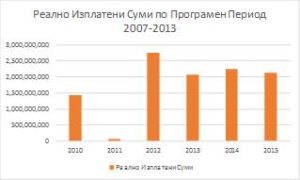
However, 2016 will provide the clearest direction for the real or natural state of the investment climate in the country. At the beginning of the 2014-2020 programming period, there will be no disbursement under the programs. In these conditions, business will have to invest independently, without EU assistance.
The combination of relatively high economic uncertainty and the lack of disbursements under European programmes from the new programming period will certainly lead to a decline in gross fixed capital formation over the next two years. This forecast is in line with the European Commission's forecast for a sharp decline in gross fixed capital formation of -2.1% next year.
The first indications of a slowdown in investments are already a fact. Last week, the National Statistical Institute presented data from its regular survey, which showed that industrial enterprises plan to reduce investments in 2016 by 4.2%. At the same time, the BNB statistics on foreign direct investments for the first two months of the year showed that they decreased by over 83% compared to the same period last year. It is important to clarify that these are preliminary data, which are based on information from larger enterprises, so the real trend will be revealed in the next few months of the year.
What needs to be done?
In the current conditions, the state must do everything possible to limit the sources of economic uncertainty. A small market like the Bulgarian one cannot influence the global economy or geopolitical processes, but the government can certainly influence other factors. This, as always, goes through the implementation of structural changes, which, broadly speaking, should be focused on the following areas:
- A deep administrative reform that will make it as easy as possible for every potential investor who wishes to invest in the Bulgarian economy. Priority should be given to reducing administrative and regulatory barriers to business. This will help to attract more investment and reduce corruption;
- Judicial reform to guarantee the inviolability of private property and personal security;
- A fiscal policy based on reducing and improving the economic efficiency of public spending will help stop the negative trend of increasing debt-to-GDP levels over the last 6-7 years.
The implementation of such policies would greatly reduce both the levels of economic uncertainty in the economy and the harmful dependence of private business on the implementation of European funds. The successful implementation of these reforms would also make the Bulgarian economy much more market-oriented and more resilient to economic crises.
Bloom, N (2014), “Fluctuations in Uncertainty”, Journal of Economic Perspectives, 28(2): 153–176.
Jurado, K, S C Ludvigson, and S Ng (2015), “Measuring Uncertainty”, American Economic Review, 105(3): 1177–1216