 EKIP– Expert Club for Economics and Politics A Different Opinion
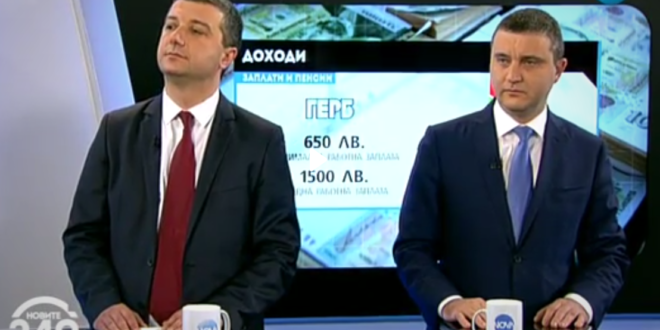
The following article aims to examine the programs of the two main parties in the upcoming parliamentary elections - BSP and GERB. The basis for this is a debate organized by "Nova TV", as well as the programs published on their websites. The article focuses on their economic aspects and, even more so, their consequences on the fiscal system.
The first debate pitted the main contenders for power in the 44th National Assembly. The BSP was represented by the former Minister of Economy from the Oresharski cabinet and author of the party's election program, Dragomir Stoynev. The podium was shared with him by the former Minister of Finance, Vladislav Goranov, and surprisingly for the clashes between the two parties, the debate began with consensus.
The parties united around the thesis that the economy should be the driving force behind income growth. The latter is also a main focus for the upcoming elections, and GERB estimates that the average salary will increase by 50% to 1,500 leva. within one of their mandates (in December it exceeded 1,000 leva according to NSI data). However, Stoynev considered this not a serious promise, since according to him this is a kind of "organic" growth, or in other words, achieved without invasive state policy.
Apparent unanimity
The BSP program confirms Stoynev's indignation, as it is peppered with anti-market theses. According to the left, the economy needs "strategic forecasting and programming at the state level." The party is returning to its roots by pursuing the rehabilitation of enterprises with majority state control, which would also bring revenue to the budget.
They will be more than necessary, since the tax authorities will definitely be under pressure under a hypothetical red government. A private equity fund with the sonorous name "Industry" will be established with a capacity of 500 million leva, an "Innovations" fund with 150 million leva, and the capital of the "Bulgarian Export Insurance Agency" (BAEZ) will be increased by 2 billion leva at the expense of the taxpayer, 51 times the company's assets at the end of 2015. The company's equity is 15.71 million leva after covering losses, which means that it will increase 133 times. BAEZ offers standard export insurance at a lower price than the market price, transferring the risk from the entrepreneur directly to the state.
Budget under pressure
In case these expenses are not enough against the backdrop of the growing budget, the BSP intends to open two other black holes in it – the Belene NPP and the Bulgarian Railways without committing to specific figures. While the cost of completing the nuclear power plant is an enigma for financiers, the recapitalization of the railways has specific dimensions. The accumulated losses will probably reach 380 million leva by the end of 2016, and the state will also be a guarantor for the holding's obligations for a period of 2 years, the program also says. In total, the railways' loans are over 610 million leva in the latest report from 2015 and exceed the equity capital by nearly 27 times.
The spending does not stop there. The Socialists will redistribute 6% of the country's GDP to state education and science (about 4% currently), and cultural expenses will also increase by 1%. Together with the social benefits prepared by the BSP, the swelling of the expenditure side of the budget cannot be predicted. Stoynev did not give more specific estimates, if any, during the debate, but in view of the above, we can expect either an increase in the public debt and/or the tax burden under the next red government.
On the GERB side, the “Economy” section is the shortest in the party’s program. Attention is focused on two areas – “removing the administrative burden for business” and “supporting the development of economic zones.” The first measure focuses on transferring the bureaucratic burden to the state, and the second aims to spread the “Thrace Economic Zone” model outside of Plovdiv through the construction of infrastructure.
What can't be done with money can be done with more money.
Boyko Borisov's party does not intend to remain completely indebted to its opponents, as it envisages doubling teachers' salaries (the average salary in education is 1046 leva as of December 2016). The measure, in Goranov's words, aims to improve public education, which will "drive the economy and, accordingly, the average salary". Budgetary spending on education will also grow under GERB, but without a previously announced pace. Here the party is ahead of its opponent, who sees teacher salaries in the state system 40% higher in one mandate.
As for the minimum wage, GERB aims to increase it by 40% to 650 leva by the end of a possible mandate. However, the BSP believes that it should move in parallel with the growth of the average wage, thus not lagging behind, which will increase labor costs in the private and public sectors.
On social policy issues
The delicate issue of the pension system, surprisingly, is touched upon very briefly in both programs. The BSP hints that it will “ recalculate pensions and reduce the differences between old and newly granted ones.” In what direction this will happen and to what extent, it was not a subject of discussion. GERB adheres to the gradual increase, it is clear from the program, as from June 1 pensions will increase by 2.4%.
The centenarian, in addition to raising, also intends to attack the incomes of citizens. It is preparing a " way out of the "flat" tax " , which starts with a 20% tax on the incomes of those earning over 120 thousand leva per year. The opponents from GERB, on the other hand, are in favor of preserving the flat rate.






One comment
Pingback: Why I won't vote in these elections either – EKIP – expert club for economics and politics