EKIP– Expert Club for Economics and Politics A Different Opinion
Prohibition in the United States (1920-1933) is remembered primarily through popular culture’s romanticized depictions of gangsters, speakeasies, and richly dressed ladies and gentlemen drinking illicit cocktails. In fact, our modern societies have retained something else that defines this historical period – and that is Prohibition itself. Although we no longer have prohibitions on alcohol in the Western world, with the exception of a small number of municipalities in North America, other substances collectively known as “drugs” are still prosecuted to the full extent of the law.
Although it can be traced back to the early 20th century, today's prohibition regime took on its full form in the 1970s, when the American government took up the war on drugs - first locally and then internationally. Measures were tightened, sanctions increased, the authorities became more active and more aggressive. Today, after 40 years of war by the authorities, now clear and supported by data, we can talk about the effects of prohibitions, both on alcohol and drugs.
Prohibition is expensive and doesn't work
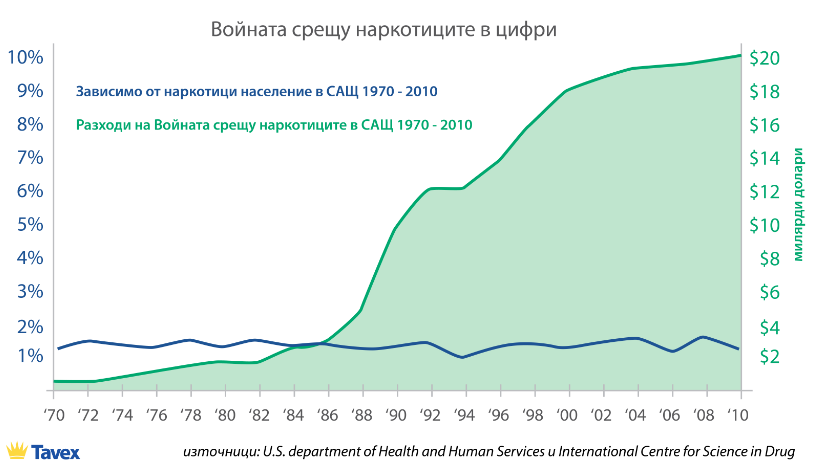
The first and most important effect of the introduction of prohibition is that a huge amount of resources are spent without achieving even minimal progress on the main goal, namely to limit the supply and use of illegal substances. The statistics in the USA are eloquent, the state has spent over 1.6 trillion dollars since the beginning of the war on drugs to combat drug distribution, and the percentage of addicts, instead of decreasing, has doubled to 2% of the population. In fact, we don't even need statistics on this point, each of us knows that with good will, he can easily get whatever drugs he wants, despite the sanctions and prohibitions.
A 2010 study by Harvard economists found that the implementation of prohibition policies in the United States costs state and local governments $41.3 billion annually and results in potential budget losses in uncollected sales taxes of $46.7 billion.(1) Their calculations also show that drug-related cases consume one-sixth of police and court budgets that could be used to deal with other, more serious crimes. Currently, in places like Colorado, the lifting of part of the prohibition – specifically the free sale of cannabis – has even created additional tourism, medical and agricultural businesses. The industry in the state has achieved $1.3 billion in sales, which have brought about $200 million in revenue to local coffers(2), while at the same time the police, courts and prisons have realized savings and budget optimization.
Prohibition encourages overdoses
The next important effect of prohibition is an increase in overdoses and drug-related illnesses. The reason for this is rooted in several circumstances that come into combination with each other. First, we have a market with less information about the products and those who sell them, because transactions are mainly carried out on the street. Second, consumers cannot openly report problems with the products, because in practice they have participated in an illegal act with people who are criminals. Third, precisely because they do not work with official traders, they cannot seek damages from them through normal judicial or regulatory channels. On the supply side, the incentives to sell a better product are weaker precisely because there is poor communication between consumers and they cannot transmit information about the product, as happens in open markets.
The final and perhaps most important reason, especially when it comes to overdose deaths, is the increase in potency that is characteristic of markets operating under prohibition. In just ten years since the start of the war on drugs, from 1974 to 1984, the potency of marijuana, expressed in terms of active ingredient content, jumped nearly 8-fold.(3) Similarly, during Prohibition, the popularity of beer and wine declined sharply, replaced by hard liquors such as whiskey and homemade moonshine.
Such behavior is expected – the creation and transportation of the banned substance becomes dangerous and accordingly the incentive, for both sellers and users, is to get more of the effect with a smaller dose. The modern phenomenon of “designer drugs” is a version of the same thing, bypassing the ban with new molecules and formulas that are not yet prohibited by law, but are new, untested, with unknown side effects and, not coincidentally, very often lead to deaths.
Prohibition creates crime
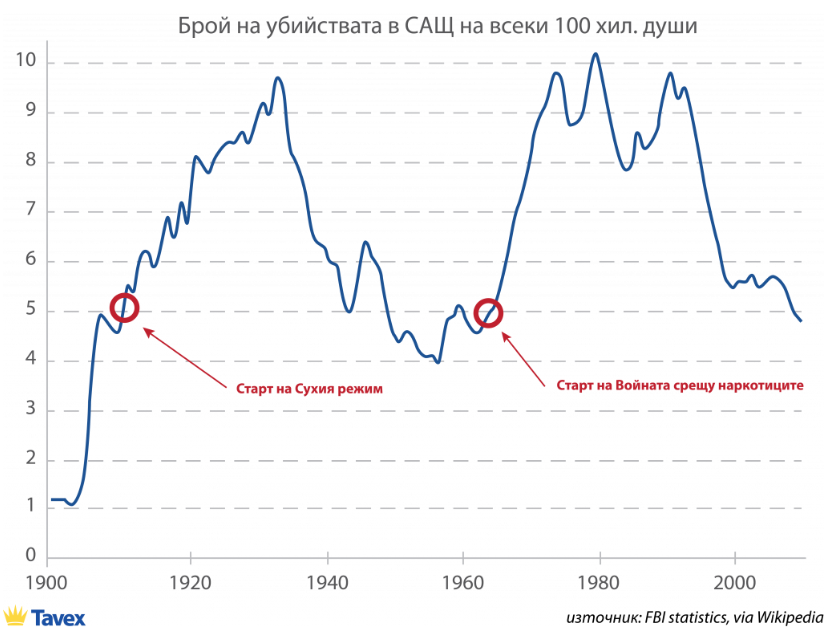
The third important effect is related to violence and crime. A market that has been made black by legal restrictions is controlled by different rules and people than one that operates openly. Automatic criminalization and the lack of legal channels for resolving disputes lowers the price and increases the efficiency of violence. In a 1997 study of crime in New York City, available data showed that 40% of recorded murders were related to unsettled black market scores and only 7.5% to the effects of drug use. (4) The situation was similar in the 1920s, when the murder rate in the United States jumped from under 4.6 per 100,000 people in 1910 to almost 10 per 100,000 people in 1933, just after the end of Prohibition.
It is no coincidence that gangsters, like Al Capone or the Mexican drug cartels during the prohibitions we know, are present. Strong mafia structures are more effective in using violence, the entry of competitors is more difficult due to the characteristics of the market, which is why monopolies last longer, and last but not least, the mafia has more tools to use corruption in dealing with the authorities than independent dealers. Again, historical experience has shown that in drug wars and dry regimes, sellers are criminals (even by definition), while in the absence of prohibitions we have a completely normal business without violence.
Even if the use of certain substances seems harmful or morally unacceptable, historical and economic analyses show that prohibitions and prosecution of consumption have a number of serious negative effects, the impacts of which are significantly more severe in a negative direction than the personal or societal dangers arising from the substances themselves.
Original post from the Tavex.bg blog
Източници:
(1) Jeffrey A. Miron and Katherine Waldock, “The Budgetary Impact of Ending Drug Prohibition,” White Paper, Cato Institute, September 27, 2010
(2) https://www.marketwatch.com/story/marijuana-tax-revenue-hit-200-million-in-colorado-as-sales-pass-1-billion-2017-02-10
(3) Quarterly Reports of the Marijuana Potency Monitoring Project, National Institute of Drug Abuse, University of Mississippi, 1974-84
(4)P. J. Goldstein, H. H. Brownstein, P. J. Ryan, and P. A. Bullucci, “Crack and Homicide in New York City: A Case Study in the Epidemiology of Violence,” in Crack in America: Demon Drugs and Social Justice, ed. Craig Reinarman and Harry G. Levine (Berkeley: University of California Press, 1997), pp. 113–30.