EKIP– Expert Club for Economics and Politics A Different Opinion
Murray Rothbard, "For a New Liberty: The Libertarian Manifesto"
You can read Part I of this essay here.
Noise is also a type of air pollution. Noise creates sound waves that travel through space and irradiate the property and bodies of others. Only in recent years have medical professionals begun to study the harmful effects of noise on human physiology. And in these cases, a libertarian legal system would allow for damages and class actions against excessively loud and dangerous noise – against “noise pollution.”
Courts should focus on protecting private property
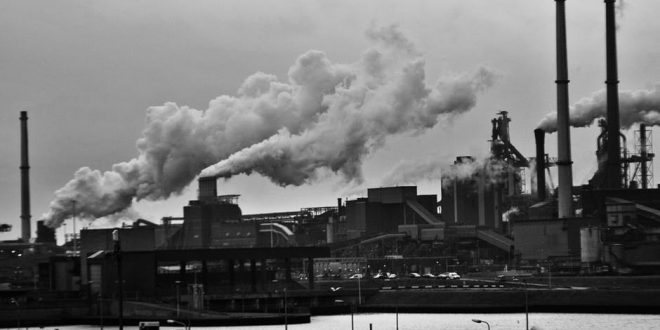
It follows from the above that the solution to the problem of air pollution is crystal clear and has nothing to do with multi-billion dollar government programs that burden the taxpayer and do not even address the real problems. The solution is simple: the courts must once again assume their role - protecting the right to life and property against unwanted external interference - and therefore prohibit the discharge of pollutants into the air. But what about the advocates of pollution in the name of industrial progress? Or the inflated costs that will have to be paid by consumers? And what to do with the polluting technology that already exists?
The argument that such anti-pollution litigation would increase the cost of industrial production is as morally reprehensible as the pre-Civil War argument that the abolition of slavery would increase the cost of cotton production, making freeing slaves “impractical,” though morally right. It would mean that polluters are allowed to pass on the high costs of pollution to those whose lungs and private property they have damaged.
Moreover, the cost-technology argument misses the vital fact that if air pollution is allowed to continue unchecked, there will be no economic incentive to develop technology that does not pollute. On the contrary, the incentives will be in exactly the opposite direction, as they have been for the last century. Imagine that, with the advent of cars and trucks, the courts had ruled as follows:
In general, we would consider trucks passing through people's yards to be a violation of their private property, and we would insist that trucks only travel on roads, regardless of traffic. But trucks are vital to the common good, so we rule that they can cross any yard if their drivers think it will alleviate traffic problems.
If the courts had ruled this way, we would have a transportation system that would systematically destroy citizens' yards. And any attempt to stop it would be thwarted in the name of modern transportation needs!
This will create an incentive for the development of non-polluting technologies.
I emphasize that this would be exactly the same type of regime as the one we have at the moment regarding air pollution, which is much more harmful to us than having yards plowed by trucks. In this way, from the very beginning, the state has given the green light to polluting technologies. And accordingly, it is not surprising that today we have exactly such technologies. The only solution would be to make polluters stop polluting and therefore to redirect technology towards non-polluting and even anti-polluting solutions.
Despite the primitive anti-pollution technology available due to the lack of incentives in this direction, some techniques have already been developed to combat noise and air pollution. Silencers can be installed on noisy machines. Pollutants can be filtered out as they leave the stack and recycled and converted into useful raw materials for industry. In this way, sulfur dioxide can be recycled into sulfuric acid, an economically valuable resource (6).
The highly polluting spark-ignition engine would either have to be “cured” by new devices or replaced entirely by non-polluting engines such as gas, steam, or electric. And, as libertarian and systems engineer Robert Poole Jr. points out, the costs of implementing non-polluting and anti-polluting technologies “would ultimately be borne by the customers of the companies that sell such products, that is, by those who choose to do business with the company rather than being passed on to innocent third parties in the form of pollution (or a tax).” (7)
Robert Poole clearly defines pollution as “the transfer of harmful particles or energy to another’s body or property without the consent of the owner.” (8) The libertarian (and only comprehensive) solution to the problem of air pollution is to use the court system to combat such infringements of private property rights. Recently, the direction of the court system has begun to change: new court decisions have emerged and class action bans have been lifted. But this is only the beginning. (9)
Why conservative “solutions” to the problem are unsatisfactory
Among conservatives—as opposed to libertarians—there are two types of response to the problem of air pollution. One type, expressed by Ayn Rand and Robert Moses, is to deny that there is a real problem and to attribute all public concern to the left’s desire to destroy capitalism and technological progress in the name of tribal socialism. While this claim is partly true, denying that there is a problem is a denial of science itself and lends credence to the leftist charge that capitalist defenders “put property rights above human rights.” Moreover, the protection of air pollution does not even protect private property. On the contrary, it places a conservative stamp of approval on the actions of those industrialists who trample on the private property rights of citizens.
The second, more considered conservative response is that of pro-market economists like Milton Friedman. Friedmanists acknowledge the existence of air pollution, but propose that this problem be solved not by protecting private property, but by some supposedly utilitarian calculation of “costs” and “benefits” made by the state, which in turn creates and implements a “public good solution” for how much pollution is acceptable.
This solution is achieved either by legalizing a certain amount of pollution (granting quotas and “rights to pollute”), by graduated taxation of polluting companies, with a preventive purpose, or by. This approach not only gives enormous bureaucratic power to the government in the name of protecting the “free market”, but also allows the violation of private property to continue in the name of some collective solution imposed by the state. This regime is far from a true “free market” and shows that, as in many other economic spheres, it is not possible for freedom and the free market to be truly protected without protecting the right to private property.
Friedman's grotesque claim that those who live in the city and do not want to get emphysema should move to the countryside is reminiscent of Marie Antoinette's famous "Let them eat pasta!" and shows a lack of sensitivity to human rights and the right to private property.
The Libertarian Solution vs. Conservative
Friedman's claim is actually a fragment of the conservative "if you don't like it here, leave" proposition, which implies that the state rightfully owns all the land "here" and anyone who is dissatisfied with its governance should accordingly leave. Robert Poole's libertarian critique of Friedman's proposals demonstrates a refreshing contrast:
Unfortunately, this is an example of a serious failure of conservative economists. Nowhere in this proposal is there any mention ofrights. This is the same failure that has plagued the defenders of capitalism for 200 years. Even today, the term “les fers” conjures up images of black smoke and soot-smothered English industrial cities from theXVIII century. Early capitalists agreed with court decisions that smoke and soot were the "price" to be paid for the benefits of industry... But "lese faire" without rights is a contradiction; the "lese faire" position is based on and derives from human rights and can exist only when those rights are not violated. Today, as environmental concerns are increasingly widespread, this old adage is once again associated with capitalism.
Friedmanists are right that air is a scarce resource, but we need to think about itwhyThis is so. If it is a scarce resource because of the systematic violation of rights, then the solution to the problem is not to raise the price of the status quo and punish the violators, but to enforce and protect the rights of citizens... If a factory emits huge amounts of sulfur dioxide that enters a person's lungs and damages them, it means that the owner of the factory has been aggressive towards that person and has broken the victim's leg. This must be emphasized because it is key to the libertarian "lese faire" position. "Less faire" polluter is a contradiction and must be pointed out as such. A libertarian society is a society offull responsibility, in which everyone is fully responsible for their actions and, accordingly, all damages that arise from them. (10)
In addition to abdicating its primary function of protecting private property, the state contributes to air pollution in a more direct way. In the recent past, the Department of Agriculture has organized mass spraying of DDT by helicopter over vast areas of land, despite the objections of the farmer-owners. To this day, the Department of Agriculture continues to pour tons of the poisonous, carcinogenic insecticide over the South in a futile and costly attempt to eradicate the fire ant. (11) And the Atomic Energy Commission has dumped tons of radioactive pollutants into the air and soil through its nuclear power plants and nuclear tests and experiments. Municipal electric and water plants, as well as the plants of state-appointed energy monopolists, heavily pollute the atmosphere. One of the great tasks of the state in environmental matters is, accordingly, to put an end to its own pollution.
Conclusion
So, if we carefully abstract from the confusion and inconsistent philosophy of modern environmentalists, we see that there is an unshakable argument against the existing system; but this argument is not against capitalism, private property, economic growth, or technological progress. The argument is against the failure of the state to protect the right to private property against infringement. If property rights were fully protected, that is, against infringement by both private individuals and firms and by the state, we would realize that in ecology, as in other spheres of the economy and society, private initiative and modern technology are not the curse from which humanity suffers, but its salvation.