EKIP– Expert Club for Economics and Politics A Different Opinion
Highlights:
- Construction production falls in December, but it is still too early to talk about a reversal of the strong upward trend in the sector
- Inflation is also slowing, both in consumer and manufactured goods, but remains high
- Lending is accelerating slightly, with housing lending growing at the fastest pace towards the end of 2017
- Industrial sales and production are growing more slowly, but this is probably a seasonal dynamic and it is too early to worry
- Consumption is seriously increasing in November and December, thanks to the holiday season
- In 2017, all sectors grew at a faster pace, the average growth rate in industry and retail was 50% higher than in 2016.
December marks the first decline in construction since the beginning of the year
We begin the analysis of the latest NSI data for 2017 with a look at the construction sector. This is the sector that undoubtedly recorded the most remarkable growth rates over the past year and at the same time raised concerns among a number of institutions and analysts (including ours) about a swelling bubble. Therefore, it is logical to focus the analysis of the latest data for 2017 on it. In addition, in view of the increasing importance that developments in the sector are acquiring in view of the remarkable dynamics of its production, from now on we will place a deeper focus on the data for it published by the NSI.

Source: NSI
In December, the NSI reported a decline in construction output of 4.04% year-on-year. This decline was mainly due to civil engineering construction, which fell by as much as 8.88% - the most serious deterioration since February. Growth in building construction also fell, but at a much slower pace of 0.05%. In view of the constant warnings (specifically from us, but also from other analysts and institutions) that signs of bubble formation are appearing in the property market and construction, these latest data seem at first glance to refute this narrative.
However, this would be a hasty conclusion. The winter period is usually quite weak for the construction sector for obvious (mostly climatic) reasons. During the period December-February of each year, there is usually a slowdown in production growth. Yes, the fact that we compare data on an annual basis should neutralize these seasonal fluctuations at least to some extent, but they can never be completely eliminated when we analyze only calendar-adjusted data.

Source: NSI
More intriguing than the mere presence of a decline in the construction production index is its severity, which is truly remarkable in December. Before drawing conclusions about a potential reversal in the construction production trend, we should wait until at least January (in which we are also likely to see a decline, or at least relatively slow growth). Overall, the construction production trend in 2017 was strongly upward and we expect this to continue in 2018.
But, if production in the sector continues to decline after the winter season, then we can already talk about a reversal of the trend. However, it is too early to draw such conclusions for now, especially in the context of increasingly rapid growth in housing loans and low interest rates on them, which stimulate demand on the property market and push prices higher and higher, which, quite logically, provide an incentive for more construction, not less. Not to mention the highly positive macroeconomic environment in general – practically the best since before the beginning of the last global economic crisis.
The pace of price inflation accelerated significantly in 2017.
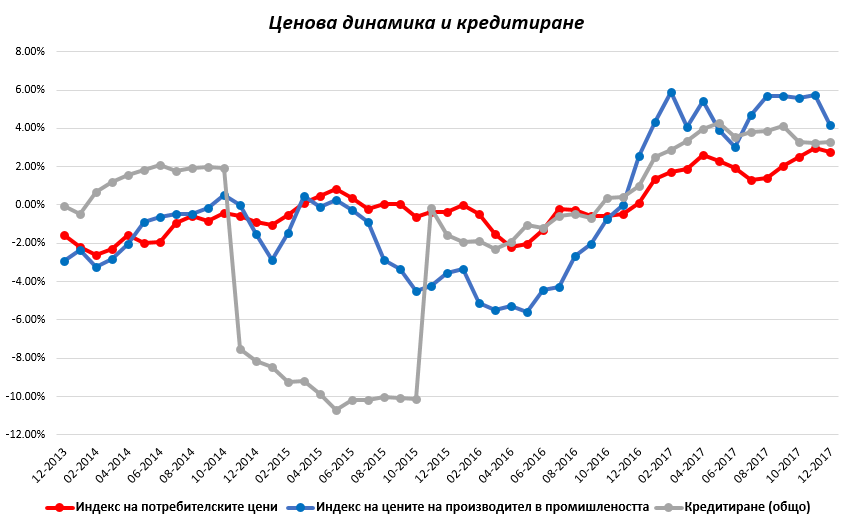
The National Statistical Institute's December inflation data showed the first slowdown in its pace since July. The consumer price index rose by 2.77% year-on-year in the last month of 2017, compared to 2.97% in November. Meanwhile, the industrial producer price index also grew at a slower pace – 4.16% in December compared to 5.75% in November.
Source: NSI, BNB
A more detailed breakdown by the NSI shows that the slowdown in consumer price inflation is mainly due to lower inflation in food and non-food prices. However, service prices continued to grow at an increasingly faster pace in December, reaching 2.65%, compared to 2.10% in November. On the part of manufactured goods, the slowdown in their price growth is mainly due to lower inflation in the prices of intermediate goods and energy goods. The prices of the former grew by only 2.82% in December, which is the lowest level recorded since October 2016, and of the latter by 8.60%, compared to 11.28% in November.

Source: NSI
Overall, despite the slowdown in December, the price trend in 2017 is strongly upward. For comparison, in December 2016 the consumer price inflation rate was only 0.09%. The acceleration that the inflation rate experienced in 2017 is remarkable, but not unexpected given the positive trends in the Bulgarian economy as a whole. The improvement in production growth in all sectors, combined with the decline in unemployment and the accelerated growth of wages, quite logically push up prices, both for consumer and manufactured goods.
Housing lending grows at fastest pace towards the end of 2017
Of course, one of the most key factors leading to an acceleration in the inflation rate is lending. And in Bulgaria, it has undergone a serious recovery and acceleration of its growth in the past year 2017, which is particularly acute in certain categories, such as housing loans. BNB data show that in December lending as a whole grew by 3.30% on an annual basis, marking a slight acceleration from the 3.22% reported in November.
A more detailed breakdown shows that the main contributor to the acceleration in overall credit growth in December was the category of loans to non-financial corporations. Lending to corporations grew by 1.66% this month, compared to 1.34% in November. Meanwhile, growth in lending to households and NPISHs slowed to 6.02% in December, from 6.35% in the previous month. This was mainly due to a slowdown in consumer credit growth, which fell from 6.70% to 5.77%.

Source: BNB
At the same time, however, housing lending continues to grow at an ever-faster pace. In December, it grew by 7.37%, which is the highest level reached since before the start of the Eurozone crisis 6 years ago. The BNB's interest rate statistics show record low levels of housing loan interest rates for the last decade. It is this huge influx of more and more credit at an ever-lower price from the banking sector to the real estate sector that is the main factor causing the strong growth in prices and ballooning the market over the past year. Real estate expert Iliyan Koychev likened the trend in housing loan interest rates over the past year to a sharp "slippery slope", which in our opinion is also very dangerous.
This is how dangerous bubbles form. At this point, it is clear that the real estate market and the construction sector are in the initial stages of a bubble. The lowest interest rates since the last bubble (since before 2008), combined with the highest levels of construction production and growth in housing lending are clear signs of this. Not to mention the growth in prices.
The European Commission warned of imbalances in the construction sector back in November, and in January even the Bulgarian National Bank advised banks in the country to be more careful in their lending. In 2018, the real estate market and the construction sector should be a key focus for all economists and analysts, because it is the imbalances in this sector that pose the most serious threat to the long-term sustainable growth of the economy. The EKIP will continue to expand its monitoring of this sector in 2018, and you can expect increasingly in-depth analyses on the topic from us!
Industrial production and sales are slowing, but it's too early to worry
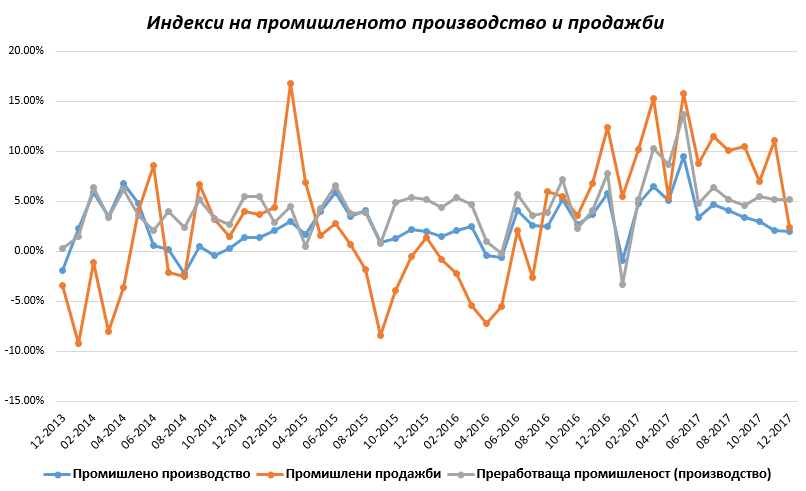
Turning our attention to the industrial sector, we see that NSI data indicate another slowdown in its production growth. In December, the industrial production index increased by 1.97%, which is the lowest level recorded since May 2016. This is mainly due to a decline in the extractive industry of 5.24%, while the growth of production in the processing sector slightly accelerated to 5.18% in December. Overall, despite the slowdown in the second half of the year, 2017 was very strong for the industrial sector and better than the previous one. The average growth rate in the sector for the last 12 months is 3.93% on an annual basis, compared to 2.61% in 2016. This is a 50% higher average growth rate.
Source: NSI
In early 2018, we are very likely to see a pick-up in industrial production growth. As we mentioned in the previous issue of the Macroeconomic Monitor, the late autumn-winter period of each year is usually weak for the industrial sector, but towards the end of winter and the beginning of spring, production growth starts to accelerate. The same is very likely to happen now, and overall, the slowdown in growth in the sector in recent months is not yet a cause for concern.
Industrial turnover growth also slowed in December, and much more significantly than that in manufacturing. Industrial sales grew by just 2.36% year-on-year, compared to 11.03% in November. This sharp slowdown was due to both a slowdown in sales growth in manufacturing in December (to 3.32% from 12.23% in November) and a 1.20% decline in the production and distribution of electricity, heat and gas. Only in the mining and quarrying industry was the opposite trend observed – sales there grew by 1.86% in December, recovering from a 0.49% decline in November.

Source: NSI
The geographical breakdown shows that sales growth has slowed in both the domestic and foreign markets. Domestic sales grew by just 1.30% in December, while foreign sales grew by 3.86%. These are the lowest levels of industrial sales growth in both markets since the beginning of 2017 and the first time since July 2016 that sales have grown so slowly in both the domestic and foreign markets. Again, these figures in themselves are not a cause for concern (yet). The past year 2017 was overall a much better year for industrial sales than 2016, and there are no indications yet that this positive momentum will reverse in 2018.
Consumption grows faster due to seasonal factors
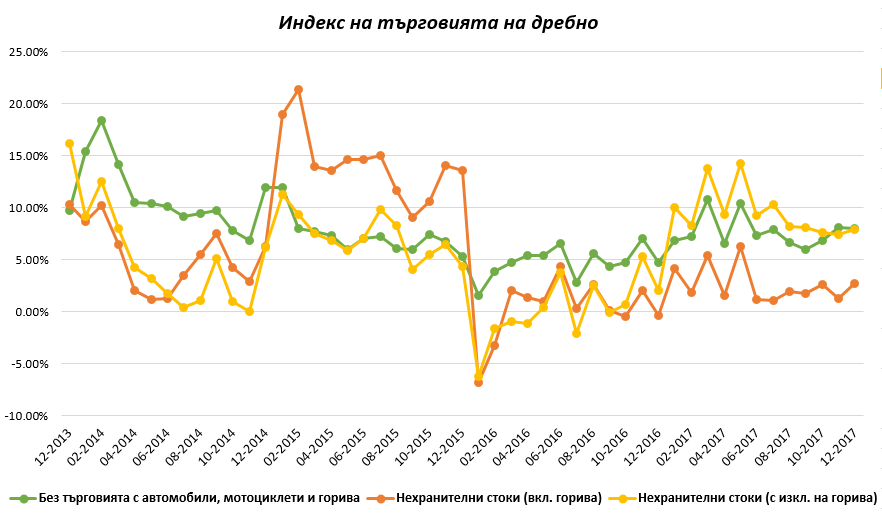
Finally, we turn our attention to retail trade, where we already have a significant acceleration in the pace of growth in November and December. In December, the retail trade index excluding motor vehicles and motorcycles grew by 8.01%, and in November by 8.05%. These are the first months in which growth in the sector has exceeded 8% since May and the best months for the second half of 2017. This improvement is of course expected, given the traditional seasonal surge in consumption around Black Friday in November and the Christmas and New Year holidays in December.
Source: NSI
In December, the growth of both non-food goods excluding fuels and the same category of goods including fuels accelerated, which indicates that the consumption of all non-food goods as a whole increased during the month. A more detailed breakdown of the NSI shows that the turnover of retail trade in various goods increased the most noticeably – by 12.6%. Logical, given that around Black Friday and the Christmas and New Year holidays, consumption increases not only of food, but also of all other goods for gifts and the like. In second place in terms of sales growth is retail trade in food, beverages and tobacco products – by 8.4% (for the Christmas and New Year tables, of course).

Source: NSI
Overall, 2017 was a very strong year for both the industrial and construction sectors and retail trade. The average growth rate of retail trade excluding motor vehicles, motorcycles and fuels in 2017 was 7.71%, compared to 4.91% in 2016 – again, over a 50% difference upwards.
The overall macroeconomic picture in 2017...
Ultimately, we cannot help but conclude that 2017 was a very strong year for the Bulgarian economy. Growth in virtually all sectors accelerated significantly over the past year and reached the highest levels in the years since the onset of the last global economic crisis. Overall, we believe that these high levels of growth will be maintained and possibly even accelerated in 2018, given the positive macroeconomic environment not only in Bulgaria, but also on a global scale and most importantly – in Europe.
The economic recovery of the European Union as a whole has lagged behind that of economies like the United States in recent years, but in the second half of 2017 it finally started to gain momentum. It is very likely that 2018 will be even better for many EU countries than 2017, which may also boost the growth of Bulgaria's economy, given how serious our economic integration is with EU member states through foreign trade channels.