EKIP– Expert Club for Economics and Politics A Different Opinion
Bulgarian economic history cannot give a universally valid answer to this question, but it can suggest in which direction to look. Therefore, it is worth paying a little attention to some of the supposedly “generally accepted” truths about Bulgaria’s economic past. Among them, one can point out the almost axiomatic statement that Stambolov’s economic policy laid the foundations of the Bulgarian economic “miracle” of the early 20th century. And the principles of this policy were so correct that subsequent governments adhered to them.
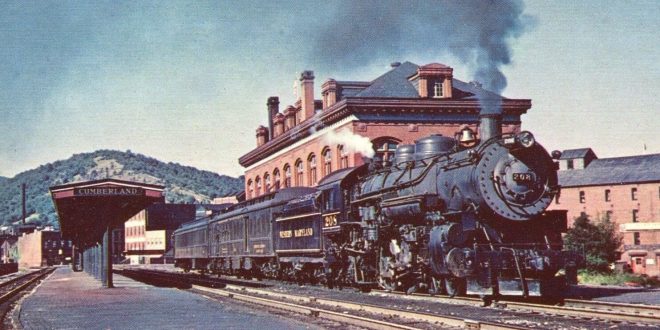
One of the main pillars of Istanbul's economic policy is railway construction. The opinion about the positive importance of railway construction in the young Bulgarian state seems so obvious that it seems to need no justification. After all, we all know that improving infrastructure is an important tool through which the state authorities create conditions for economic growth, encourage business, etc. However, is this really the case?
"Dissident" views
It turns out that in Bulgarian society, both before and after the Liberation, there were serious and well-founded critical views on this issue. Among the first such views, one should mention that of Hristo Botev, who was a friend and co-author of Stambolov. On May 17, 1875, Botev declared himself from the pages of the newspaper "Zname" against the construction of railways in the Bulgarian lands, which were then still within the Ottoman Empire. His words against such government support for the economy are worth remembering: " But because the railways are built only by governments (and their relations to the peoples are the same as the relations of robbers to the peaceful inhabitants) and by famous private thieves and robber companies, and because they serve exclusively only their interests, they are harmful to every nation ..." Botev argues that railway construction, when carried out by the state with the help of privileged companies, leads to what is called, with the not entirely accurate term, crony capitalism. In this practice, it is one of the primary sources of the vicious alliance between state power and state-favored private individuals, which in turn is the opposite of the free market.
We can assume that Botev, as a poet, hardly understood the benefits that railway construction could bring. It can also be assumed that he was skeptical of the Ottoman state's ability to build railways and his criticisms were directed at it, although his words were for all governments. After the Liberation, however, Prime Minister Petko Karavelov also spoke out against the construction of railways in Bulgaria. He was aware that such construction was associated with large foreign loans, the repayment of which would put the country's fragile public finances to the test, and that railways could facilitate the ruin of local craftsmen. Karavelov's second argument against railway construction may not be among the most accurate, but despite everything we see that Botev's concerns before the Liberation were alive and well-founded. And Karavelov also did not think that Bulgarian society would benefit.
Of course, politicians are not necessarily to be trusted. Studies by economic historians on the development of relatively backward agrarian societies in the late 19th and early 20th centuries also reach conclusions that are completely opposite to the generally accepted truths. The Italian researcher Vera Zamani notes that in Italy, railway construction led to the import of rails, locomotives and wagons, but did not stimulate local industrial production, but rather put the country's public finances under serious strain.
Facts and arguments
What are the facts about railway construction in Bulgaria after the Liberation until the beginning of the Balkan Wars? What is seen at first glance is impressive. In 1887, there were 223 kilometers of railways in the country, and in 1911 there were already 1930 km., which were relatively cheaply built from the point of view of direct state investments.
However, the assessment of what has been achieved should not stop there. It is important to see whether these railways have really helped the economic development of the country and whether the railways are really cheap. The statistical data on the increase in the length of the railways can be compared with the calculations of the state of Bulgaria's GDP for the same period. This calls into question the meaning of the construction.
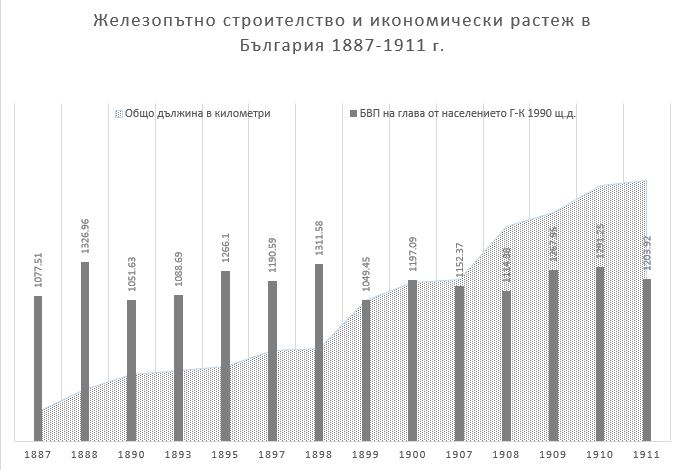
Sources: M. Ivanov, 2012, Gross Domestic Product of Bulgaria 1870-1945, Sofia: Ciela; K. Popov, 1916, Economic Bulgaria. Sofia: State Printing House.
As can be seen from the graph, over a period of almost a quarter of a century, the total length of railway lines in the country has increased significantly, without this being associated with any noticeable increase in GDP per capita in the Principality of Bulgaria. Obviously, the influence of railways is subtle macroeconomic.
Perhaps they helped the emergence of the first modern industrial centers? The answer is again negative. It is known that the industrialization of Gabrovo began immediately after the Liberation, long before the connection of the city to the country's railway network, which took place in early 1912.
As for the claim that the railways were built relatively cheaply, it is worth mentioning several assessments by contemporaries. In 1902, Petar Germanov wrote that the operation of the Bulgarian railways was too expensive and they gave almost nothing to meet the payments on the foreign loans made for them. In 1911, the entrepreneur Ivan Grozev noted that the operation of the Bulgarian railways was twice and three times more expensive compared to that of European lines. Other contemporaries claim that the organization of the work is subject to all kinds of criticism. Ultimately, cheaply built railways suffer from poor organization, do not bring the expected revenues, and their expensive operation shows that cheap actually comes out expensive. When built by the state.
And again about corruption
In his criticism of the construction of railways, Botev also draws attention to another danger - the intertwining of the interests of politicians with those of certain privileged private companies. Such intertwining also leads to solid corruption. Indeed, the construction of railways is one of the classic incubators of corruption in the decades after the Liberation. And it is not only related to public procurement of rails, wagons and locomotives, from which politicians and entrepreneurs close to them also benefit. Railway lines often pass by the properties of interested politicians, and this increases the price of the properties. The construction of railways requires huge investments, which come from external loans. Some of the politicians responsible for concluding these loans do not fail to secure solid income by favoring companies connected to creditors and other schemes.
Thus, in 1904, the Bulgarian state concluded a loan agreement with the French Banque de Paris et de Pays Ba. In the terms of granting loans, the creditors included a requirement that part of it be used for the construction of the so-called Trans-Balkan Railway Tarnovo – Tryavna – Borushtitsa. The route of this railway line is far from the most profitable for the Bulgarian economy. The terrain is unsuitable for high-speed trains, construction is expensive, etc. An important fact, however, is that the creditor bank has investments in the “Knyaz Boris” mine in the Tryavna Balkans. A railway line would increase its profits. The Minister of Trade and Agriculture N. Gennadiev played a major role in choosing this route. In return, he was provided by the French with their own shares in the same mine.
In conclusion
Yes, before the outbreak of the First Balkan War (1912), there were almost 2,000 km of railway lines in Bulgaria. However, they:
- they are not cheap, because after construction their operation is expensive;
- do not stimulate economic modernization;
- force the Bulgarian state to resort to external lending, which is not repaid from the investments made;
- in order to service the loans, taxes are increased and
- help to corrupt the political elite.
In fact, who has the state really helped?