EKIP– Expert Club for Economics and Politics A Different Opinion
The belief that various economic and social problems are solved by adopting or improving special laws, regulations and ordinances is a persistent myth. Its existence is most easily established in the conditions of an election campaign. Then all competitors offer legislative programs that should improve the lives of voters. The myth is systematically and persistently nurtured by the directly interested lawmakers: politicians and bureaucrats. Their existence is justified if there is faith in their competence and knowledge in society about what exactly regulatory acts are needed.
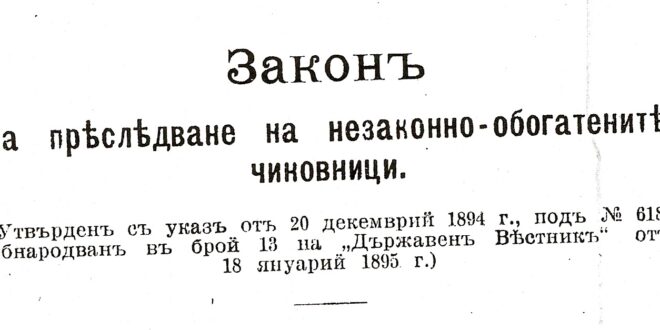
This article is an attempt to demythologize the belief in the magical power of words. It is dedicated to the content and fate of one of the interesting and topical-sounding laws from the dawn of the Third Bulgarian State: The Law on the Persecution of Illegally Enriched Officials. It was adopted by the VIII Ordinary National Assembly at the end of 1894. Its main content and purpose are clear from the title: the fight against corruption and abuses to which officials are susceptible. They cannot cause anything but approval. The important question is: have the declared goals been achieved with the adoption of the special law?
The historical context
The adoption of the Law for the Prosecution of Illegally Enriched Officials is directly related to the specific political and social picture in the Bulgarian Principality at the end of the 19th century.
In May 1894, the government of Stefan Stambolov fell from power. After the Liberation of the country, he was directly involved in the main political events as a member of the Liberal Party. In 1884, he became chairman of the National Assembly, and after the abdication of Prince Alexander I in 1886, for a year he was one of the three regents who ruled until the election of Prince Ferdinand in 1887. Stambolov became Prime Minister in 1887. Until his fall from power, changes were made in the composition of the cabinets, but Stambolov remained the prime minister and a strong figure who actually ruled the country.
The time of the Stambolov regime has several main characteristics that influence the adoption of a special law to prosecute illegally enriched officials. First of all, it should be noted the severe political crisis. Stambolov is trying to limit Russian influence in the Principality and diplomatic relations with the great northern empire are severed. The country's foreign policy orientation is pro-Western. Stambolov's opposition consists mainly of Russophiles, who are subjected to severe persecution. Elections are held with violence, freedom of speech is limited, and legal opposition events are restricted. Russophiles organize riots and terrorist attacks against representatives of the government. The extremely acute domestic and foreign political situation suggests that after Stambolov's fall from power, his opponents will look for a way to take revenge on the all-powerful Prime Minister and his supporters.
During Stambolov's time, the state began to pursue an active economic policy. The first foreign loans were taken, the construction of railways and ports began, the army was rearmed, and efforts were made to promote industry by the state. The macroeconomic results of this policy were not impressive. Other trends gained visibility. More and more public funds were being channeled through ministers, deputies, and state officials. This objectively created conditions for large-scale corruption and the rapid enrichment of responsible individuals. Rumors of abuse, bribery, and favoritism of those close to the ruling party also increased. Some of these rumors were not without foundation. They also concerned Stambolov, who was not distinguished by great personal integrity. Towards the end of the Stambolov regime, public sentiment for punishing those who had become rich from their proximity to power was easily discernible.
To punish bad predecessors
After Stambolov's resignation, Dr. Konstantin Stoilov became Prime Minister. The 7th Ordinary National Assembly, in which the majority was made up of supporters of the former Prime Minister, was dissolved. In September 1894, relatively free parliamentary elections were held, in which the supporters of the new Prime Minister, already united in the People's Party, received a majority. On October 15, the first regular session of the legislative body opened. Hopes were expressed for "moral and material revival", for progress and "prosperity of the people's welfare".
The new political morality was expressed by the introduction of a special Bill for the prosecution of illegally enriched officials. This took place on November 18, 1894, and the author of the bill was the Breznički MP Stefan Bobchev. The mere announcement of the introduction of such a document caused loud applause from the deputies. The socialist Nikola Gabrovski was delighted that the bill was retroactive, i.e. with its help, the wrongdoing officials from the Stambolov era would be punished.
During the discussion of the first reading, the submitter Stefan Bobchev explained that the bill was borrowed from German disciplinary regulations. This is one of the many cases of importing “good practices” from Europe. The explanatory memorandum to the document noted that in the event of bribery, theft, embezzlement of public funds, etc., officials are punished according to the general procedure of the Criminal Code. On the other hand, however, the traditions and current legislation in the country did not allow for “finding an account of the official’s illegal enrichment”. Sudden enrichments also occurred, “the source of which, being undisclosed, remains unclean, immoral, unauthorized, perhaps even criminal”. The motivation for the bill is to “enable the easy search for criminal enrichments and their punishment”, and also to “punish unjustified enrichments”.
The discussions were relatively short. Dr. M. Tsachev expressed his gratitude to the submitter for having taken the trouble to prepare such a normative act. He clearly justified the adoption of such a law with the desire to personally punish Stefan Stambolov. According to Tsachev, during the years in power, Stambolov's salary income was approx. 920,000 leva, and the real estate owned by the former Prime Minister was worth approx. 3 million leva. Bobchev nevertheless clarified that the goal was not personal revenge against Stambolov, but discipline of officials. By the end of the parliamentary session, the law was adopted and in early 1895 it was published in the State Gazette.
Content of the law and its powerlessness
The law to prosecute illegally enriched officials is short. It consists of only six articles. Article one declares that every state or municipal official who is suspected of being so is obliged “if requested by the competent authority, to justify his enrichment”. This must be done by presenting an accurate account and indicating all sources of enrichment. Article two clarifies that “the head of every official or employee” is the competent authority that may require the presentation of an account. The relevant administrative authority then examines the presented account and, if it discovers a crime, sends the case to the relevant prosecutor’s office for prosecution and punishment of the guilty party under the general criminal law.
Fines are provided for refusal to provide information by the official, which are collected regardless of the verdict of the relevant court. The last two articles of the Law sound impressive, according to which all amounts and properties of the illegally enriched official or properties that he has transferred to a third party are confiscated in favor of the state. A separate transitional article specifies that the provisions of this law are also valid for officials who were in office before its adoption. Apparently, the idea of punishing Stambolov's people, and probably Stambolov himself, remains a driving motive for the members of parliament.
Up to this point, the story is rather trivial. The representatives of the people planned to punish the plundering officials, and later historians positively assessed what was done in defense of the public interest.
Tracking the application of this law reveals a completely different reality. In 1920, i.e. a quarter of a century after the VIII Ordinary National Assembly adopted with acclamations the Law on the Prosecution of Illegally Enriched Officials, an analysis in the authoritative magazine “Legal Thought” found its “absolute non-application”. A little more than a decade later, the situation is the same: the law continues to be unimplemented. The reason seems absurd. It lies in “the reluctance of the competent authorities to apply it – even in those cases in which the applicability of the law was beyond any doubt”.
Conclusion
What exactly does the history of an unimplemented law mean? First: it was adopted under the emotion of the fall of Stambolov with the hidden hope of punishing the officials who abused it. This did not happen, some of Stambolov's officials were replaced by new ones and the deeds of the predecessors were forgotten. New times come and the past remains for historians. Second: at least in the Balkans, the authorities decide whether, when and how to implement a given law. If its representatives judge, even the best law remains only of a wishful nature. In this case, we can obviously speak of the supremacy of power, not the supremacy of law. All the similarities with modern times that are discovered are not accidental.
The words of laws have no superpowers, they do not change reality. Often the laws themselves are as meaningless as a door in a field: no one passes through it.