EKIP– Expert Club for Economics and Politics A Different Opinion
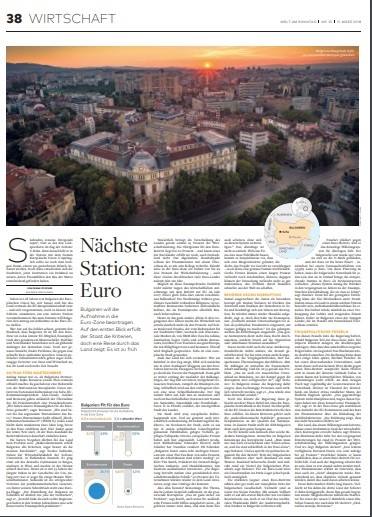
Earlier this week, we from the EKIP were officially quoted by one of the largest newspapers in Germany – Die Welt. As part of Die Welt’s coverage of Bulgaria’s application for membership in the eurozone, our team was recently interviewed about our expert opinion on the subject. In their article, Die Welt concludes, based on their impressions from conversations with economists and other experts in Bulgaria, that it is still too early for our country to adopt the euro.
As leading Eurosceptics and opponents of Bulgaria's entry into the Eurozone, we were directly quoted by the publication:
"However, the most serious opponents of the euro are not the pro-Russian parts of Bulgarian society," the author of the article writes, citing his conversation with Stoyan Panchev, head of the neoliberal think tank EKIP. Panchev believes that the strict attachment of the lev to the German mark and subsequently to the euro is the better option for the country, as it forces politicians to limit spending. It is from these shackles that the government will be freed, if Bulgaria enters the eurozone, Panchev believes. Then imports into the country can increase, without direct negative consequences. On the contrary: economic growth can accelerate, the expert claims, but warns that the negative consequences will be felt only a few years later."
In the context of Bulgaria's EU Presidency and the explicitly stated intentions of our government to apply for membership in the "Eurozone waiting room" (i.e. the ERM-II exchange rate mechanism) this year, the topic of the possible adoption of the euro in our country is extremely topical. For more than a year, the EKIP has not only been following, but also actively commenting on the topic, presenting our analytical view on the potential consequences of adopting the euro in Bulgaria.
The article in the print edition of Die Welt:
Last year we published an article titled "Why Bulgaria Should Not Join the Eurozone", which became one of our most popular and frequently cited articles. Since then, we have also been actively participating in the media discussion on the topic, with special appearances on numerous television media outlets, the culmination of which was my debate with former Deputy Prime Minister Nikolay Vassilev on bTV. It is a great success for us that we have now been able to share our expertise with one of the largest European media outlets, but you can be sure that this will not be the end of our appearances on the topic.
The currency board works better than the euro
Bulgaria's entry into the Eurozone is a political and economic step of monumental proportions, which will certainly have extremely serious (and potentially catastrophic) consequences for our economy and the lives of every Bulgarian citizen. Because of this fact, we feel obliged to continue to express our opinion and position on the subject and to do everything possible to prevent the government from making a monumental mistake, such as Bulgaria's entry into the Eurozone.
Bulgaria's current monetary system not only works, but it works far better than the Euro would. For 20 years, our currency board has provided comparative stability and monetary security and, most importantly, has limited the ability of politicians to use monetary policy tools to benefit themselves through unprofitable and irresponsible economic and fiscal policies.
This is an advantage that our monetary system has over that of any other Eurozone country, and it is especially noticeable compared to countries like Greece. If Greece had been on a currency board rather than a Eurozone member, the massive crisis it has been in over the past decade would never have happened.
Bulgaria needs not the euro, but better economic policy
Bulgarian citizens and businesses will not benefit from joining the Eurozone and removing the "straitjacket" of the currency board. The only possible winners are politicians and their associates in business and the non-governmental sector, at the expense of all other citizens and businesses. Let us not be fooled by the tempting promises of higher economic growth, lower interest rates and that we will finally catch up with Western Europe in terms of income. These are either outright lies or manipulations.
Joining the Eurozone is not a panacea for our economic problems, just as joining the EU 10 years ago was not a panacea for our governance problems, and in particular the high level of corruption. Joining the Eurozone will actually only make these problems worse, because it will expand the opportunities and create incentives for those in power to continue to pursue increasingly irresponsible and dangerous fiscal and economic policies.
What we need is the opposite. More serious restrictions on the ability of politicians to interfere in the economy and benefit themselves at the expense of other citizens and taxpayers. That is, we need to reduce state intervention in the economy and force domestic leaders to be more responsible in their political decisions. Joining the Eurozone will not achieve this.