EKIP– Expert Club for Economics and Politics A Different Opinion
Author: Assoc. Dr. Hristiyan Atanasov
How the state's departure from its priority can have a positive impact
Let's start with the fact that agriculture was the main priority of the Ottoman state throughout its existence. It can be said that the reasons for this were mainly fiscal, but also social. Thus, the data on the revenues in the state budget clearly confirm that agriculture formed the majority of the tax revenues of the Ottomans (between 25-30% of all revenues were formed only from the contributions from the tithe tax (yoşur "öşür" ), with the percentage increasing many times over if we also calculate the taxes from other activities related to agriculture). In addition, despite the lack of accurate statistics, we can claim that the vast majority of the population in the empire, about 90%, was engaged in agriculture. Something that would be valid for a long period of time for the Bulgarian economy after the Liberation, as well as the economy of the Republic of Turkey long after the collapse of the state of the padishah. I will add that the data on the employment of the population of Bulgaria after 1878 again show that the largest number of people (again about 80-90%) are employed in agriculture.
The total volume of receipts in the Ottoman treasury and the amount of "tithes" (1857/58 - 1877/78), the amounts are in groszov
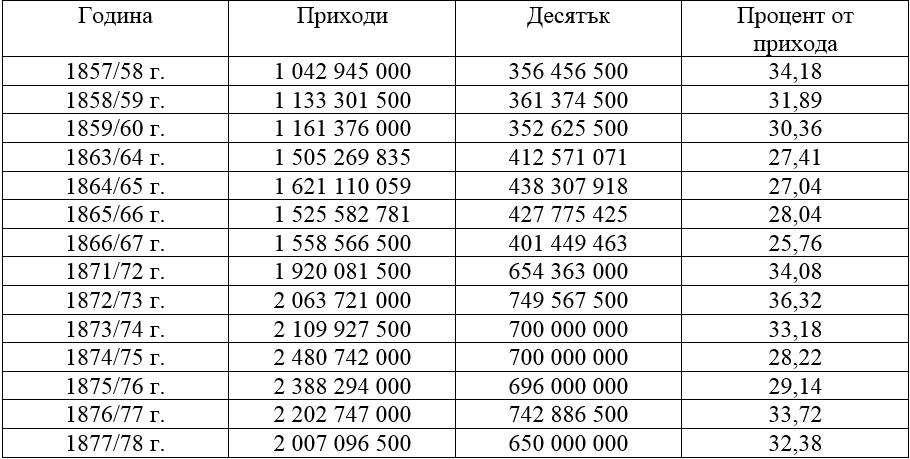
Data taken from Ottoman Financial Statistics, Budgets, 1841-1918. Ankara: State Institute of Statistics, 2003.
At first glance, this should lead to attempts at stronger regulations and a desire for greater state involvement in agriculture. This is especially characteristic of the empire during its “classical period” (15th–16th centuries), when all production was to some extent fixed, the ownership of the vast majority of arable land was state-owned, the prices of agricultural products were regulated, trade in them was a state monopoly, and their export was limited. In the 18th–19th centuries, a period that coincided with the Bulgarian Renaissance, this was no longer the case and agriculture experienced relative growth, with the Ottoman rulers pursuing a policy of intensifying agricultural production. As the government in Constantinople did?
First of all, the Ottomans saw the recipe for revitalizing the industry in several specific directions that would lead to the beginning of the "expulsion" of the state from the sector. This was done by refusing to standardize the prices of agricultural products that were purchased by the state, by reducing the tax burden, which according to the Ottomans should happen by eliminating the system of tax over-buying (there was no exit of the state here, but there was a desire to reduce abuses and hence the amount of the tax). Perhaps the most fundamental change was the gradual granting of private property rights to agricultural producers.
No monopoly towards free pricing
First of all, the question of the prices at which agricultural products should be sold is of utmost importance. It is known that the production of cereals was the main branch of agriculture during the 18th and 19th centuries, and the key point in this case is that trade in them was also a monopoly of the Ottoman state itself. No one had the right to export grain from the empire before the state guaranteed its necessary purchases. The latter had an enormous impact on the price, in the direction of a decrease. The state bought cheap cereals in order to be able to feed the larger cities, especially Constantinople.
This cannot be profitable for the agricultural producer, as long as the prices of his products are kept artificially low. Since the price is kept artificially low, the ordinary peasant is not motivated to accumulate a market surplus to sell on the market. So, if one should seek to stimulate the production of agricultural products, an increase in prices must be caused to encourage farmers to produce more. In the late 1840s, this is exactly what was done through legal mechanisms. In 1838, mandatory state supplies of grain were abolished, and in 1840 the ban on their export from the empire was also lifted. This opened the empire's markets to Western traders and increased demand, which in turn led to an increase in the prices at which grain was purchased. That is, an incentive was given to the direct producer to try to produce more surpluses.
Private owners instead of tenants
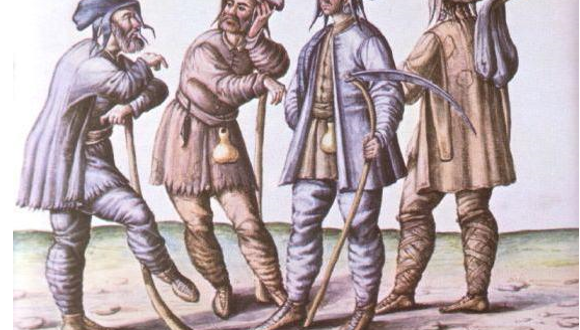
The second issue, which seems to me the most important, and regarding which there are too many ambiguities, contradictions and ambiguities, is the issue of land ownership. It is more than fundamental. It is well known that one of the main pillars on which capitalism is based is private property. It is known to specialists that in the Ottoman state there was private property, but it was extremely limited. Thus, in the 15th – 17th centuries, farmers had property rights only over their homes and a small plot of land around them (this is the so-called mulk “ mülk” ). The remaining lands, which are the vast majority of rural lands, and which farmers cultivate are state-owned (the so-called miri “ miri” ) and the producers are only a type of tenants working on them. In all likelihood, this is the reason why the Bulgarian peasant of the period, and indeed of the following years, had no desire to try to improve and intensify his farm, insofar as he was not its owner. After all, why develop lands of which he is not the owner, but only a user?
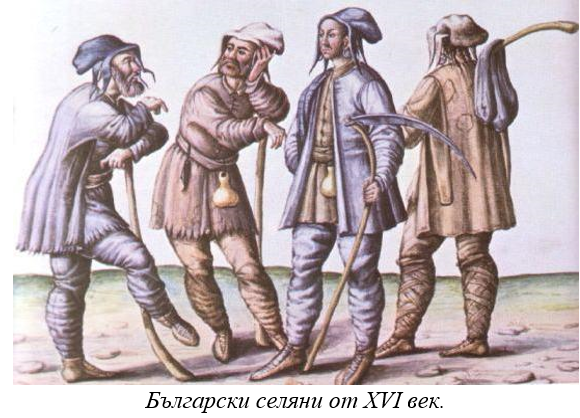
In the 18th century, when the Ottoman state was weak, this changed and some more influential individuals – including both Muslims and Christians – began to own land as private owners, albeit illegally, and managed to turn these plots into real “oases” of capitalism – cultivated by paid workers, production for the market, etc. In the 19th century, the legal status of ownership of arable land also underwent some changes and peasants gradually acquired rights as owners of the land they cultivated. This certainly showed a strong psychological drive and farmers now had a personal interest in intensifying their farms and generating a market surplus. More production could lead to greater profits, also guaranteed by higher prices, formed on a free market principle.
No abuses in tax collection aimed at reducing taxes
The third major issue is related to the tax burden. In the Ottoman Empire, especially in the 18th and early 19th centuries, taxes were collected through the so-called “ iltizam ” system. In this system, at first glance, the state “waived” its right to collect taxes in favor of private individuals, through an auction at which predetermined tax revenues were sold. However, this “waived” was to a large extent fictitious, since those who won the right to collect taxes from a specific area were essentially state officials.
In addition, the winner of the auction, if he does not resell the right to collect the tax to another person at a higher price, begins to collect the taxes in practice and naturally his aim is to collect an amount that is greater than the one he paid at the auction itself and this leads to an increase in the tax burden. Thus, agricultural production is taxed instead of 10%, as is the law, at a higher rate – 15-20% and more. There is no way that this way of collecting taxes will be an incentive for the farmer to try to produce more, the tax system will simply suck up any accumulated surplus. The Ottoman government tries to change things, although not very successfully, and to ensure that the peasants will be taxed only with the legal tithe.
These changes in trade and export monopolies, price fixing, land ownership and the tax system, whether successful or not, completed or half-baked, are at least indicative of the intentions of a part of the Ottoman political elite to create the conditions for the intensification of agricultural production. They are also indicative of how a smaller state and the desire to reduce taxes could prove beneficial for the development of a sector.