 EKIP– Expert Club for Economics and Politics A Different Opinion

At the end of last year, the cabinet proposed that the minimum wage in Bulgaria be increased to 510 leva in 2018. The administrative increase in the minimum wage is a frequently used tool by the state to “fight poverty”. In practice, however, this increase has a negative impact on employment and the investment climate. Whenever the price of a good or service is increased by the state, and not through the price mechanism of supply and demand, the end effect is the opposite of what was sought. Any such regulation in the long term makes the people whom this economic policy aims to make richer poorer.
The only reason why this vicious practice has not yet had its negative effects is that currently the European, and hence the Bulgarian, economy is on the rise. This fact has led to record levels of employment and growth in the average wage. The problems here will occur when the business cycle turns. It is precisely in times of economic recession that the administrative increase in the minimum wage reveals in reality how harmful an economic measure it is, because it will in practice make it illegal to create jobs at the market price of labor at a time when employment is most needed to overcome the economic crisis.
Negative effects on business
In a market economy, the main employer is private business. In 2017, out of 3,150,000 employed persons in Bulgaria, only 673,000 were employed in the public sector. All other jobs were generated by the private sector. In these conditions, entrepreneurs know best how to value the labor of a given worker, because unlike the state, their ultimate goal is to produce a high-quality, low-cost final product that they can successfully sell on the free market in order to make a profit that compensates them in proportion to the risk they take. The graph below clearly illustrates the extremely worrying trend in recent years of the minimum wage significantly outpacing labor productivity. For the period 2010-2017, as a result of the administrative increase, it increased by nearly 92%, while over the same period of time, labor productivity increased by only 35%.
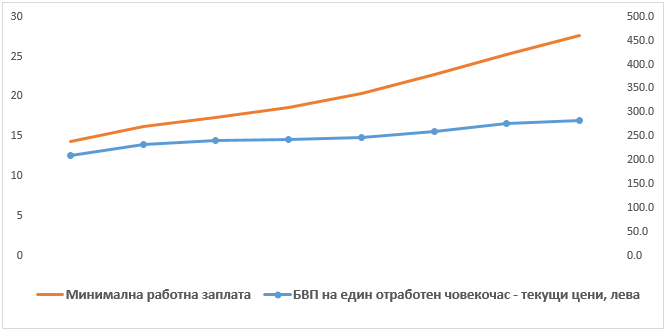
This negative trend, in general, means that the state forces businesses by law to pay labor prices that do not correspond to the value that workers generate. That is, against another increase in labor costs, there is no corresponding increase in the value generated. A secondary effect of the administrative increase in the minimum wage is that it leads to a proportional increase in the average wage. In the long term, this will invariably lead to a contraction in the profit margins of the business. This directly leads to an increase in the cost of the final product, which makes the company, and on a more global level, our economy, less competitive. Fundamental economic logic states that when the price of a product or service increases, its consumption decreases. This is true to an even greater extent when this growth is achieved through non-market means, as is the case with the increase in the minimum wage by the state.
When a business is unable to successfully pass on the increased cost of the product or service provided to the end customer, the company experiences a decline in revenue and incurs losses. In order to save itself from bankruptcy, the business will be forced to take measures to limit losses. These measures most often involve layoffs of low-paid workers who work at the minimum wage. In cases where the business manages to successfully pass on the increased cost of the final product to its customers, this will again have the most negative impact on those workers who work at the minimum wage. The new, higher equilibrium price levels of final products directly reduce their disposable income, making them poorer than they were before the introduction of the minimum wage. In other words, this measure makes poorer precisely those people whom the increase in the minimum wage aims to make richer.
Negative effects on the labor market
When an employer is faced with the alternative of hiring a low-skilled worker who would be on minimum wage and an educated worker who would be paid slightly above the minimum wage, the employer will always choose to hire the more educated employee because, other things being equal, he or she could create more value. In this way, people who are without education and experience are discriminated against by employers because the state does not allow businesses to hire them. Another major problem that Bulgarian politicians clearly miss is that the levels of pay for labor prices vary significantly by geographical region. In Sofia in 2017, the minimum wage amounted to 30% of the average wage. Over the same period of time in Vidin, the city with the lowest labor prices, the minimum wage represented 65% of the average wage for the region.
When the state determines the price levels of labor, it clearly does not realize the great fragmentation of the domestic economy. Business in Sofia can much more easily absorb the increase in the minimum wage, while business in Vidin will encounter much greater difficulties in this aspect. It is not logical and rational for the state to burden business with higher levels of labor remuneration in the poorest region not only in Bulgaria, but also in Europe. Again, the direct effect of state intervention in the labor market will be a decrease in employment, especially among the low-educated members of our society.
Another negative effect of the increase in the minimum wage is that businesses will start hiring more and more people in the gray sector. One of the greatest successes of our political class after the transition is the introduction and maintenance of low direct taxes. This has largely had a positive effect on the process of brightening our economy. The low tax burden has naturally led businesses and workers to not see any particular economic logic in this, and they run the risk of hiding taxes. Unfortunately, in recent years, the constant increase in the minimum wage has largely eliminated this positive effect. More and more employers prefer to work in the gray sector in order not to pay high insurance contributions and avoid the minimum wage. On the other hand, workers are satisfied because they both receive social benefits from the state and also receive a salary, albeit lower than that established by law.
In one of the most significant economic works ever written, "Human Action," Ludwig von Mises mentioned the so-called "Ricardo Effect." It states that as labor costs increase as a result of an increase in the minimum wage, businesses will be forced to start laying off people, replacing them with as many machines and automation of production processes as possible.
Conclusion
At the beginning of this year, the European Central Bank (ECB) published a comprehensive study covering over 8,000 companies in Europe. The study aims to understand what the real effects on business will be when the minimum wage increases. The sample also includes 456 Bulgarian companies. The study shows that 25.2% of Bulgarian companies that have workers on the minimum wage will be forced to lay off staff. This percentage amounts to nearly 14% for companies that do not have workers on the minimum wage. The study also reveals another extremely problematic effect. 35% of companies that have workers on the minimum wage say that they will have to increase the prices of their products, with this percentage increasing to 41.3% for those that do not have workers on the minimum wage. The general trend for both types of companies is that the increase in the minimum wage will also lead to an increase in other salaries in the companies.
On this basis, I think it is very easy to answer the question I posed in the title. The state should not intervene in any form whatsoever in market phenomena, such as the level of the minimum wage. Entrepreneurs and workers, through the forces of supply and demand, are the only factors that can effectively determine the equilibrium price of one of the most important factors of production - labor. Therefore:
- The minimum wage is 0;
- The minimum wage makes it illegal to hire low-skilled and low-educated people;
- The minimum wage always leads to unemployment, with its most negative impact being most noticeable during recessions;
- The MRP has a negative impact on business profitability, leading to a decline in capital accumulation and investment;
- This measure increases the share of the shadow economy;
- An administrative increase in the minimum wage always leads to more expensive goods and services, which in turn leads to a contraction in consumption.





2 коментара
Pingback: Positives and Negatives of Budget 2020
Pingback: What are the biggest problems with Budget 2020?