EKIP– Expert Club for Economics and Politics A Different Opinion

Author: Philip Bagus *
*Philip Bagus is an associate professor at Rey Juan Carlos University. He is an associate scholar at the Mises Institute. He is the author of numerous books, including In Defense of Deflation, Blind Robbery!, The Tragedy of the Euro, and co-author of Deep Freeze: Iceland's Economic Collapse.
While the euro crisis seems to be a distant memory, with all eurozone countries keeping deficits below 3% of GDP, there is one problem for the euro that is quietly growing: the unresolved banking crisis. And it is no small problem. The balance sheets of the eurosystem and eurobanks stood at €30 trillion in January 2018, or about 291% of GDP.
European banks are in trouble for several reasons.
First, banking regulations have become stricter since the financial crisis. As a result, regulatory and compliance costs have increased significantly. Today, banks must meet the requirements of national authorities, the European Banking Authority, the Single Supervisory Mechanism, the European Securities and Markets Authority and national central banks. The currently staggering 4% of total revenues that go to compliance costs is expected to grow to 10% of total revenues by 2022.
Second, there are hidden risks in bank balance sheets. That there is something questionable about the assets of European banks can be quickly detected when comparing the banks' market capitalization with their book value. Most European banks have price-to-book ratios below 1. Germany's Commerzbank has a price-to-book ratio of 0.49, Deutsche Bank has a price-to-book ratio of 0.36, Italy's UniCredit has a price-to-book ratio of 0.23, Greece's Piraeus Bank has a price-to-book ratio of 0.14, and AlfaBank has a price-to-book ratio of 0.34.
At a price-to-book ratio below 1, when buying a bank at current prices and liquidating its assets at book value, the investor can make a profit. Why don't investors do this? Simply because they don't believe in the book value of bank assets. The assets are overly optimistically valued in the eyes of market participants. Given that the equity ratio of the banking sector in euros is only 8.3%, the low value of assets can quickly evaporate equity.
Third, low interest rates contribute to rising asset prices. Stock and bond prices have risen due to the ECB’s monetary policy, which has led to accounting profits for banks. Thus, monetary policy has artificially supported bank profits in recent years.
In fourth place, according to the ECB, non-performing loans, those where borrowers fall behind in their payments, amount to 759 billion euros, i.e. 30% of banks' capital.
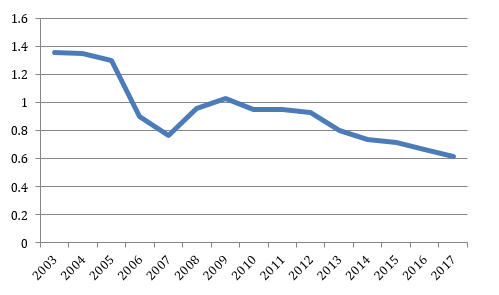
Fifth, banks face more challenges ahead. Due to artificially low interest rates, insolvency rates have fallen. In Germany, in 2003, 39,470 companies (1.36% of existing companies) declared insolvency. By 2017, insolvencies had fallen to 20,200 companies (0.62%).
Bankruptcy rate in Germany 2003-2017,%
Source: Creditreform.de
Companies that would otherwise go bankrupt are able to survive because of low interest rates, which are close to zero. Their survival is not without its costs, as they suck up resources that could be used in other sectors and projects. Each year of the ECB’s zero interest rate policy postpones tens of thousands of bankruptcies, adding to a growing stock of “zombie companies.” “Zombie companies” are causing the Eurozone’s anaemic growth, as they suck up resources that could be used more productively in other production lines. When interest rates rise rapidly, these “zombie companies” will be pushed to the brink of bankruptcy, and insolvency rates will return to more normal levels, causing serious problems for banks.
Sixth, lower interest rates have created serious problems for banks’ interest margins. Banks’ deposit and lending margins have fallen. Deposit margins are the result of investing bank customers’ deposits in the interbank market. Traditionally, banks can make profits this way, but not in the world of negative interbank rates resulting from the ECB’s policy.
The transformation margin is the result of maturity transformation - when a bank borrows short-term from a customer and makes a long-term loan to another customer. With a flattened yield curve, this transformation yields lower than normal profits. Borrowing at 0% to make a long-term loan at 0% is not profitable. Furthermore, when banks make long-term loans at very low interest rates and short-term interest rates start to rise, margins shrink even further.
The credit spread arises from the risk of lending. Banks try to compensate for the falling passive and transformation margins by taking on higher credit risks. Competition among banks in this area also reduces the credit spread. In this way, the ECB's zero interest rate policy cannibalizes the traditional profitability of banks.
Seventh, eurozone banks are still closely tied to their governments. As of January 2018, eurozone banks held €3.536 trillion. The sovereign debt on their books amounts to 13% of their total balance sheet. When the sovereign debt crisis resurfaces in the next recession, banks can expect losses on their sovereign debt.
When interest rates rise in the future, banks will face several difficulties. First, non-performing loans will increase and “zombie companies” will collapse. Second, banks’ long-term, low-interest loans will become more difficult to refinance at a profit. Third, asset prices will fall, leading to losses. The government could get into trouble.
As a result of these losses, banks will be forced to restrict lending as their capital shrinks. Ironically, the ECB’s zero interest rate policy, designed to stimulate credit expansion, will ultimately lead to a credit crunch. There will be a severe recession and a decline in the money supply. The crisis will not only threaten the banking system but also the euro, as the struggling eurozone governments will try to recapitalize their banks with proceeds from newly issued debt.