EKIP– Expert Club for Economics and Politics A Different Opinion
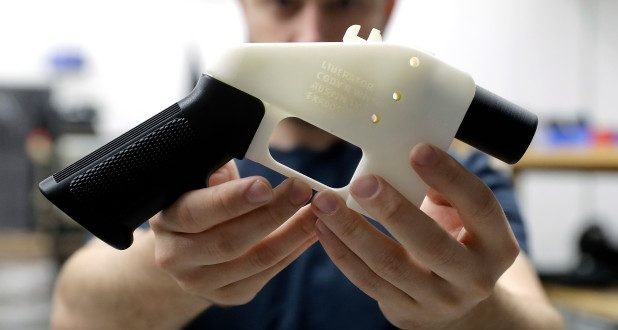
Technology de facto renders gun control meaningless, which greatly empowers even the smallest secessionist movement.
Many of you have probably heard of 3D printers. These are machines that produce all sorts of objects on a principle similar to printing text from Microsoft Word onto a sheet of paper. They receive the parameters and size of the objects in the form of an electronic file and, based on it, build the object from a material in a powder or liquid state, most often plastic, turning it into a solid and with the exact proportions described in the file. Depending on the consistency and qualities of the material, the printed object can do the same job as the real original and will cost much less. This is a revolutionary technology with the potential to change the way we make things forever, with a chance to transfer production from the factory to each of us in our basements.
You've probably already guessed what guns have to do with this process. This technology allows absolutely anyone to acquire a firearm by simply printing the components from an ordered and received file and assembling it. Even those for whom the state has decided that they should not have access to weapons. The resulting gun is entirely made of plastic, with only its trigger made of steel, but it can be removed and put back on whenever we want. This means that the weapon is able to pass through metal detectors at airports. Weapons specifically made to be untraceable are illegal, as long as they do not have at least one metal part. Because of the metal trigger, they meet this requirement.
Turning point
In 2012, American law student at the University of Texas, libertarian and crypto-anarchist Cody Wilson founded Defense Distributed to draw up plans for a 3D printed gun. The gun was ready the following year, and was named the Liberator. Wilson also published the gun’s plans online in open source format so that anyone in the world could download them and make their own. In his words, Wilson wanted to become the Julian Assange equivalent of guns.
Later in 2013, the U.S. State Department arrested Wilson on charges of violating the International Traffic in Arms Regulations (ITAR) for posting the plans online, and the internet knows no borders. In early August 2018, the State Department offered Wilson an out-of-court settlement allowing the design to be published and distributed, confident that the Justice Department would win the case in court based on the First Amendment to the U.S. Constitution, which guarantees freedom of expression, and within whose framework the free sharing of this design falls.
The situation we find ourselves in is a watershed from a legal perspective. The state cannot limit the spread of this type of weapon without banning 3D printers entirely, which is like banning factories because periodic work accidents there claim more victims than any workshop. At the same time, however, it cannot limit the spread of the plans without starting to contradict its fundamental law – that the government has no right to limit self-expression in any way.
The consequences
This could be the end of large, centralized superstates, because it would greatly empower any breakaway groups that wish to separate themselves and their property from the existing states that exercise authority over them.
Throughout history, gun control has been the primary tool by which a state has secured control over a territory and its population, and virtually everyone has practiced it. In the Russian Empire, for example, for centuries, certain ethnic groups, such as the Muslims of the south, were considered unreliable to be given weapons to serve as soldiers. No weapons, no problem.
A state cannot wage endless war with a part of its population to subdue it, because the tax revenue it collects from it may not be enough to cover the damage caused by the rebellions. It may be more profitable to let its more restless elements secede into their own state than to constantly deal with them. Game theory in politics and war is a game of nerves, and whoever gives in first loses.
The practical face of anarcho-capitalism
What does Ancapistan have to do with it? Anarcho-capitalists are right about many things, except for the practical emergence of Ancapistan. This would be difficult to achieve through political growth. The mass man, if nothing else, is becoming more statist and collectivist in his mind, and freedom and responsibility will increasingly scare him. That is why he will be against some groups seceding from his state, and will increasingly support the inclusion of new territories and people into it. Everything is moving towards the ideal of Thomas Hobbes - the world state.
No one would delegate his security and rights to an external private police and court that holds all the weapons while he himself stands unarmed and defenseless. Rather, each would strive to be a state unto himself, and the law that rules over individuals in their disputes would be the rules of present-day international relations—each state has its own destiny. In reality, politics will replace law entirely. This does not mean a worse world, because there are objective managerial benefits to having decisions made close to the people who will be affected. But these benefits are not always politically obtainable, and often have to be acquired militarily.
The only salvation lies in improvements in the technology for conducting offensive and defensive warfare, which would allow smaller state formations to exist independently and have a chance against larger attackers. The invention of the machine gun allowed a small nation and country like Bulgaria to have a serious fighting chance against entire colonial empires of the rank of England and France during World War II. And it is no coincidence that many new states were formed in Europe after it - political and territorial decentralization is observed. In the other war, in which the offensive response of the machine gun - the tank - was improved, political and territorial centralization followed, which led to the de facto formation of only two political entities after it - NATO and the Warsaw Pact.
Covenant
3D printed weapons will be the modern equivalent of the machine gun in the political development of the world. As Charles Martin said: “God created men, but Samuel Colt made them equal.”