EKIP– Expert Club for Economics and Politics A Different Opinion

The factors that have led to the current crisis in Turkey are at a fundamental level two. The huge current account deficit and the high levels of price inflation, especially since 2012. In turn, these two factors are a direct result of the fiscal and monetary policies that Turkey has chosen to follow over the past decade. What is interesting is that for a long time, the monetary and fiscal policies that Turkey has followed have had very positive effects. And for years, the country was considered a role model for its strong levels of economic growth, despite being torn apart by political conflict and instability. In reality, however, it is precisely in this past “success” that the current “failure” of Turkey’s economy is rooted. Time for a little history.
Monetary policy during the period 2009-2016
When Recep Erdogan first came to power in 2003, he managed to implement some reforms that significantly stimulated the growth of the Turkish economy. In 2004-2006, the country's GDP growth peaked at around 10% per year for almost all quarters of that period. Erdogan began to be praised by various media and experts for his success in turning around the country's economic growth after the difficult years of the 1990s. However, this happiness did not last very long. In 2007, growth began to slow down, and in 2008, the global economic crisis hit and it completely collapsed. The Turkish economy fell into a severe recession, with GDP shrinking by 4.8% in 2009.
To restore growth, the government under Erdogan has undertaken a massive fiscal stimulus, and the central bank has radically cut interest rates in an attempt to stimulate bank lending. From over 16% in 2008, it has been reduced to 6.3% in early 2011. The stimulus is working. This stimulus from the Turkish central bank has been accompanied by similar monetary policy abroad, and specifically the United States. Since 2009, the Federal Reserve (the central bank of the United States) has kept interest rates at record low levels and undertaken an unprecedented expansion of the money (and therefore credit) supply.
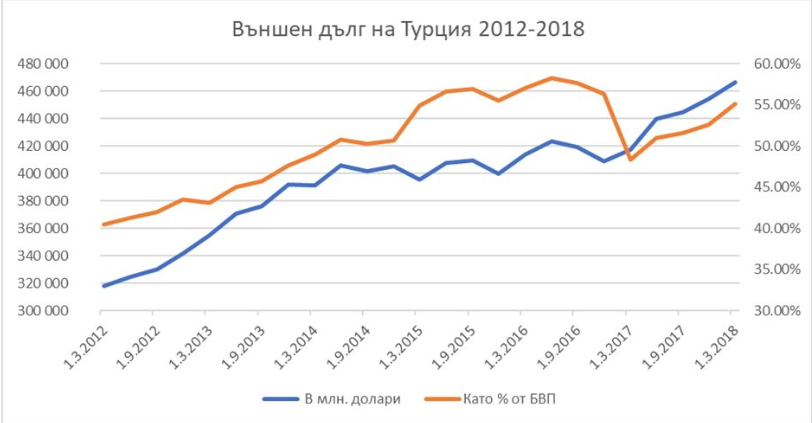
Such monetary policies lead to a temporary acceleration of growth, but the problem is that in the long run they have disastrous consequences for an economy, because they distort the natural production structure, creating short-sighted and counterproductive investments. To understand how this happens, it is worth briefly familiarizing ourselves with the so-called "Austrian theory of the business cycle", developed by economists such as Ludwig von Mises, Friedrich Hayek and Murray Rothbard.
Why is growth based on artificially low interest rates unsustainable?
The problem with growth that is based primarily on an artificially low price for debt (in the form of lower central bank interest rates) is that it is unsustainable in the long run. When the central bank lowers interest rates, it encourages the banking system to lower its interest rates and, accordingly, to lend more. This credit is used by businesses (and consumers) for more investment and consumption. However, this increase in credit is not due to a corresponding preceding symmetrical growth in savings, but simply to money that the central bank has decided to print. Lowering interest rates on its part is exactly that – an increase in the amount of money in the economy.
Real savings are necessary because, at a fundamental level, people economize on scarce physical goods and services (such as labor). Money is simply a medium of exchange between individuals. Especially in the era of fiat money, its value is only exchangeable (it is just paper) - having more money in the economy does not necessarily mean that there are more resources available to allow for increased production and/or consumption.
In conditions of scarcity of available resources, in order to increase production in one sphere of the economy, it must be limited in another and the resources accordingly transferred from the first to the second. This obviously requires saving – of real, physical resources and of course, labor. However, printing more money “hacks” this natural economic balance. When its quantity increases, this creates the impression that savings of real resources have also increased. However, as you can already guess, this is not necessarily the case – the central bank can “print” more money without savings actually increasing.
But the signal is sent – interest rates fall, the supply of credit by banks increases, and businesses are forced to borrow more to finance new investments. The problem is that these investments are not sustainable because they are made on the assumption that a given amount of real resources X has been saved. And they are not. A larger amount of money is used to purchase the same or almost the same amount of real goods and services. In a situation where the amount of money in an economy grows faster than the amount of goods and services (roughly speaking), inflation occurs. And of course, the faster the money supply grows relative to the supply of goods and services, the higher the level of this inflation.
Therefore, to prevent the escalation to hyperinflation, sooner or later the central bank is forced to raise interest rates and restrict the money supply. The current crisis in Turkey is precisely the result of this reversal of monetary policy. However, what is interesting is that in Turkey, the leading role in the direction of the business cycle is actually not the Turkish central bank, but the American one.
The Fed's influence on Turkey's economy
In Turkey, the situation is quite complex because, being a developing economy, the business cycle there, in addition to the monetary policy of the Turkish Central Bank, is significantly influenced by the monetary policies of the US and the Eurozone, which are the source of foreign investment, on which its growth depends to a very large extent. The sharp acceleration in the inflation rate, as well as the growth in Turkey's current account deficit, which we are currently observing, are due to a combination of factors caused by both the monetary policy of the Turkish Central Bank and that of the Federal Reserve in the US.
During the period 2009-2016, when the Fed kept interest rates in the US at record low levels, this stimulated investment in developing economies such as Turkey, which have great potential for future growth. Due to the extremely expansionary monetary policy of the Fed, liquidity flowed from the US to other countries. The so-called “developing” economies, such as Turkey, have traditionally been an attractive destination for this liquidity, because due to their (as yet unrealized) large-scale potential, Western banks and investors could realize very serious profits if they invested in them. In Europe, due to the similar direction of the ECB’s policy, especially in the last few years after 2013, the situation is the same.
Businesses in Turkey themselves are taking advantage of this opportunity and are starting to take out loans en masse from American banks (denominated in dollars), which are attractive due to low interest rates. And so, due to the monetary policy of the Fed and the ECB, both Turkish businesses are taking out more loans in dollars (and euros), and Western businesses are investing more money in the Turkish economy. Thus, it is quite possible that the business cycle in Turkey is actually more dependent on the dynamics of the monetary policy of the Fed and the ECB than on the Turkish Central Bank.
The U-turn in Fed policy and its consequences
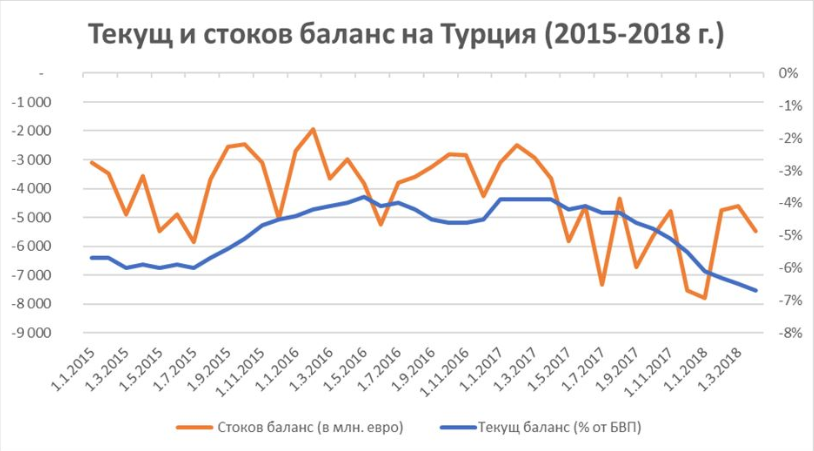
In 2016, however, the US central bank's policy began to reverse. After raising interest rates for the first time in a decade in late 2015, the Federal Reserve raised interest rates for the second time in December 2016. And then, within 15 months, it raised rates four more times. This is a huge problem for the economy of a country like Turkey, which owes a huge amount of foreign debt denominated in dollars.
Suddenly, the excess liquidity becomes smaller and smaller, Western investors begin to withdraw their investments, and banks raise interest rates on their loans. This has a catastrophic effect on Turkish business and subsequently on the country's current account. Due to the change in the Fed's monetary policy, both Western investors have less and less resources to invest, and banks raise their interest rates, respectively, making dollar-denominated credit more expensive. So, the current account deficit swells.
The Fed’s policy change has led to a significant increase in Turkey’s external debt service costs, both in the public and private sectors. This has created a huge debt burden problem, which has been exacerbated by the policies of the Turkish Central Bank over the past year and a half. Although both the Fed and the ECB have begun implementing measures to limit the growth of the money supply in their respective economies (the US and the Eurozone), the Turkish Central Bank has stubbornly continued with its expansionary policy, mainly under pressure from Turkish President Recep Tayyip Erdogan.
The Turkish Central Bank's stubbornness is making the situation worse
This leads to a relative depreciation of the Turkish lira against other currencies, such as the euro and especially the dollar, which further worsens the financial situation of Turkish businesses. Because the greater the ratio of the quantity of Turkish lira to the quantity of dollars and euros, the lower the exchange value of each lira against these two currencies, all other things being equal. Elementary supply and demand. And when the exchange value of the Turkish lira against the dollar falls, this makes the debt of Turkish businesses denominated in dollars increasingly expensive.
The combination of these factors has led to an exponential growth in Turkey’s external debt burden over the past year and a half, bringing Turkey to the brink of a debt crisis and creating a real threat of mass bankruptcies in the corporate sector. This demonstrates categorically that the country’s impressive growth rates of the previous few years were in fact just a mirage, fueled solely by cheap credit.
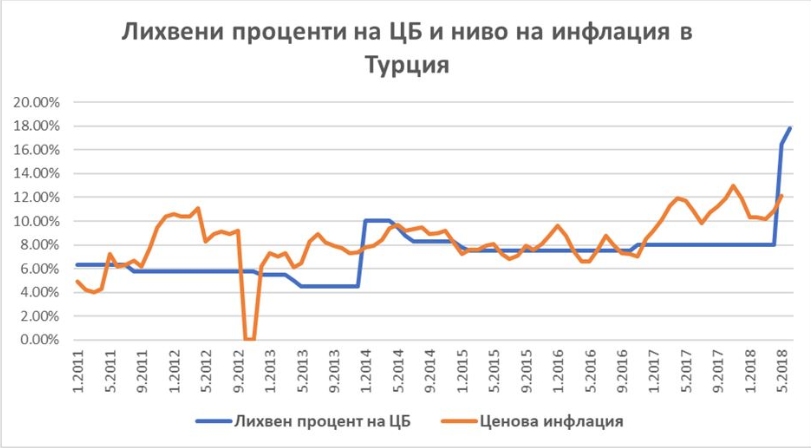
In response to these problems, Turkey has finally taken some action. The central bank has sharply raised interest rates in the past few months from 8.0% to 17.8% in an effort to curb galloping inflation. This is the right move, but it is not enough on its own. If Turkey wants to avoid recession, it needs to adopt fiscal and economic policies that would encourage businesses to make sustainable investments. Such policies would include sharply cutting taxes and cutting government spending.
To recover from the artificial boom caused by money printing and the crisis that followed, businesses need more breathing space. Resources must be freed up from the public sector to be used by the private sector to undertake sustainable investments. In this way, the loss of jobs and the pain of inevitable bankruptcies following the bursting of the credit bubble will be compensated for much more quickly. If Turkey takes the opposite path and decides to “protect” jobs by rescuing businesses on the brink of bankruptcy, in the hope that this will support its GDP growth, the problems will remain. Short-sighted and counterproductive investments will not be cleaned up, but on the contrary – even more scarce capital will be wasted on their “rescue”. Such a policy would condemn Turkey to long-term stagnation at best and a deep crisis at worst.
Original publication: Tavex.bg