Guest Author November 11, 2018 Economic theory, Culture and history
Guest author: Stefan Boyadzhiev Man never mounts higher than when he knows not where he is going. —Oliver Cromwell* Two weeks ago, EKIP published an article by Slavcho Marinov, which was dedicated to a critique of libertarianism. It, in turn, was the second part of the author's more general theme and idea, to …
More » Georgi Vuldzhev August 19, 2018 Economy, Economic and fiscal policy
The factors that lead to the current crisis in Turkey are at a fundamental level two. The huge balance of payments deficit and high levels of price inflation, especially since 2012. In turn, these two factors are a direct result of the fiscal and monetary policies that Turkey has chosen to follow over the last …
More » Georgi Vuldzhev February 25, 2018 Economics, Economic and fiscal policy, Economic theory
Evgeni Dainov, one of the most famous public intellectuals in Bulgaria, published an article a few days ago about the "economists". A text in which he criticizes at length what he describes as the "economic" way of thinking. As someone who considers himself an economist, I was of course intrigued, but unfortunately I was left extremely disappointed...
More » Ivelina Petrova December 06, 2016 Economy
In a world where market signals are confused, central banks – extremely dependent on macroeconomic indicators, reforms, savings and investments with their own capital – are left on the back burner, and economies are so fragile in the face of unpredictable events, it is interesting to go back to basics and analyze through the eyes of economic laws and …
More » Ivelina Petrova August 16, 2016 Economic theory
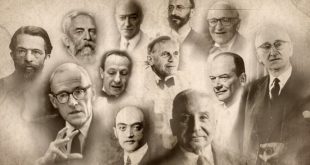
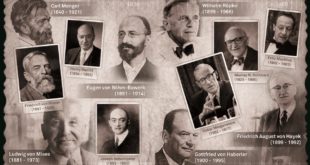
Chapter II. You can see the front parts HERE and HERE How did the Austrian School of Economics originate? In order to more fully and comprehensively understand the contribution of the "Austrians" to economic science, we need to briefly familiarize ourselves with the origin and evolution of their ideas, with the important names in history, and with the result of ...
More » TEAM July 15, 2015 Economy
Ivo Kolarov "It is impossible to understand the history of economic thought if we do not pay attention to the fact that economics as such is a challenge to the conceit of those in power. An economist can never be a favorite of autocrats and demagogues. For them, he always remains a troublemaker, and the more convinced they are...
More » Kalin Mikov June 24, 2014 Economy
The outbreak of World War I in 1914 came as no surprise to Mises. Unlike most of his contemporaries, however, he rejected the wild nationalism and imperialism that had gripped European societies, leading to the outbreak of war and ultimately the end of the relatively liberal period in Europe. As an artillery officer …
More » Kalin Mikov June 11, 2014 Economy
Ludwig von Mises was born on September 29, 1881 in Lemberg (Lviv, present-day Ukraine), but grew up and spent the first half of his life in the Austrian capital of Vienna. After returning to Vienna (most likely between 1883 and 1897), the Mises family rented a house in the suburbs at Friedrichstrasse 4, which today …
More » Daniel Vassilev June 05, 2014 Education
Since the beginning of the BSP’s mandate, we have witnessed a constant avalanche of legislative projects and proposals. A huge part of them fall into the category of “harmful to individual freedom and the market economy”. The latest proposal of the Minister of Education is definitely one of them. It is about the idea that “[t]o completion of primary education …
More » Silvia Yanakieva March 31, 2014 Economics, Economic and Fiscal Policy, Translation
The Natural Rights of Man and the Limits of Government Patrick Baron In The Law, Frédéric Bastiat presents the irrefutable maxim that human rights precede the formation of the state and, therefore, the collective actions of rulers cannot conflict with these primary rights. According to Bastiat, one can delegate to the state only those …
More »
 EKIP– Expert Club for Economics and Politics A Different Opinion