 EKIP– Expert Club for Economics and Politics A Different Opinion

(This article is a summary of the ECT proposal to abolish corporate tax on retained earnings in Bulgaria and the analysis of the potential effects of such a reform. The full text of the report on the topic can be read here.)
In recent years, the debate about corporate tax, its optimal level and the resulting benefits and negatives, has become increasingly popular. Governments, the EU, the OECD, civil society organizations are discussing the size of the rate, options for a single tax base, methods for combating tax avoidance, and even proposals for a common rate in the EU. The 2017 US tax reform has sparked global discussions. Against this background, the debate arises as to how effective the corporate tax is and what would happen if it were abolished.
Let's abolish corporate tax in Bulgaria!
For the last 20 years, there has been a global trend of reducing the corporate tax rate in almost all developed countries. The average rate for EU member states has fallen from 35% in 1995 to below 22% in 2017. In Bulgaria, from over 40% to 10%. A natural end to the trend is the complete elimination – introduction of a 0% rate of corporate income tax on companies' retained profits. But why is this necessary?
Corporate tax is unfair
Corporate tax is levied on the profits of companies – legal entities. However, a legal entity is not a real person, but a fictitious organization. Its income is ultimately distributed among people – owners, suppliers, employees. However, the profits of companies are subject to taxation different from that on the income of its owners and employees. This creates conditions for, as applied in practice in Bulgaria, double taxation– the same money is taxed once as the company’s profit and once as a dividend paid or capital gain to the owners.
The corporate tax creates negative incentives to distort the behavior of companies. Its very idea leads to the fact that it punishes successful companies – those that actually generate profit. As one of the most significant economists of the Austrian School – Ludwig von Mises – points out: “Taxing profit is equivalent to taxing success” [1]. This discourages the success of companies – conditions are created for inefficient spending and irrational overspending. Or at least it seems that way, because the basis on which the tax is calculated is a very easily manipulated indicator. Which leads to the next reason for its abolition:
Corporate tax is inefficient
The main reason for the tax to exist is to raise funds for the state budget. However, a detailed analysis of its revenues shows that their amount is not significant. Data from the Ministry of Finance show that the funds collected from corporate tax represent only 5.47% of total tax revenues and only 1.9% of the country's GDP. (Table 1).
Table 1. Share of corporate tax revenues in total tax revenues and GDP

Източник: Министерство на финансите, НСИ и собствени изчисления
*Предварителни данни
The reason for this, of course, is the incentive for companies to avoid paying taxes. And there are many options for this - legal and illegal. The legal ones listed in the Tax Code include transferring tax losses to future periods, tax relief for investments and carrying out production activities in municipalities with high unemployment, accelerated tax depreciation, tax relief for donations, hiring unemployed people, people with disabilities, etc. Other legal ways to avoid taxation arise from differences in the legislation of countries. The “double Irish” and “Dutch sandwich” schemes have become famous, through which large technology companies save billions in taxes. It is estimated, for example, that in this way Google saved $3.7 billion in 2016 alone. Illegally, taxes are saved by transferring profits to subsidiaries by providing fictitious services, non-market prices, false debt-to-equity swaps, etc.
According to the generally accepted theory of tax evasion, there are two main ways for the state to limit its levels [2]:
- reducing marginal tax rates – following Laffer's theory and
- increasing marginal costs – making it more difficult for companies to evade taxes, increasing the possibility of detection and sanctions.
These approaches have been applied in practice. Although economists argue about the optimal level of the rate for the most tax revenue, most believe that 10% (the rate in Bulgaria) is in the part of the Laffer curve in which tax revenue should grow. However, empirical data shows that the largest companies in Bulgaria by revenue pay very little corporate tax. Some of them annually realize the highest revenues among companies in Bulgaria, but register annual zero or negative profits. And the fight against this is being waged simultaneously at the local and international levels. The European Commission annually recommends measures to solve the problem (most recently in the Council recommendations on the National Reform Program of Bulgaria for 2017 and 2018), and in 2016 the EU adopted the “Anti-Tax Avoidance Directive”, the OECD is actively developing the Base Erosion and Profit Shifting project, etc.
Both approaches clearly don't work - revenues don't grow significantly. The implication is that corporate tax is ineffective. But beyond that:
Corporate tax brings harm
The first and most obvious is the additional burden that companies bear. They allocate significant resources – time, money and human – to reporting and paying corporate tax – accounting separation of expenses into tax-deductible and non-deductible, double reporting – for company and tax purposes, calculation of the estimated taxable profit for the current year, recalculation of forecasts, payment of advance payments, filling out an annual tax return, tax loss carryforward and a number of other bureaucratic formalities that do not create value, but are done only to satisfy the needs of the tax administration.
The existence of a corporate tax distorts the investment market. Arnold Harberger, founder of the Chicago School of Economics, detailed in the "Harberger model" the transfer of capital from the corporate to the non-corporate sector, which also leads to a decline in the rate of return on investment for the entire economy.
Harberger, like most economists who have studied the topic, also proves that taxed corporations pass on a large portion of the tax burden to their consumers, through higher prices, and to their employees, through lower wages. This leads to a reduction in the purchasing power of the population.
Another negative effect of corporate income tax on the economy is that it significantly increases the preference of taxed companies to finance themselves through debt rather than equity. Since interest payments, unlike dividends or capital gains, are recognized as an expense for tax purposes, they reduce taxable profit. This creates a market distortion that Professor Steve Hanke calls a tax subsidy [3]. This “subsidy” reduces the cost of borrowing and companies are encouraged to increase their leverage. This leads to excessive risk-taking, which is dangerous for the entire economy, because companies become unstable and vulnerable to economic shocks.
Benefits of eliminating corporate tax
The first and most obvious benefit is the increase in the propensity and opportunities for new investments. Companies will have more available resources, both monetary and time, and the absence of tax will increase the rate of return and, accordingly, reduce the risk [4] for new investment projects.
New investments and increased economic activity will lead to economic growth and an improvement in the business climate in the country. This, in turn, will attract new FDI (which has been on a downward trend in recent years) and the corresponding resulting benefits – inflows of cash, new highly skilled jobs, access to know-how, experience, technologies and new markets, increased competition, and more.
The abolition of corporate tax will lead to the clarification of part of the shadow economy in Bulgaria, which has the largest share of GDP in the EU [5]. A large part of the sector consists of small businesses that operate unregistered and hidden from the state. According to the National Revenue Agency, for example, 80% of the flower trade is in the shadow sector [6]. A significant reason for this business to remain hidden is precisely the existence of corporate tax. Its existence means for small businesses not only an expense of 10% of profit, but also significant time and resource costs. According to the World Bank’s “Doing Business” report, the time required for the preparation, administration and payment of taxes by businesses in Bulgaria is among the highest in the world. Some businesses, unable to cope with these costs, prefer to remain in the shadow sector. In this way, the state loses not only from unpaid corporate tax, but also from unreported VAT, unpaid social security and tax payments of those working in these businesses, and unregistered income of the individuals who manage them.
In the absence of corporate tax, its burden will stop being transferred from businesses to workers and consumers, which means an increase in the purchasing power of Bulgarians.
But a natural question arising from the proposal to abolish corporate tax is:
What will happen to the state budget?
Understandably, when it is implemented, state funds will decrease by the amount of tax revenues. As mentioned, they are on average 5.47% of the budget. However, in the medium and long term, other tax revenues would increase. Capital expenditures for the projected new domestic and foreign investments and the additional consumption caused by them and the increased purchasing power will lead to new VAT revenues. The Harvard economics professor and one of the most popular contemporary authors of macroeconomics textbooks – Gregory Mankiw, proposes a tax system based entirely on a consumption tax, without the existence of an income tax on enterprises. Currently, Bulgaria has the highest share of indirect tax revenues among EU member states – 53.6%, compared to an EU average of 34.9% [7]. If corporate tax is abolished, this share will increase further and will fully fulfill Gregory Mankiw’s ideas.
Other additional revenues would come in the form of a corporate income tax on new and higher-paying jobs and a capital gains tax on the increase in the value of companies due to the incentive to retain profits. In addition to the additional revenues, some government spending would also be eliminated – that of collecting the tax, investigating tax fraud, and that of subsidizing companies whose net profits would increase.
As a result of this, and taking into account the Ministry of Finance's forecasts for increasing total tax revenues, a slight decline in state revenues can be expected in the short term, but in the medium and long term, they will be higher than the current levels.
Because of these benefits, there has been a global trend over the past 20 years to reduce corporate tax rates. The average rate for EU countries has fallen by almost 40% from 1995 to 2017. In the US, the recent reform of the presidential administration reduced the rate from 35% to 21%. And one country has brought this trend to its logical conclusion.
In 2000, Estonia abolished corporate tax on retained earnings.
Estonia became the first country in the world to introduce such a tax model. The effect of this measure is that the country currently has the most competitive tax system among the countries of the Organization for Economic Cooperation and Development. The American organization Tax Foundation has placed Estonia at the top for the fourth consecutive year in its International Tax Competitiveness Index 2017 report.
How has the reform affected the Estonian economy?
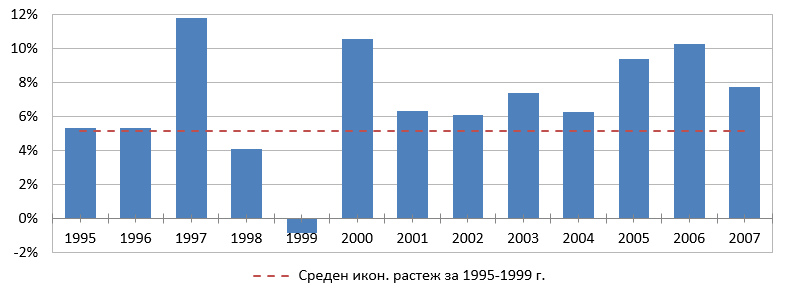
The first effect is, of course, on the amount of tax revenues. Understandably, corporate tax revenues in 2000 fell by half. Only three years later, however, in 2003, revenues not only recovered to their previous level, but also increased by one third compared to 1999 (Figure 1). This temporary decrease in corporate tax revenues, however, did not lead to a decline in total tax revenues (Figure 2). On the contrary, for the relevant period, more and more tax revenues entered the state budget, precisely as a result of the factors explained above, leading to economic growth. Figure 3 shows the growth – for 2000 it was many times higher than the previous year, and in each of the following (until the financial crisis of 2008), it was higher than the average for the years before the reform.
Chart 1. Corporate tax revenue in Estonia for the period 1995-2009 (million euros)

Source: Statistics Estonia
Chart 2. Total tax revenues in Estonia for the period 1995-2009 (million euros)

Source: Statistics Estonia
Chart 3. Economic growth of Estonia for the period 1995-2007
Source: World Bank
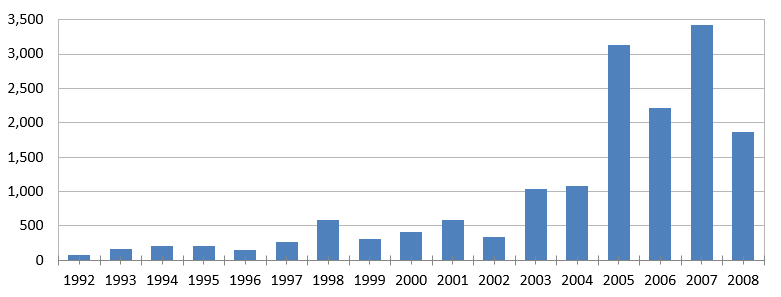
Improvements have also been observed in a number of other economic indicators. Foreign direct investment in the years following the tax reform has increased significantly (Figure 4). As a result, unemployment has been steadily declining since 2000 (Figure 5).
These significant improvements in important economic indicators are due to a complex of factors, including global economic development, simplified administration in Estonia, technology-oriented education and others, but tax reform plays a key role in Estonia's individual development. Evidence of this is the research of Professor Michael Funke from the University of Hamburg. Applying Tobin's portfolio theory, he concludes that "modeling and calibration of current results strongly support the view that the Estonian corporate tax reform of 2000 encourages investment spending" [8]. Funke also conducted a follow-up study in which he compared real data from the Estonian economy with his theoretical research. The results again support the zero tax on reinvested profits - "the tax reform benefits the investment climate and acts favorably in the long run" [9].
Chart 4. Foreign direct investment in Estonia 1992-2008 (million USD)
Source: World Bank
Chart 5. Unemployment rate in Estonia 1996-2008

Source: Statistics Estonia
Another proof of the efficiency of Estonia’s tax system, besides its top ranking in competitiveness rankings, is the fact that it manages to cover government spending. As a result, public debt has managed to remain at the lowest levels in the European Union. At the end of 2017, it was only 9% of the country’s GDP, the only one below 20% in the EU (Figure 6). For comparison, the average debt for member states as of 2017 was 86.7% of GDP – almost 10 times higher than Estonia’s.
Chart 6. Gross government debt as a percentage of GDP of EU member states (2017)

Source: Eurostat
To summarize – let’s introduce a 0% tax rate on companies’ retained profits. The corporate tax is unfair, inefficient and harmful to the Bulgarian economy. Its abolition would lead to new investments, economic growth, a stable economy, a reduction in the grey sector and increased purchasing power of Bulgarians. The effect on the state budget would be minimal, and the lost tax revenues would be quickly compensated. The example of the same reform in Estonia in 2000 confirms the expected theoretical effects. For more information on the state of corporate taxation in Bulgaria and the benefits of abolishing the tax on companies’ retained profits, read the full ECT report on the topic.
[1] Mises, L., “Planning for Freedom”, (1952)
[2] Brusarski, R., “Theory of Public Finance”, Institute of Economics, 2007
[3] See: http://www.bloombergtv.bg/boom-and-bust/2017-02-26/korporativniyat-danak-v-sasht-tryabva-da-bade-napalno-premahnat
[4] Brusarski, R., “Theory of Public Finance”, Institute of Economics, 2007, pp. 182 – 184
[5] Schneider, F., The Shadow Economy in Europe, 2013, Johannes Kelper Universitat Linz, 2013
[6] See: https://bnr.bg/hristobotev/post/100530296/okolo-80-ot-targoviata-s-cveta-ev-sivia-sektor-shtetite-sa-za-7-mln-leva
[7]“Taxation Trends in the European Union, 2018 edition”, European Commission, Publications Office of the European Union, 2018
[8] Funke, M., “Determining the taxation and investment impacts of Estonia's 2000 income tax reform”, Finnish Economic Papers – Volume 15 – Number 2 – Autumn 2002
[9] Funke, M. and Strulik, H, “Taxation, Growth And Welfare: Dynamic Effects Of Estonia's 2000 Income Tax Act”, Finnish Economic Papers – Volume 19 – Number 1 – Spring 2006






2 коментара
Pingback: 3 measures to stimulate the economy in response to the pandemic
Pingback: What to do with the economy during a pandemic - Economic Life