EKIP– Expert Club for Economics and Politics A Different Opinion
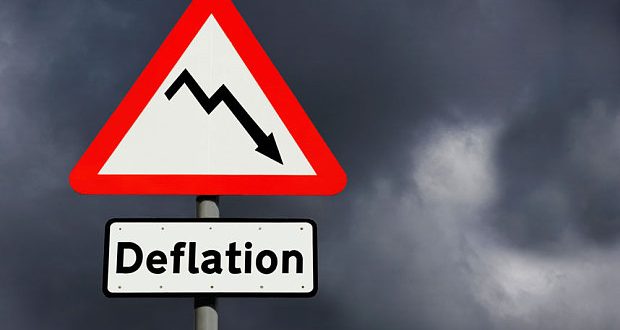
Wherever we turn, deflation is always portrayed negatively, and every writer is quick to present the fight against deflation as the bare minimum for economic competence. There are two definitions of deflation: one is a “fall in the price level,” as measured by the so-called Consumer Price Index; the definition common to mainstream economists. The second definition is a contraction in the supply of base money or other money substitutes convertible into base money on demand (this definition refers to the fractional reserve banking system based on commodity money that was in place until 1971, when Nixon abolished the “gold window”).
Economists who disagree on no other issues are happy to find common ground in the claim that deflation is bad. The problem with deflation, they say, is so obvious that it is not even worth bothering with. This tacit agreement rests on a shaky foundation. University libraries contain hundreds of books arguing about unemployment, the business cycle, and so on. But they rarely have a monograph on deflation. Its evil is beyond dispute.
What is deflation?
Deflation is a monetary phenomenon and as such it affects the distribution of wealth between individuals and different segments of society, as well as the relative importance of different sectors of production. But it does not affect the aggregate wealth of society. Deflation is a drastic contraction in the quantity of money or money substitutes, leading to a sharp decline in money prices. Such an event, even if dramatic for a large number of people, is certainly not a deadly threat to society as a whole.
Imagine that tomorrow all prices fell by 50%. Would that affect our ability to eat, wear, shelter, or travel? No, because the disappearance of money is not accompanied by the disappearance of the physical structure of production. In very high deflation, the money available becomes much less than it used to be, so we cannot sell our products and services at the same prices as before. But the means of production, the machines, the streets, the cars and trucks, the crops, and the food supplies—all of these remain in place. So we can continue to produce, and even profitably, because profit does not depend on the price level at which we sell, but on the difference between the prices at which we sell and the prices at which we buy.
In deflation, both types of prices fall in parallel, and as a result, profitable production can continue. There is only one fundamental change to which deflation contributes. It fundamentally changes the structure of ownership. Debt-financed firms go bankrupt because, at a lower price level, they can no longer repay the loans they took out when they did not expect deflation. Private households with mortgages or other significant debts go bankrupt because, as money prices fall, their incomes also fall, while their debts remain constant in nominal terms.
What is inflation?
Most economists view the cost of inflation as the loss of the purchasing power of money – estimates show up to a 98% loss in the purchasing power of the US dollar since the Federal Reserve has had full control over the money supply (since 1971). Paper money has caused several major crises. In addition, it has completely transformed the financial structure of Western economies. At the beginning of the twentieth century, most companies and industrial corporations were financed by their earnings, with banks and other financial intermediaries playing only a secondary role. Today, the picture is different, and the main reason for this is paper money.
Paper money leads to unprecedented increases in debt at all levels: governmental, corporate, and individual. In light of these long-term consequences of inflation, its supposed short-term benefits largely lose their appeal. But the great irony is that even these short-term effects on employment and growth are illusory. Sober reasoning shows that there are no systemic short-term effects of inflation at all. In other words, whatever positive effects arise, they are largely the fortuitous result of a favorable set of circumstances, and we have no reason to assume that their occurrence is more likely than accidental harm—quite the opposite! The main effect of inflation is to contribute to the redistribution of resources. Thus, there are short-term benefits for some members of society, but these are balanced by short-term losses for other citizens.
There is absolutely no reason why an increase in the quantity of money should lead to more rather than less growth. It is true that the firms that receive money directly from the printing press are benefited. But other firms are harmed for precisely the same reason, because they can no longer pay the higher wages and dividends that the privileged firm can now afford. All other holders of money, whether entrepreneurs or workers, are also harmed because their money now has less purchasing power than it would otherwise have.
Positives from inflation? There are none
Similarly, there is no reason at all why inflation should reduce rather than increase unemployment. People become or remain unemployed when they do not want to work or when they are forcibly prevented from working for the wages that their employers can pay them. Inflation does not change this fact. What inflation does is reduce the purchasing power of all monetary units. If workers expect these effects, they will demand higher nominal wages to compensate for the lost purchasing power. In this case, inflation has no effect on unemployment. Quite the opposite—it can have negative consequences, for example, if workers overestimate the depreciation of real wages it causes and demand higher than justified increases in their wages, leading to even greater unemployment. Only if they did not know that the supply of money had been increased to entice them into business at current wages would they agree to work rather than remain unemployed.
For the same reason, inflation is no cure for so-called “sticky wages”—the problem of the inflexibility of the wage level downwards, especially in recessions. Wages are “sticky” only to the extent that employees choose not to work. But the crucial question is: how long can they afford not to work? And the answer is that the period is limited by the very narrow limits of their savings. As soon as the worker’s personal savings run out, he will, whether he likes it or not, start offering his services, even at a lower price. Therefore, in a free market, wages are sufficiently flexible at any given time. “Stickiness” only arises as a result of government intervention, especially in the form of (a) unemployment benefits financed by taxes or (b) legislation giving unions a monopoly over the supply of labour.
In short, the real problem with deflation is that it does not hide the redistribution that goes hand in hand with changes in the money supply. This is what politicians and their handy economists fear. Because it clearly impoverishes some people at the expense of the equally visible benefit of others. This contrasts sharply with inflation, which creates anonymous winners at the expense of anonymous losers. Both inflation and deflation are, from the point of view we have adopted so far, zero-sum games. But the key difference is that inflation is a secret robbery, and therefore an ideal means of exploitation of the population by its (false) elites, while deflation means transparent redistribution, through legal bankruptcies.