EKIP– Expert Club for Economics and Politics A Different Opinion
Author: Jeff Deist, Mises.org
The Bloomberg terminal, the financial software used by countless analysts and traders around the world, has a problem: its system cannot price bonds that use negative interest rates. The programmers never even considered that such a situation was possible, and so they didn't program the system in a way that would allow it to adapt. As a result, users of the software get an "error" when they try to input negative interest rates on bonds into their terminals:
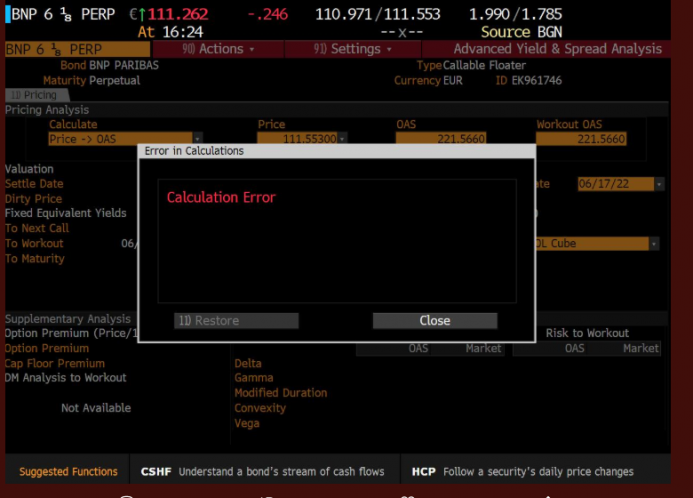
"Miscalculation" is a very accurate metaphor for the state of central bank policy. Both Europe and Asia are awash with $13 trillion in corporate and government bonds with negative interest rates, and Alan Greenspan (former Federal Reserve Chairman) believes that negative interest rates will soon appear in the United States. Contrary to the claims of both President Trump and current Fed Chairman Jerome Powell about the health of the American economy, the Federal Reserve yesterday moved back toward negative interest rates - with a 0.25% cut in the Fed's key interest rate, bringing it below 2%.
Negative interest rates are simply the latest “innovation” of “innovative” monetary policy in the post-2008 crisis era. They are a desperate attempt by central bankers to encourage the taking on of more and more debt, even though the global debt level today is many times higher than it was in 2007. Stimulus is the supposed goal of all economic policy, both fiscal and monetary. Demand-side stimulus is an obsession we inherited from Keynes, or rather, his followers. It is the absurd idea that the economy prospers by consuming and borrowing rather than producing and saving. Negative interest rates turn everything we know about economics upside down.
In what situation would someone borrow $1,000 to get $900 back at some future point? Only when the alternative is to get $800, due to expected interventions by central banks and governments. Only then does agreeing to a fixed level of capital loss seem sensible. And by capital loss I mean exactly that – when there is no positive interest, (part of) the principal itself is eaten away.
There is no "market" for negative interest rates. The future is uncertain and there is always a risk that the other party will not be able to repay the loan. The borrower may default or go bankrupt. Market conditions may change while the loan is in force, pushing interest rates up and thus harming the lender (who borrowed money at lower rates). Inflation may rise higher and faster than the nominal interest rate on the loan. The borrower may even die before repaying.
Positive interest rates compensate lenders for all this risk and uncertainty. Interest rates, like all economic phenomena, find their justification in human nature and actions. If negative interest rates could occur naturally, without intervention by central banks and governments, then economics textbooks are in urgent need of revision.
Any theory of interest concerns positive interest rates paid for borrowing capital. Classical economists and their theory say that interest is a "return on capital," not a penalty. The capital available for lending, like any other commodity, is affected by the real forces of supply and demand. No man would "sell" his capital by paying the buyer interest, as is the case with negative interest rates; he would simply hold onto his capital and avoid the risk of lending.
Marxists, of course, think that interest payments represent exploitation by the owners of capital of the needy proletariat. They think that the amount of interest paid on top of the capital returned is "stolen" from the debtor because the creditor has done no work for it (ignoring, of course, the risk involved in lending). But how can a debtor be exploited when he receives interest payments for borrowing, i.e. pays back less than he borrowed?
I suppose Marxists might actually be happy about the advent of interest rates and somehow see them as a redistribution of wealth from creditors to debtors (when, in reality, we know that "cheap" money and credit actually always primarily benefits the rich, through the so-called "Cantillon Effect"). So they should drastically rethink their theory of interest.
Austrian economists emphasize the time element of interest rates, comparing the willingness of a lender to sacrifice current consumption with the willingness of a borrower to pay a premium for current consumption. In Austrian theory, interest rates represent the price at which the comparative time preferences of lenders and borrowers meet. Again, negative interest rates cannot explain how or why anyone would ever postpone consumption without paying for it—let alone the reverse.
Of course, it should be noted that reasonable buyers of negative-yielding bonds hope to sell them before maturity, i.e., they hope that bond prices will rise as interest rates fall even lower. They hope to sell the bonds to a "bigger fool" and thus generate a capital gain. They are not "buying" the bond for the interest, but for the chance to resell it for a profit. So buying a negative-yielding bond may make sense as an investment in this sense, which is contrary to the practice of institutions and central banks, which often hold bonds to maturity and thus literally pay to lend. But even so, if and when interest rates rise, the losses for those who continue to hold those $13 trillion in bonds could be catastrophic.
Meanwhile, the huge artificial market for US government debt with at least nominally positive interest rates continues to grow, strengthening the dollar and keeping local interest rates low. Once again, the dollar is the relatively cleanest shirt in a dirty laundry. The US Congress is of course very happy about this fact, because if US interest rates were to rise even to 5% it would tear the federal budget to shreds. Rising interest rates would make debt service the largest annual item in the budget, bigger even than welfare and pensions, healthcare and defense. So we can say that Congress and the Fed are in a "symbiotic" relationship at this point; the rest of the world might call this situation America's "excessive privilege."
Negative interest rates are the price we pay for the existence of central banks. The destruction of capital that we are witnessing goes against every human impulse. Civilization requires accumulation and production; de-civilization occurs when too many people in a society borrow, spend, and consume more than they produce. No society in past human history has even considered negative interest rates as an idea, so, just like central banks, we are all in completely uncharted territory.