EKIP– Expert Club for Economics and Politics A Different Opinion
Sofia is a city of contradictions. Our capital has some of the largest separate parks in Europe, it is located in close proximity to a natural park, but despite this, the city's residents regularly express dissatisfaction with the lack of green spaces. To understand what this paradox is due to, we cannot look superficially, as unfortunately too often happens on the part of the city government itself. To solve this problem, we first need to take a closer and more detailed look at the data. We can only hope that after us, the future government of Sofia will do the same.
How "green" is Sofia compared to other capitals?
According to the European Environment Agency, Sofia has 62% green urban areas. That is, 62% of the entire area of the city is covered with greenery. If we compare this indicator with other European capitals, we see that Sofia ranks ahead of cities such as London, Copenhagen, Amsterdam, Vienna, Berlin, Bucharest, Warsaw, Stockholm, Prague, Budapest, Riga, Tallinn, Helsinki, Dublin, Brussels, Madrid, Lisbon and even Paris.
Do they seem like a lot to you? Because they are – these are the capitals of 18 out of 28 member states of the European Union. Sofia ranks at the top of this indicator – in terms of the share of green spaces, the capital of Bulgaria ranks 5th out of 24 capitals for which the EAO has data. Here some of you will immediately object that this indicator is not precise enough – the share of green spaces in the entire area of the city may be large, but if their distribution is uneven, there may be large parts of the city that are practically without green spaces.
Very right. That's why the EAO also has an indicator "distribution of green spaces", which aims to show how evenly distributed green spaces are in a given city. According to it, the distribution of green spaces in Sofia is 18.74 meters per hectare of the entire city area. According to this indicator, Sofia is no longer such a serious leader. Berlin, Copenhagen, Stockholm, Dublin, Paris, Riga, Helsinki, Tallinn, Warsaw, Prague, Vienna and Madrid are ahead of us this time - the total share of their green spaces in the entire city territory may be smaller, but it is more evenly distributed. Here Sofia is no longer in the leading positions - it ranks 16th out of 24. You can view the mentioned data in the table below.
Table 1: Share and distribution of green spaces in 24 European capitals
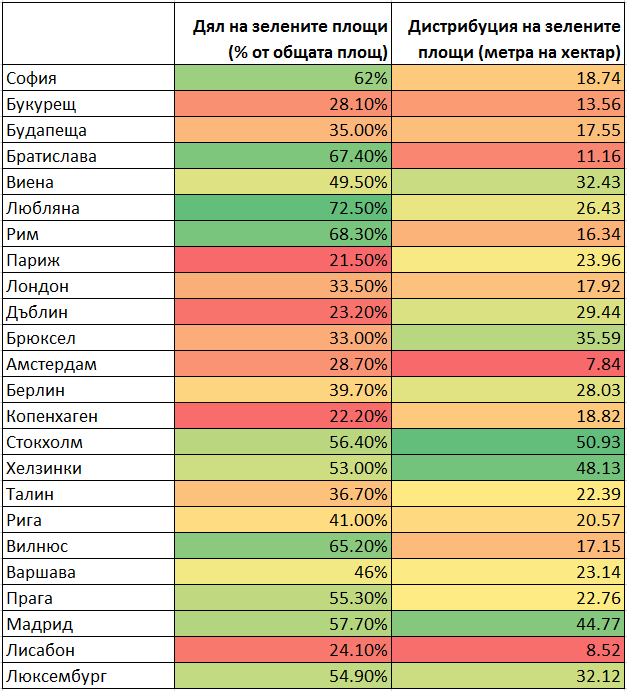
Source: European Environment Agency
A lot of green space, but unevenly distributed
We are now getting to the root of the problem. In terms of the total amount of green space, Sofia is one of the greenest capitals in Europe, but because the distribution of these green spaces is relatively uneven, it seems as if there is not enough green space. The truth is that in certain areas of the city there is a surplus of green space, while in others there is a shortage.
If we look at a map of Sofia, the picture becomes even clearer. In Sofia, there are several huge green spaces – Borisova Garden, Hunting Park (these two are practically connected and form one super-large green area), South Park, West Park, North Park, Vartopo Park and Vrana Park-Museum at the very eastern exit of the city. These green spaces are distributed in almost every corner of the city – western, northern, south-central and southeastern. Only in northeastern Sofia does there not exist a large park, but this is due to the presence of the airport.
Despite the presence of a very large park in almost every corner of the city, we notice that there are also significant areas where there are no designated parks. The central part of Sofia and its adjacent neighborhoods are rich in designated parks. They are much smaller than the above-mentioned huge parks, but they are large enough to diversify the urban environment and provide enough greenery in the central parts of the city. It is no coincidence that we almost never hear complaints from residents in this area that their neighborhood lacks green spaces. Such complaints usually come from the outer neighborhoods such as Mladost, although they are otherwise located next to huge designated green spaces.
Size doesn't (much) matter.
The size of green spaces is much less important than their accessibility and quality. The fact that the share of green spaces is large due to a few huge parks is not particularly important for residents of neighborhoods that are completely cut off from these green spaces. What does it matter to a resident of Obelya that there is practically an entire forest next to Dianabad? In addition to accessibility, quality is also much more important than quantity. Even if Sofia had a 5 times more even distribution of green spaces than it currently is, if they are not well maintained and their quality is low, their accessibility will still be very poor.
Some of the most famous urban planners of the 20th century, such as Jane Jacobs, have repeatedly noted that green spaces that are not maintained and turn into unsightly neglected forests, which often become hangouts for criminals and drug addicts. Such green spaces worsen the urban environment, instead of improving it. It is precisely parts of large parks that are at the greatest risk of turning into such areas, because the larger a given green area is, the more difficult it is to maintain it qualitatively. Moreover, due to their excessive size, it inevitably happens that only certain parts of large parks are used daily by city residents. Those parts that are not used regularly, quite naturally, begin to decline.
Conclusion
There is a need for a paradigm shift in the management of green spaces in Sofia. As the data clearly shows – there are many green spaces in Sofia. The problem, obviously, is with their accessibility. That is why, in the report on the urban planning policy of Sofia, which we published last year, the EKIP recommended prioritizing the quality, rather than the quantity and size, of green spaces in the city. It is better to have smaller, but more evenly distributed, well-maintained and accessible green spaces than a few huge, almost forested parks, parts of which remain unmaintained and inaccessible to most of the city.
The future municipal government, which will be elected in the local elections in October, should first conduct an analysis of the distribution and attendance of parks in Sofia. It should identify 1) where there is a shortage of such designated green spaces and 2) which parts of the current green spaces are regularly used. Based on this data, it can be prioritized where there is a need for the construction of new green spaces and where parts of the current ones actually turn out to be redundant and, accordingly, are territories that can be utilized in another, more fruitful way for the respective region.