EKIP– Expert Club for Economics and Politics A Different Opinion
Author: Frank Shostak, Mises.org
It is widely believed that the resources that in normal times are used to generate economic prosperity are not used to their full capacity during recessions. Some experts argue that what is needed in such situations are policies that will increase the availability of credit (and thereby generate economic activity that will utilize those resources). Ludwig von Mises wrote on this topic in Human Action:
"Here, they argue, we have enterprises whose productive capacity is either not used at all or not fully used. Here are piles of unsalable goods and swarms of unemployed workers. But here are also masses of people who would be lucky if only they could satisfy their needs to a greater extent. What is missing is credit. Additional credit would allow entrepreneurs to continue or even expand production. The unemployed would find work again and be able to buy the products. This logic sounds plausible. But it is nevertheless completely wrong."
The claim that a lack of credit is what prevents the absorption of unused resources sounds reasonable at first glance. However, it must be noted that what is missing is productive credit. Productive credit occurs when a wealth creator who has accumulated some real savings lends those savings to another wealth creator. By giving up the borrowed wealth for the time being, he is compensated with interest by the debtor.
In principle, the more real economic wealth is generated, the lower the interest rates that creditors are willing to accept (i.e., their time preference would likely decline).
Note that the interest rate is just an indicator – it is not responsible for the generation of real wealth. Any policy that distorts interest rates makes it more difficult for wealth creators to assess the availability of productive credit in the economy. This in turn leads to the misuse of productive credit and the weakening of the process of economic growth, i.e. wealth generation.
Distorted interest rates result in overproduction of certain goods and underproduction of others.
Loose monetary policy appears to be working because of the increase in the availability of real wealth
As long as real wealth in the economy grows, the monetary policy of "easy money" seems to "work." However, when this growth stops or even turns into a decline, "the music stops" and this policy also no longer "works" no matter how much it expands.
On the contrary, the more aggressive the central bank's monetary policy, the worse things get in the real economy. The reason is that easy monetary policy reinforces the exchange of "something for nothing" and consequently deepens the weakening of the process of generating real economic wealth - the heart of economic growth.
Here, some would argue that, regardless of the factors that cause the emergence of unused resources, the role of the central bank is to pursue policies that will allow for a wider use of these resources.
Aggressive monetary policy, however, cannot replace the real savings that are needed to absorb these resources. Note that the central bank is not and cannot be a creator of wealth and therefore does not have real savings to generate real economic growth. GDP growth has nothing to do with natural economic growth. Individuals at different stages of the production process need goods and services to sustain their lives and well-being, not the paper we call money.
Unused resources are a result of the previous boom
What these analysts who advocate loose monetary policy miss is that the unused resources appear precisely as a result of the central bank's monetary policy, which causes cycles of economic booms and busts. As a result of the previous aggressive monetary policy, any number of unproductive and "ballooned" economic activities appear. These projects depend entirely on the policy of "easy money" to exist, which redirects real savings to them from those that generate real wealth. When the crisis occurs, the bubbles burst and many resources appear that are not used.
There is only one sustainable solution to this. People will have to cut back on consumption and production, which was just a bubble, the result of central bank monetary policy. It is entirely possible that certain types of consumption and production will have to be eliminated altogether. This also means that those people who were engaged in those activities whose products are of the lowest priority will have to adapt to the new situation. This will have to happen either by accepting lower wages or by redeploying to activities of higher priority. This may require retraining.
In this interim period, there will be many unused resources.
Mises writes:
"After the collapse of the boom there is only one way back to a state in which the progressive accumulation of capital protects the process of steady improvement of material well-being: new savings must be accumulated for the capital goods necessary for the sustainable equipment of all productive sectors. It is necessary to provide savings and capital goods to those sectors which were neglected during the boom. Wages must fall; people must temporarily restrain their consumption until the capital squandered in bad investments is recovered. Those who do not find such hardships of the smoothing period pleasant must in time abandon the policy of artificial expansion of credit."
Mises also says that
"If there are goods that cannot be sold and workers who cannot find work, the reason can only be that the prices and wages demanded are too high. He who wants to sell his inventory or his labor skills must reduce his demands until he finds a buyer. Such is the law of the market. It is the mechanism by which the market directs the actions of each individual to those lines of production in which he is able to contribute most productively to the satisfaction of the needs of the consumers."
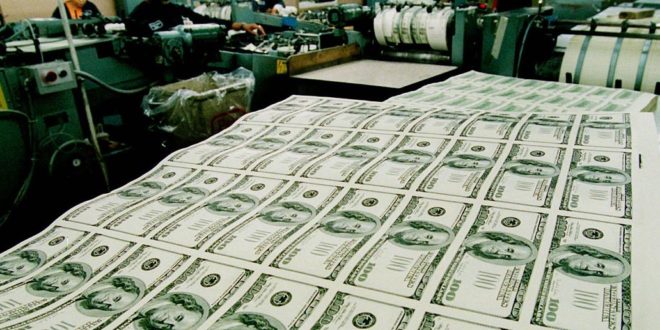
It is obvious that printing more money cannot solve the problem of unused resources. What is needed is time to rebuild the pool of real savings and wealth that was squandered by the central bank's previous "easy money" policies. The rebuilt pool of real wealth will create new opportunities for the absorption of various unused resources.
The most important decision the authorities can make is to acknowledge the damage that money printing has caused and to abandon this kind of interference in the real economy.