EKIP– Expert Club for Economics and Politics A Different Opinion
Author: Yaroslav Romanchuk, original publication from 14.04.2020
The global coronavirus epidemic has significantly accelerated the crisis trends of the modern world. The monetary and fiscal policy measures proposed by international organizations (IMF, World Bank, OECD, UN) and G7 governments after emerging from the global recession of 2008-2009 had a short-term positive effect on the global economy. The very scale of the recession of the late 2000s was greatly exaggerated and the situation turned out to be not as negative as it was presented.
According to the IMF report on the state of the world economy from October 2014, world GDP increased by 3%, in 2009 it was 0%, and in 2010, under the influence of powerful monetary and fiscal drugs, it sharply increased to 5.4%. In 2011, GDP growth was also recorded by 4.1%. Expressed in figures, the situation looks as follows: in 2008, world GDP amounted to $62,308 billion, in 2009 - $59,063 billion, in 2010 - $64,525 billion, and in 2011 - $71,423 billion.
In the IMF Report of October 2017, the figures were slightly adjusted. In 2009, world GDP decreased by 0.1%, for 2010, growth remained at 5.4%, and the data for 2011 were adjusted to 4.3%. For 2009, GDP was recalculated to $65,906 billion (plus $1,381 billion), for 2011 - $73,119 billion (plus $1,696 billion).
These data show that the recession was short-term and shallow. If we take the average annual growth rate for the period 2009-2012, it is 3.3% of GDP, and for the period 2009-2018 - 3.5% of GDP. This is less than for the period 1999-2008 (4.2%), but still a pretty decent result.
The rapid recovery of economic growth rates was achieved to a large extent through synchronized and coordinated actions of central banks and governments. In general, for the first time, an international syndicate of such a scale was activated to provide liquidity to the world market. Central banks set a precedent of negative interest rates (~$18 trillion. financial instruments in this area), increased liquidity (mainly through the purchase of government bonds) to more than $12 trillion., sharply reduced their demands on borrowers and, mainly, on governments. At the same time, governments used fiscal policy tools at full steam such as nationalizing private companies and pouring money into them, expanding state investment programs, stimulating consumption, selective debt forgiveness, providing tax and customs privileges, subsidies, etc.
The beneficiaries of this policy were, above all, the system-forming companies at the national and global level, governments and participants in state programs, as well as companies from the too-big/important-to-fail category. They became the main driver of the global value chain, which accounts for more than half of the world's GDP and foreign investment.
The world economy has not been able to get rid of the structural distortions, toxic assets and frozen capital that caused the crisis of the late 2000s. They were simply “flooded” with liquidity when the investor state, the consumer state and the regulator state were activated. The accumulation of negative side effects of this policy was already evident in the late 2010s. To begin with, the debt situation has significantly worsened. According to the World Bank, in 2018 the external debt of low- and middle-income countries amounted to $3462 billion. State and state-guaranteed external debt has grown from $1372 billion in 2008 to $2935 billion in 2018. The volume of payments for servicing external debts in figures has doubled.
The growth of public debt in high-income countries is even faster. In France in 2008, gross public debt was 68% of GDP, in 2019 – 98.5%, in Italy in 2008 – 102.4% of GDP, in 2019 – 134.8% of GDP, in Japan – 191.3% in 2008 and 237.4% in 2019, in Spain – 39.4% of GDP in 2008, 95.5% in 2019. In Portugal in 2008 – 71.7% and 117.6% of GDP in 2019. Great Britain in 2008 – 50.2% and 85.4% in 2019. USA in 2008 – 73.6% and 109.0% in 2019. Gross government debt in the G7 countries increased from 89.7% in 2008 to 118.7% of GDP in 2019. In the developed G20 countries, in 2008, debt was 85.7% of GDP, and in 2018 – 113.3%.
According to IMF data, at the beginning of 2020, total public and private debt reached a record $188 trillion, ~230% of global GDP. The main reason for the growth of debt in the last 12 years is that part of the private sector that has benefited from the unusual monetary policy of central banks. There is no doubt that this opens up space for the creation of powerful unions of representatives of Big Government and Big Business. They have access to the generous instruments of state support, can afford to make investment and production mistakes and then let the theorists and ideologists of Leviathan blame the growth of crisis phenomena on all of private business and capitalism. This is a fatal and dangerous substitution of concepts, which is a widespread method of manipulating public opinion.
The dynamics of the size of the state in the period 2008 - 2019 convinces us of the obvious trend of nationalization of the global economy. State spending in France in 2008 was 53% of GDP, in 2019 - 55.8%. Germany – 43.6% of GDP and 45.4%, Greece - 50.8% GDP and 47.9% of GDP, Italy – 47.8% of GDP and 48.7% of GDP, Japan – 34.2% of GDP and 37.6% of GDP, Portugal – 45.3% of GDP and 43.1% of GDP, Spain – 41.1% of GDP and 41.9% of GDP, Great Britain – 40.9% of GDP and 38.7% of GDP (a pleasant exception), USA – 37.3% of GDP and 36.1% of GDP, G7 – 40.1% of GDP and 39.6% of GDP, developed countries G20 – 39.4% of GDP and 38.9% of GDP.
If we take into account the property, resources and assets owned by the state in developed countries, which is ~35-45% of their total amount, and also the regulatory burden (10-15% of GDP), we have reason to call the dominant model market socialism and interventionism. The managers of foreign goods at the international and national levels have buried the critically important foundations of capitalism, but continue to blame it for all problems and crises.
The source of finance for the recovery of the economies of low- and middle-income countries after 2008 became foreign direct investment. At the end of 2009, the world had accumulated $17.74 trillion in inward FDI. The share of developed countries is 69.6%. The amount of outward FDI is $18.98 trillion. The share of developed countries is 84.3%. At the end of 2018, inward FDI amounted to $32.27 trillion, the share of developed countries is 64.4%. Accumulated outward FDI (by investor country) is $30.97 trillion. (74.4% participation of developed countries). In 2020, FDI is expected to decrease by 35-40%, as both financial and non-financial organizations will restructure their parent companies.
In the conditions of deep recession, we are witnessing even greater centralization and oligopolization of international trade and production, as well as the expansion of discriminatory practices against small and medium-sized businesses, imposed by the managers of foreign assets in both rich and poor countries.
This syndicalism is disguised by manipulating people's phobias and ignorance and structured as a global agenda: countering viruses, global warming, corruption, terrorism, depletion of natural resources, fighting poverty, inequality, unemployment, gender/LGBT equality, etc. The hyperbolization of fears, the distortion of cause-and-effect relationships, the idealization of international organizations (they are objective, professional, omniscient and fair), active propaganda in the media and social networks, the international syndicate of central banks, governments, and also academic/university structures (through the forced adoption of a politically correct platform and a monopoly over the right to use the term "science" and "scientific" only in relation to what is approved by the heads of educational organizations) - all this is actively used to format the current system of production and exchange of money, goods and services. For the total excommunication from the true science of "economics", which today is preserved mainly by the Austrian School of Economics, excommunication from the philosophy of capitalism and from the worldview of libertarianism, where the central idea is freedom. Theorists and beneficiaries of the model of universal state interventionism are leading an active campaign to discredit capitalism and the free market in order to hide from society and influential groups the true culprit and organizer of global and national crises - Leviathan.
Leviathan deepens wealth inequality, but blames the "invisible hand of the market"
The unprecedented monetary and fiscal expansion of central banks and governments in the period 2009-2018 led to a sharp increase in wealth inequality and the concentration of capital in the hands of the beneficiaries of state interventionism. If we compare the Credit Suisse «Global Wealth Report» from 2010 and 2010, the wealth pyramid looks like this:
Pyramid of Wealth. Credit Suisse Rating. 2010 and 2019.
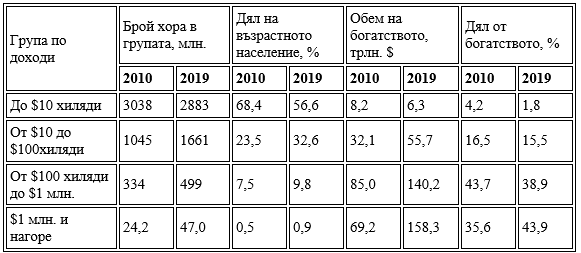
*Total wealth in 2010 was $200 trillion, and in 2019 - $360.6 trillion.
Source: Global Wealth Report 2010. Credit Suisse.
Global Wealth Report 2019. Credit Suisse.
https://www.credit-suisse.com/about-us/en/reports-research/global-wealth-report.html
The growth of property inequality and the increased concentration of wealth are direct consequences of state interventionism. The first and largest recipients of the new money have become the “too-big/important-to-fail” companies, including powerful financial organizations. Taking advantage of property indulgences from the government, immune from bankruptcy, applying discriminatory measures, the representatives of the “Big Business/Big State” union are actively developing their thesis about the immorality, injustice and inefficiency of the current situation, offering their solutions – a global Leviathan to fight capitalism and the selfish interests of business.
The Great Depression of 1929-1932 in the USA legitimized and formed a national government of general interventionism. Then the level of state intervention was significantly lower than today. The Great Depression of 2020-20... threatens to form a Global Government of general interventionism. Undoubtedly, the greatest contribution to the degradation of the West and the deepening of distrust in national and international institutions is made by Russia and China. Their information and hybrid wars, corruption schemes, active use of "useful idiots" to discredit political and economic foundations, are designed to form beliefs among the population of the whole world that "everyone lies", "all governments are bad", "all business is corrupt", "good/evil is relative", "wealth is theft", "I am being exploited" and "money is evil".
Today, this powerful force is encroaching on Freedom, promising people around the world stability, safety, and protection from known and unknown threats. The architects of the new model of the global Leviathan rely on the crisis of trust in national authorities, phobias of “global threats,” ignorance of the true science of “economics,” socialist thinking regarding the concepts of “freedom” and “private property,” and an acute shortage of moral leaders and authorities. Unfortunately, it may turn out that the global Leviathan uses modern technologies (robots, artificial intelligence, 3D printing, Big Data, 5G, augmented/virtual reality) not to increase good, but to tighten control.
Translation: Marina Zaharieva