EKIP– Expert Club for Economics and Politics A Different Opinion
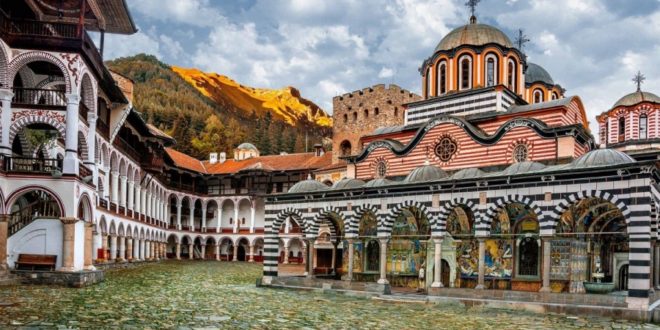
The Rila Monastery will receive over half a million leva as a state subsidy, it became clear in news from the beginning of June. In typical government style, a sensitive and popular topic related to one of the most important sites in Bulgarian history and culture was immediately resolved through unclear procedures by Prime Minister Boyko Borisov. Did the Rila Monastery have a financial problem? We will give it money. After all, that's what the state is for, to help.
Let's get this straight from the start. The Rila Monastery is indeed a central and extremely important site of Bulgaria's cultural heritage. Undoubtedly – one of the most important and undoubtedly one of the top 10 World Cultural Heritage sites. And it is valuable not only as a material object, but also as a symbol of some ideals embedded in our culture – but more on that later.
In this sense, support for the problems of the Rila Monastery is not a bad thing; what is bad is how and where it comes from. The clarification is for all non-right-wing people who have come across this text and for whom any criticism of a given action of the state (for example: "The state is increasing money for education") is taken as criticism of the action itself ("Oh, so you are against more money for education"). The case with the Rila Monastery is identical. Because there are alternatives for help. And it is enough to turn to the ideals of the Bulgarian National Revival, of which the Rila Monastery is one of the many material symbols.
Let's go back exactly 200 years. During the previous century, the Rila Monastery was the subject of a number of attacks by all kinds of gangs, looted and burned. The Turkish authorities imposed arbitrary fines, and the monastery itself suffered financially from inappropriately taken loans from moneylenders. Gradually, however, the monastery returned its loans. The situation stabilized and the monastery managed to begin a number of large-scale construction projects.
The monastery uses its property to the maximum. In addition to income from its own properties, they also manage to benefit from charitable activities throughout the country. Metsis are created throughout the country, which, in addition to housing the taxidiots (simply put – the collectors of donations), also develop independent economic activities, the proceeds of which also go back to Rila. The visit of pilgrims to the monastery itself and its immediate surroundings also brings income.
Thus, the monastery was gradually built into the form it is in today. These are the residential wings, the accompanying buildings and, of course, the central temple "Assumption of the Virgin Mary".
An interesting fact is that by 1830, an earlier, medieval church existed on the site of today's building. How exactly it looked is the subject of professional discussions, but what is more interesting is that its merits were appreciated by some of those responsible for the monastery - monks and laypeople. It was destroyed, but after many years of disputes whether and how it could be preserved, restored and renovated. Our idea that people 200 years ago did not think about cultural heritage is a bit superficial. Certainly, the idea of authenticity and methods of preservation were different, but the idea that an old object has its own cultural and historical value existed. And it was alive because of the ingrained idea that this object carries some kind of material and immaterial memory, and not because of a few conventions and regulations.
However, the decision was "made" when a fire broke out in the early 1830s, destroying the old church, after which the current one was built. And today's temple was a huge and extremely expensive undertaking. Not only the construction, but also its furnishing with the most exquisite iconostases, the most beautiful paintings. Just the efforts made to find and choose the highest quality possible icon painters are inspiring for today's listener.
The funds were collected from the usual revenues of the monastery mentioned above, but also from much larger donations from wealthy Bulgarians from all over the country. Leading among them, for example, were members of the wealthy Chalakov family, who at the same time were busy allocating funds for Bulgarian churches in Plovdiv and a Bulgarian school, the Doganovy family, who were also busy with donations for churches in Koprivshtitsa, etc., etc. The fact is that some of them took advantage of the state structure - most of them got rich through trade or various types of production, but some of the richest were tax collectors for the Ottoman treasury. But in the end, they used the economic opportunities and situation for the emancipation of the Bulgarian people - education and culture.
Thus, in the 19th century, the Rila Monastery was rebuilt after its difficult previous century. With the exception of the Hrel Tower, what we can see there today is the result of this development. Of the good management of finances and of the active attitude of the Bulgarian people, albeit under Ottoman rule, towards their sanctuary.
The situation, although 200 years newer, is not extremely different. There are devotees. There are properties. Donations can be made – small or large. They used to draw, and they paid off loans, and now they can.
If the usual financial activity does not bring in enough revenue for the planned expenses, are the Bulgarian people ready to help? And is the financial activity itself adequate enough? We can hardly understand. Because when a problem arises, the Prime Minister comes and saves the monastery. We have no way of seeing whether this revival spirit, in which people actively organize and help something they find sacred, exists at all.
And if it doesn't exist - with such behavior it will never appear. Because if everyone waits for someone else to help, no one will ever take matters into their own hands. Of course, this is our money again - Borisov doesn't take it out of his pocket - he takes it out of our pockets. After it has gone through several levels of bureaucracy to provide the salaries of the state administration. But this is also the most difficult problem: both today and 200 years ago, we pay. But 200 years ago, people knew that they were helping. They allocated their own money to give it to what they care about. For the local church, or for the local school, for the local "hospital", i.e. hospital, for the community center, or the museum (the first, albeit primitive, museums in our country are precisely from the Bulgarian National Revival). And they felt close to what they allocated for.
Today we allocate for the state administration. And if the political power that controls the state administration is in the mood, it can allocate for something more meaningful than its own salaries. And in the end, we have both paid for the repair and existence of the Rila Monastery, and we have no feeling that we have done it.
Thus the ideals of the Bulgarian National Revival were killed. Today, people do not come together for private interests to build a local school, a local community center, or a national monastery. Today, we are forced to pay a government with an army of a huge bureaucracy that supposedly does this better than us.
And there is money – it seems that Bulgarian society can pay for the restoration and maintenance of the Rila Monastery for 600,000 leva, plus a lot more money for all levels of bureaucracy and politicians from the contribution to the National Revenue Agency to the monastery’s bank account. The revival of the Bulgarian Renaissance ideals will be to demand back this forcibly taken money and to pay this 600,000 leva ourselves, and not a penny for bureaucrats and politicians.