EKIP– Expert Club for Economics and Politics A Different Opinion
(The Agitation for Happiness or How the Federation of Servile States Came into Being) [1]
Krasen Stanchev
"Success is going from failure to failure without loss of enthusiasm."
(Winston Churchill, 1941)
“The more the state "plans", the more difficult it becomes for the individual to plan”
(Friedrich von Hayek, 1944)
The year
2022 is one of the most terrible in terms of uncertainty and risks since the Cuban or Caribbean crisis, when the world is on the brink of nuclear war. There has been no international conflict in Europe like the aggression of the Russian Federation against Ukraine since 1945. Truly significant aggressions like the invasion of Soviet Russia and the Warsaw Pact in Hungary and Czechoslovakia did not generate full-scale resistance and did not develop into wars, and the world perceived them as an internal imperial work of the USSR. The same was the attitude towards the wars in the Yugoslav federation.
Against this background, the political language and self-confidence of the European Union are not amenable to a change towards more realism, if not elsewhere, then at least in economic and monetary policy, although behind the rhetoric there are glimpses of a rejection of previous irrational policies.
In Bulgaria, the efforts to compensate everyone with taxpayer money for everything that the uncertainty of the last two years has brought them, if by some chance they are not stopped by circumstances, will end up eliminating the achievements of the last 25 years - a currency board, a ban on financing the state and banks with monetary policy funds, balanced budgets, membership in NATO and the EU, and an equal income tax for all, with built-in incentives for more work and business.
Elections and internal political rivalries are leaving important changes in the European Union unattended.
The discussion of the "Next Generation EU" is being conducted with typical amateurishness that has been ingrained in the public consciousness for a decade and a half. At best, it is thought that "we will take some money" and invitations for discussion in morning advertisements on state radio, paid for by the European Parliament.
A premonition
Feeling that the referendum in the UK will take the kingdom out of the Union on June 22, 2016, I felt compelled to share the following warning.
"However, the most important question remains: will the EU continue to function in the way we know it, regardless of whether the British vote "for" or "against" the EU. As with any established situation, the general rule applies to the EU: when you go further and it gets worse, or when you go further and it gets better."
Observing the election of the current European Parliament and Commission, including the collective approaches imposed on the Union to the collective management of economic life, including the “Green Deal”, I am increasingly convinced that the first option is unfolding – it goes further and gets worse. The process has its explanations. They are also not new – the Union has long functioned as a political organization that has fallen into the “Prisoner’s Dilemma”. And it is this tradition that caused Brexit and gives rise to the following far from entirely amusing trends.
Language and the campaign for happiness in the EU [i]
The Union has a minister (commissioner) for "an economy that works for people", with at least (depending on how you count) sixteen supervisory competencies - from SMEs, through monetary policies, the ECB, EIB and EBRD and investment and trade, to climate change, the "green plan" (or "deal") and protection of working EU citizens.
It requires special research into why, at whose idea and in what environment the very name of the portfolio Commissioner Dombrovskis appears. But in the older generation of member states like Bulgaria (or at least in those who deal with the history of the recent past) it should awaken allusions to Nikita Khrushchev's slogan from 1956: "Everything in the name of man, everything for the good of man". This slogan then became the cornerstone of the propaganda for communism and the agitation for happiness in Bulgaria and in other communist regimes in Europe. For a long time, the politically incorrect comment that "yes, indeed, we even know who the man is" also took root in our country.
If you look at the names of the EU directorates (ministries) - the impression is also that everything is for the good, each name is to instill in the voter a kind feeling of the care of the Union's bodies towards him and his successors for an indefinite time to come.
Or to take the names of the party factions in the European Parliament - my favorite liberals now sound like "renewable energy sources", suggesting a renewal of Europe on the example of what is currently understood as such a source - sunlight, wind and biomass. Although the Union and "Europe" are ultimately a human creation, not a natural phenomenon or a given.
This suggestion did not arise by chance: when years ago the German liberals approached rationally in one of the election campaigns the proposals for "green" policies, they suffered one of the most significant failures in their history. Of the names of the parties (about 200 from all member states), whose representatives became deputies in the current parliament of the Union, the most obvious is perhaps the name of the "Communist Party of Bohemia and Moravia". (Now it has one deputy, Mrs. Ekaterina Konechna, before there were four and very active.) In general, it is extremely difficult to orient oneself as to what exactly is meant behind the names of the primary parties of the European parliamentarians. Even if you understand, it is a non-trivial task to explain it to a foreigner. With "DPS" it might work, but with "VMRO" it is almost impossible. The situation is similar even with some ruling parties. Not only from Bulgaria.
Another striking example is, of course, "The Next Generation: COVID-19 Recovery Package". It is now clear that the recovery will certainly occur before the subsidy package becomes available in any significant volume. And it is far from certain that, when it does, the effects will be positive.
The “next generation” has been included in political rhetoric in the post-election period. The timing of the emergence of political names and slogans is never accidental.
"Fight"
Before the “next generation”, politicians with the EU “fought” for higher competitiveness of economies (for which their help is mostly an obstacle), with climate change and with the COVID-19 pandemic. The pandemic proved that there are more urgent public tasks than expectations of a climatic end of the world. Even for a moment, this end was forgotten. The “fight” with the pandemic in Bulgaria even received a personal illustration: COVID-19 was targeted with daily appearances by people in military uniforms, representatives of the “headquarters” created specifically for this fight.
The word “struggle” and its derivatives give visibility to a certain heroism and even determination, which in political circles do not arise by themselves and require enormous skill to recognize the real problems and the right political solutions for society. [ii]
"Fight" usually acquires more intensive use in a pre-election environment. Because it contains the message of heroic opposition to other candidates for elected office. However, the objects of struggle are not the enemy candidates, but the windmills of obvious or imaginary social and economic problems. Even if there are no obvious problems, they must be invented. Otherwise, the competition of the fighting parties and candidates has no meaning, object and orientation.
This explains why in political economy there is a seemingly strange regularity, first noticed, if I'm not mistaken, by Walter Williams: politicians more easily take harmful and reckless actions than those that would have a positive meaning for many.
Investing State and Regulatory Socialism
For Bulgaria, “fight” also has historical connotations to the period of emergence and redistribution of markets between various sellers of protection and nuisance services to motivate payments. These sellers were called “fighters” and their emergence was somewhat natural. [iii] But it is perhaps strange that despite this historical semantics, politicians now fight for everything and everyone.
One way or another, during the fight against the pandemic, governments do nothing special. The political virology of 2020-2021 shows that, first, what they are doing is not something new and that, second, their policies are characterized by some typical inefficiency, except perhaps in solving logistical problems of collective action (such as quarantine practices and isolation of the sick). The situation is practically the same in other countries of Central and Eastern Europe during these two years. The only difference is in the exceptional mortality rate, which is high in all these countries, but in a global dimension Bulgaria is second only to Peru.
In reality, the most accurate statistic is that of mortality. For the simple reason that people cannot be a little dead.
As Petar Ganev first noticed, the mortality rate for 2021 is one of the worst in the entire history of Bulgaria, with statistics practically the same as in 1918 (with war, cholera and Spanish flu) in terms of absolute (number) and relative mortality indicators. But without population growth.
There is more clarity in the promising "Just Transition Mechanism: Ensuring No One is Left Behind".
This is the political instrument that closes coal-fired power plants in order to replace their fuel with natural gas. Gazprom benefits from this venture, with over 41% of natural gas supplies to the Union at the time of the mechanism’s creation. For some countries, the percentage is twice as high. But this circumstance, according to the “just” transition, does not matter much, because according to the plan it will be only a temporary replacement for coal and in eight years there will be another transition.
In 2022, it turned out that this "transitional resource" for the "Green Deal" was nothing more than a) a cross-subsidy to finance the Russian Federation's war against Ukraine and b) a fiscal illusion of a low resource price, which is paid at levels that neutralize previous false "profits."
The well-intentioned EU cannot work in any other way than as an investing state. In fact, it has been working like this until now, only the scale is expanding. At first glance, by a small amount, because there is a ceiling and a stated adherence to the principle of “no expenses, no income”. According to the decision of the World of the Union from December 2020, the ceiling on the contribution of member states increases from an average of 1.26% of gross national product (GNP) to 1.43% of the respective annual GNP.
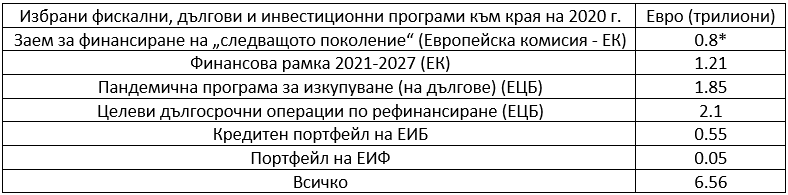
Sources: EC, ECB and EIB. *Incorporated in the Financial Framework but raised on sovereign debt markets.
The very name of the policy "next generation" is part of the happiness campaign.
Otherwise, in sociology, "generation" is a construct that appeared in the mid-1860s, denoting people existing at relatively the same time, considered as a collective, possibly distinguished by some (possibly) arbitrarily and abstractly selected criterion. For example, the generation "of" electricity, the era of atomic weapons or the Cold War, 1968, the new millennium or the Internet.
Empirically and in life, generations are mixed and overlap, remaining relatively categorically distinguishable only within the family, small groups and organizations. In these cases, it is conventionally assumed that the generational cycle is 25-30 years. As far as I can tell, in the case of the EU, “generation” is used for the first time as a characteristic of an international treaty and an alliance between states. The idea is clearly to denote some kind of reciprocity and community.
In its current form, the EU has existed since 1999-2004, from the process of preparation and formal membership of the countries of the former CMEA, Cyprus, Malta, etc. A distinctive feature of the current change is that it is carried out not by amending the treaties and criteria for membership, but through changes in regulation, monetary and fiscal policy.
In its original form, the EU, i.e. the European Economic Community, had the function of saving the nation-state. It reserved pure politics – direct income taxes, social policy (including pensions, education and healthcare), the army and justice – for nationally elected politicians, governments and leaders.
Financing the "Next Generation"
I cannot offer an analysis of the financing of the so-called "European Green Deal" here for now. It is in a pending state and will probably not be implemented as conceived and promised. And, of course, it will not have a significant positive effect on the global climate, even if it is implemented according to the original plan. But this is a topic for a separate analysis.
To finance the Next Generation, the Union needs new tax revenues. In 2021, there is only one new tax, a kind of fine, determined by the assessment of the tonnage of non-recycled plastics in the Member States. However, it should be noted that in the next five years at least four more taxes will be introduced and the process of discussing the draft directive on a “European MRP” has begun. [iv] The calls for and theoretical reflections on what new European taxes should be and how they could be introduced without violating the Treaty on the Functioning of the EU are a huge and independent research task.
Regarding the role of the central bank, it should be noted that the two ECB programs mentioned here do not exhaust all of the ECB's mechanisms for "pumping" liquidity into the EU economies. According to colleagues Gordon Kerr, Bob Lydon and Enrico Colombato, the total effect of the ECB's channels of influence is equal to 25% of the eurozone's GDP. Their conclusion is as follows.
"European federalists may not be happy at the moment that the direction of the Union seems to be towards the creation of a European superstate, but we still warn that this vision remains far in the future, while attention should now focus on the dangers to the European economy of printing money on such a scale and masking the problems in the banks through this ECB policy."
It is obvious that the policies indicated in the table are stretched over time, for example, the issuance of debt by the EC has a horizon of 40 years. But it is also obvious to me that the de facto Commission, with the approval of the EU Council, i.e. the heads of the executive branch in the member states, does not simply have at its disposal the limited 163-185 billion euros per year, as stated in the financial framework until 2027, i.e. the correspondingly small percentage of GNP. In fact, the incomplete calculation in the table tells us that, as a political principle, these EU bodies and banks will directly influence 5-6% of the GDP of the entire Union every year. The indirect influence is more difficult to predict. But it is also likely that most of the innovations in the fiscal and monetary functioning of the EU from 2020 and 2021 will be preserved beyond the term of the multiannual financial framework, beyond 2007. At least until the time of the next “EXIT.”
The policies of the Commission and the Council, usually imposed through regulation of individual sectors of economic life, rather than fiscally, are supported by the ECB and the EIB with the issuance of money and investment. In May this year , Nikolay Nenovski and Eric Magnin called this mechanism “soft monetary constraints” (SMC).
The conclusions from their analysis are non-trivial and multidirectional, but it is worth pointing out at least the following.
- IGOs, regardless of the tax and fiscal policy of individual member states or the Union, give rise to phenomena that are characteristic of the lack of hard budget constraints and give rise to unforeseen consequences, close to the deficit economy, but expressed in low efficiency and comparative uncompetitiveness;
- This effect of the IGO gives rise to a tendency towards the growth of government debts and contradicts the criteria for the stability of the euro and membership in the euro area;
- Although not entirely, the ECB’s policy resembles what was stated in point 5 of the economic program of the Communist Manifesto of 1848, which states: “centralization of credit in the hands of the state through a single national bank with state capital and an exclusive monopoly.” [v] In a milder version, it resembles the mono-banking systems of the CMEA countries.
Similar to the ECB, the EIB is becoming a bank for the development of politicians' ideas. For example , by 2025 it should become a "Climate Bank". The EIB is currently not financing projects that do not comply with the correct regulatory goals. What is more important, however, is that this "development" bank is merging with or uniting in common projects practically all national development banks, all BDBs of the EU. In the period from 2007 to 2014 alone, the EIB's portfolio doubled, while the German development bank KfW only grew by 40%. (The rule is that small such banks grow much more significantly, as is the case with the Finnish bank and the BDB.) The reason is that according to the "Juncker plan" the administration of EU projects by the government administrations of the member states is bypassed in this way. If the general or national recovery and development plans stall or prove to be a factor in corruption, many of their initiatives will be transferred to the EIB.
All this will be under the expert supervision of the Commissioner for an “economy that works for people.” In the meantime, it is the people who will become more dependent on the political structures of both the Union and the member states.
The servile state as a winner
For those who don't know, the servile state is a term from political economy and political philosophy, introduced by Hilaire Belloc in 2012, further developed by John Anderson at the end of World War II and reinterpreted in 2009 by Kenneth Minnock as the erosion of moral norms by the means of democracy. The main thing about it is that when you intend to do something, you have to queue up to receive permission and/or funding from the government or someone with a privilege established by it. This does not necessarily have to be done out of obligation or coercion, it is enough that there are incentives for such opportunism and that it is likely that "if not me, someone else will get a subsidy", a hidden interest rate or a lower price.
Without burdening the reader with references, here is an overview of how the EU, through the "New Generation" and other "measures" and "instruments", acquires the qualities of a servile state.
- The amounts indicated in the table, probably almost a trillion euros per year, are precisely an incentive for economic and political opportunism.
- In the EU in 2020, there are only four countries with a GDP (calculated at current prices) over one trillion euros. From Europe, we should add Great Britain and Russia to them. Separately, there are six countries in Europe with a GDP over 0.5 trillion euros. (Among them are Switzerland and Turkey.) Separately, in the EU there are ten member states whose GDP is below the amount that the European Commission allocates per year, and in Europe there are 29 countries in this situation.
- With such a volume of fiscal and monetary incentives, it is impossible not to distort the money and incentives for individual countries, businesses and civil society structures, including political parties (regardless of whether they govern or not).
- In order to make everything happen, the governments of the member states must be bribed either with large transfers from the EU relative to GDP for "recovery and sustainability" (Croatia and Bulgaria are leading here), or with large-scale debt purchases by the ECB (Germany, France, Italy and Greece are in first place here).
- This balance of large and small "beneficiaries" of the EU seems extremely unstable, although the timing of the unfolding processes of uncertainty, "boom" and economic decline are difficult to predict.
- The main economic effect here is that of crowding out: when you queue up for subsidies and subsidized credit, you are not using your own or market-available resources. Since not all of them can be financed, investments that would have taken place under other conditions are either postponed or never made. This effect is subject to calculation, but so far no one has bothered to do so. In fact, for about a decade now, calculations of the economic consequences of EU regulatory policy have been of steadily deteriorating quality.
- The likelihood of the creation of state-owned companies and the expansion of the volume of public (state and municipal) procurement is increasing – currently probably around 2.7 trillion euros (which should also be added to the table above). As is the likelihood of the spread of the well-known “Gordon Tullock Auction” in our country: everyone pays, but one wins, who may not even have paid.
- The Union increasingly resembles a political body that operates on the model of the "Prisoner's Dilemma". The competition for privileges encompasses both political leaders, parties and bureaucracy, and citizens, voters, their organizations, including companies. Although cooperation and information exchange have some abstract meaning (and benefits), each tries to live at the expense of the other or at least prevent him from doing the same. This behavior is rational, because each expects the other to be the first to benefit from the imposed regulations and policies. The spontaneity of cooperation and social order decreases, creativity and initiative are somehow punished, the economy begins to be perceived as a zero-sum game, and "democracy" is decisions imposed from the top down.
- Public problems begin to seem solvable only with better and more science-like state governance. (For example, one can assume that the EIB will solve most of the problems of recovery and sustainability plans.) Somewhat mutually contradictory, but very harmful principles of state governance from the 1930s in the USSR and Germany begin to be imposed – on the one hand, “personnel decide everything”, and on the other – “there are no irreplaceable people”. The limitation of personal initiative (the private sector is not forbidden, but only financed with taxpayers’ money) and the need for projects to appear risk-free strengthen the desire to present policies as indisputable scientific ideas.
The "state" does not trust the people, but politicians promise them a risk-free existence
In order for policies conceived at the "European" or national level to develop, governments in servile states must not and do not actually trust the people, must not like what people eat, drink, smoke and inhale (see the Nanny State Index ), what and how they think, speak, dress or what behavior they follow.
For all this to happen, people are asked to be voters who believe that the state, i.e. the currently ruling politicians, can provide them with a 100 percent risk-free existence in the conditions of a slowly approaching end of the world.
In 2020-2023, this claim to politics, parties, and governments taking care of everything has clearly taken root in the public, political, and economic life of not only the European Union.
Most recovery and resilience plans have a built-in mechanism of servility: beneficiaries must demand participation in the projects from state authorities and politicians. The latter are the practical owners of their countries. This fact is often forgotten, but it is the real driver of asserting national sovereignty – the “owners” want them to distribute the common resource for the European Union.
In other words, programs and budgets like the "New Generation EU" fuel patriotism based on corrupt redistribution and can themselves become a factor in the collapse of the Union.
[1] This is an expanded and expanded version of the article first published in Economic Life on August 2, 2021. The text is based on my short lecture delivered online in Tbilisi on April 20 (in memory of Kakha Bendukidze ) and in Stockholm on June 10, 2021 to Svensk Tidskrift on the topic “The Unintended Consequences of Regulation: What Has Been Forgotten from the Experience Before 1989”. This version has been deliberately revised by the author for publication in EKIP.
[i] "Agitation for Happiness" is the name of an exhibition at the Russian Museum in St. Petersburg of the art of the USSR from the 1930s to the 1950s, held in early 1994. The exhibition presented paintings, music, theater sets and photographs (usually with explanations and commentary under the exhibits) from the period from the end of the New Economic Policy, the first five-year plans, forced industrialization, starvation, the expansion of the Gulag, purges and persecutions, the war and the post-war period of Joseph Stalin's rule. Based on the materials from the exhibition, of which probably a third became available to the general public for the first time, also in 1994, a book was published (in Germany, Sweden and Russia), which today is a bibliographical rarity and an exceptional testimony to the discrepancy between life and propaganda.
[ii] The Coase Theorem of Nobel laureate in economics Ronald Coase follows that economic policy, power can change things for the better only if it reduces transaction costs, i.e. if a way is found to reduce the costs of a) information, b) the exercise of property rights and their derivatives, and c) disputes over the exercise of these rights.
[iii] One of the good reconstructions of the period of the rise of the wrestlers is given by the following dissertation: Petrunov, Georgi Svetlozarov. Social dimensions of organized crime: Organized crime in the period of transition / Georgi Svetlozarov Petrunov; Scientific [supervisors] Krasen Stanchev, Duhomir Minev; [Rec. Valentina Zlatanova, Georgi Dimitrov]. - Sofia, 2006. - 256 p. : with tables. ; 30x21 cm
Proposed by the Bulgarian Academy of Sciences. Institute of Sociology. - Defended before the Bulgarian National Council of Sociology, Anthropology and Cultural Sciences, 25.01.2007. - Approved by the Higher Attestation Commission with protocol N 12-6/02.04.2007. - Printed edition - Bibliography at the end of the text Appendix: Abstract40 p. Abstract; 40 p. 21 cm.
[iv] A minimum wage is the imposition by force (i.e., by law and the threat of violence if it is not complied with) of an amount of remuneration, of income that is not produced but must be set aside by people who produce something that provides income. This is perhaps the most accurate definition of this wage.
But it is neither an economic, nor a social, nor a humane way of solving any problem.
The proof can be found even in the Bible, in the New Testament.
Let us read what is said in the Gospel of Luke (3.11), where John says "let him give the second shirt" etc.
Regardless of the translation options, the text suggests:
- a) that it is a matter of advice, not of taking away by force,
- b) that there is a certain surplus of shirts,
- c) that the shirt must have been manufactured or purchased first,
- d) that what is happening must be in good faith.
In no case is it about the use of violence. John says the same about food, the conversation is also about taxes, etc.
Both the Old and New Testaments are very clear on this and many other similar occasions. And there is no significant difference in this interpretation of helping one's neighbor if we compare what is said in the Gospel with the understanding of public care and assistance from non-Christian religions and civilizations.
[v] For lovers of the history of ideas, I should mention that almost all points of this program are being propagated and implemented as a political salvation in the twentieth century and in our days, here is the full text of this part of the Communist Party Manifesto: "in the most advanced countries the following measures can be applied almost everywhere: 1. Expropriation of landed property and use of the land rent to cover state expenses; 2. High progressive taxation; 3. Abolition of the right of inheritance; 4. Confiscation of the property of all emigrants and rebels; 5. Centralization of credit in the hands of the state through a single national bank with state capital and an exclusive monopoly; 6. Centralization of all transport in the hands of the state; 7. Increasing the number of national factories, of the means of production, increasing and improving arable land on a general plan; 8. Compulsory labor for all, creation of industrial armies, especially for agriculture; 9. Unification of agriculture with industry, measures for the gradual elimination of the antagonism between town and country; 10. Public and free education for all children. Abolition of factory labor for children in its present form. Linking education with material production, etc.