EKIP– Expert Club for Economics and Politics A Different Opinion
What does Trump's return mean for Europe's economic future? In a word, difficulties. Donald Trump's return to the White House poses a serious challenge for Europe, which is heavily dependent on the United States economically. Trump is expected to adopt a significantly more aggressive approach to trade and economic policies, which could lead to the introduction of high tariffs and other restrictive measures on European goods. In addition, the new US administration is likely to be more focused than ever on stimulating innovation and improving the competitiveness of the American economy. In this context, the European Union will have to adapt quickly or fall further behind its overseas "partner".
Trump has repeatedly threatened to impose large tariffs on European goods. This is very likely to happen. The consequences for Europe of a 10-20% tariff on all exports to the US would be very severe. Even if Trump does not carry out his threats in full, but chooses a more selective approach, EU industrial exports will certainly be affected. This is a big problem. The EU's trade surplus with the rest of the world in 2023 is 38 billion euros. This is entirely due to the huge exports to the US, which is the largest market for EU exports with a nearly 20% share. The EU's trade surplus with the US alone is 155 billion euros in 2023. In other words, it is the reason the EU has a trade surplus at all.
With China, another key external market, the EU has a trade deficit of nearly €400 billion. Accordingly, if Trump imposes even a fraction of the tariffs he has threatened to impose, the EU’s trade surplus will collapse. This means that the economic problems experienced in recent years by export-oriented economies such as Germany will deepen. The economic stagnation is likely to escalate into a full-blown economic crisis.
Beyond the rhetoric, the reality is that the EU is in no position to retaliate appropriately. About a quarter of EU imports from the US are energy - especially liquefied natural gas. Europe cannot afford to impose heavy tariffs on US energy imports because there is no alternative. In the past, Russia would have been such an alternative, but due to the breakdown in diplomatic relations with it and the sanctions imposed on it by the EU, the situation is now radically different.
Germany has been pursuing a frankly insane energy policy for decades, closing its nuclear power plants and making itself increasingly dependent on imported natural gas. Germany's heavy industry, which is its economic core, is extremely energy-intensive. At a time when there is no reliable source of cheap energy, the entire economic model of Europe's largest economy is beginning to shake to its foundations. The green transition could have been a transition not only to a carbon-free Europe, but also to a Europe without external energy dependence, regardless of whether we are talking about the US, Russia or the Middle East. This could have happened by making the development of nuclear energy the number 1 priority in the energy transition process, but it should have happened decades ago.
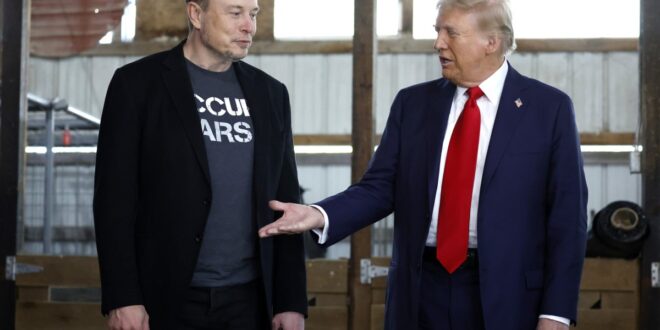
But that’s not even the whole (unpleasant) picture. One of the biggest differences between Trump’s campaign this election cycle and the previous two has been the tech industry’s attitude toward him. Traditionally leaning toward the Democratic Party, many of the most successful tech entrepreneurs in the US, led by Elon Musk, have sided with Trump this time. Musk has even become a de facto member of Trump’s campaign team in recent months, regularly appearing at his campaign events. This is indicative of Trump’s own shift in focus on economic policy.
In fact, it may be more accurate to speak of a broadening of focus than a fundamental shift. While Trump’s economic messages in 2016 were almost entirely focused on trade protectionism, this time deregulation and innovation are also coming to the fore. During the campaign, Trump regularly spoke about the need for deregulation to stimulate innovation. He also repeatedly mentioned the need for more investment in nuclear energy, in parallel with a relaxed regime for oil and natural gas extraction. In an appearance on Joe Rogan’s podcast, Trump spoke at length about the potential of nuclear energy and the need to ease the regulatory regime that is a major obstacle to its development. As part of his campaign, he also promised to repeal the regulations that the Joe Biden administration imposed on the newest and fastest-growing segment of the digital sector – artificial intelligence.
Meanwhile, Elon Musk was agreeing with him and going into even greater detail about the actions that the US government needs to take to improve the productivity and competitiveness of the American economy. And if Trump may lack enough specific knowledge to carry out the most optimal deregulation program possible, Musk certainly has a plan. It is no coincidence that he even proposed the creation of a new unit to optimize the work of the state apparatus. In recent years, the Tesla and SpaceX founder has gone from being a darling to the most hated businessman in the mainstream media in the US, but let's not fall into stupid delusions simply because of the evolution of his political positioning.
He is perhaps the most successful high-tech entrepreneur of the 21st century. One of his companies is the main reason why the United States still has the most developed space program in the world, and another of his companies is the reason why electric cars are a successful consumer product with a global market. It would be a mistake to underestimate his abilities, as well as his likely enormous influence in the new Trump administration. American journalists from CNN say that Musk has been spotted at Mar-a-Lago with Trump every single day since the election, while the new president is making decisions about the composition of his future administration.
All of this means that the new US administration is likely to pursue policies that prioritize innovation, productivity, and the competitiveness of the American economy above all else. Unless Europe wakes up and follows a similar approach, the old continent is doomed to fall even further behind its “partner” across the Atlantic. The overregulation, lack of innovation, and neglect of the strategic importance of energy independence (and the role of nuclear power in this regard) that the EU has suffered from for decades will now be more damaging than ever. If Europe does not adapt, its backwardness will deepen and make it even more dependent on America.