EKIP– Expert Club for Economics and Politics A Different Opinion
A week ago, it was exactly 30 years since one of the biggest one-day crashes in financial markets in human history – the so-called "Black Monday". On October 19, 1987, stock exchanges around the world lost a huge percentage of their capitalization in just a few hours. By the end of the month, stock markets in Hong Kong, Australia, Spain, the United Kingdom, the United States and Canada had lost 45.5%, 41.8%, 31%, 26.45%, 22.68% and 22.5% respectively. How did the biggest correction in stock markets since the Great Depression come about, and what lessons can we learn from its history?
Did a computer error cause the 1987 crash?
The most common theory explaining the massive correction is that it was a consequence of the advent of computerized trading of financial instruments. According to this theory, what caused the collapse of the markets was the massive sell-off of stocks by the automated trading programs of the newly introduced computer systems in the 1980s. The irony is that the function of these automated trading computer systems was to hedge investments against risks. That is, to protect investment funds from potential losses. The systems were programmed to start liquidating stocks when certain levels of loss were realized.
The stock market crash occurred precisely when, on the morning of October 19, these predetermined loss levels were reached and the systems began to liquidate long positions and sell shares en masse. However, the main mistake of these programs was that they assumed that liquidity levels would remain constant. Therefore, the risk of causing a stock market crash was not taken into account, and thus the massive sell-off and panic buying were triggered.
However, this is only a technical and partial explanation that cannot paint the whole picture. The main question is not why the massive sell-off of stocks and closing of positions by automated computer systems occurred. The main question is how such high losses were realized from investments in stocks that the automated selling was triggered? Here we are no longer talking about a computer error based on incorrect programming, but an error in the monetary policy of the US central bank.
Black Monday is the result of a bubble in the stock markets
The financial market crash of 1987 was actually a natural correction of the bubbles in the economy and financial markets that had formed in the previous years due to the expansionary monetary policy of the central bank. In practice, this crash is a typical illustration of the business cycle and its unfolding, as described in the Austrian business cycle theory, developed to the greatest extent by the economists Ludwig von Mises and Friedrich Hayek.
Chart 1: The Dow Jones Stock Market Correction in 1987
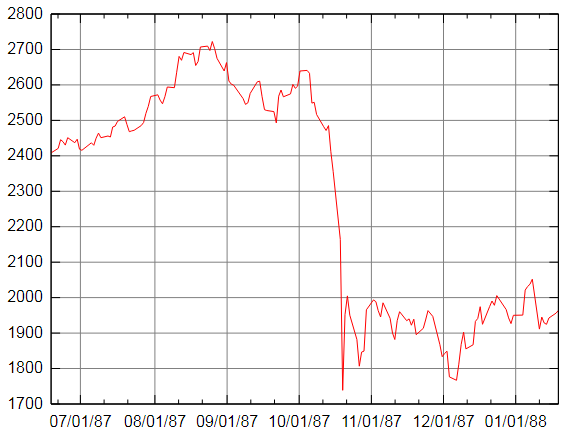
Source: Wikipedia
The story of Black Monday begins a few years before 1987, back in 1982, when the US economy was in the midst of a very serious crisis. At that time , the Federal Reserve (FED) undertook a policy of very serious increase in the money supply (i.e. printing money) in order to get the US economy out of recession. With short breaks, this very liberal monetary policy continued until 1987.
How does this bubble form?
It should be noted that the pace at which the Fed printed money during this period was unheard of since the years before the Great Depression. However, the central bank's policy did not lead to hyperinflation or even a more serious acceleration in price growth. During the period 1983-1986, the consumer price index increased at the following annual rates: 3.8%, 4.0%, 3.8%, and 1.1%. The inflationary effect that the Fed's monetary policy had on prices during this period was dampened by the following factors:
- The increase in the productivity of the world economy as a result of the ever-wider spread of higher technologies. The spread of higher technologies in agriculture in particular leads to strong growth in the productivity of this sector and a corresponding decline in food prices. The higher productivity of the world economy and, accordingly, cheaper imports reduce the level of inflation in the United States.
- In the early and mid-1980s, Western Europe was recovering very slowly from a recession, resulting in relatively low demand on international markets for basic commodities such as oil, industrial metals, and some consumer goods such as food. At the same time, developing economies were increasing their production of such goods in order to stimulate their exports and accumulate foreign exchange reserves, mainly dollars, with which to finance payments on their government debts. This combination of factors led to a decline in the prices of the aforementioned categories of goods.
- The temporary breakdown of the OPEC and ITC agreements in the 1980s led to an increase in oil and tin production and a corresponding decline in their prices.
The combination of all these factors means one thing: cheaper imports for the United States of a number of key goods, which blunts the rate of inflation within the domestic economy. However, this cannot continue forever.
Inflation is returning and the dollar is depreciating
In the early years of the economic boom from 1982 to 1985, the dollar appreciated significantly against other global currencies such as the Japanese yen and the German mark, peaking in February 1985. This appreciation of the dollar was due to the fact that while inflation rates in the United States were similar to those in Germany and Japan, interest rates were significantly higher. This attracted a significant amount of foreign capital and led to the appreciation of the US currency.
However, in early 1985, the first signs of inflation appeared in the United States due to the Fed's attempts to reduce the US trade deficit by deliberately devaluing the dollar against other currencies. As a result, in the approximately two years from February 1985 to April 1987, the mark rose by 7.42% against the dollar and the yen by 75%. During this period, the dollar lost about 40% of its market value against a basket of key international currencies.
The Fed reverses the direction of its monetary policy
To stop this depreciation, the Federal Reserve took desperate measures, which eventually led to the infamous Black Monday. In early 1987, the Fed reversed course and began selling off Treasury securities, thereby restricting the money supply and raising interest rates. The Fed sold almost 4% of all securities it held, and as a result, the dollar stabilized between January and March 1987. This policy of tightening the money supply continued in the following months.
After markets concluded that the Fed's monetary policy had finally reversed course, interest rates began to rise sharply in the summer of 1987, a rise that continued until Black Monday. Over the course of about a month and a half, from late August to mid-October, the rate on high-yield corporate securities rose by one percentage point, an extremely rapid pace of growth.
The bubble in the stock markets is exposed and corrected
 At the same time, however, the stock market boom is coming to an end. During the nearly five years during which the Fed has been relentlessly printing money and flooding the US economy with liquidity, stocks have been in a strong bull market. It is the printing of money that keeps interest rates low that stimulates investment, improves the financial health of US corporations, and ultimately drives this bull market. When the Fed reverses its monetary policy, it is quite logical, as it happens with interest rates, that the trends in stock markets also reverse.
During the period April-September 1987, the average return on industrial stocks in the S&P400 fell from 2.52% to 2.33%, while the yield on high-yield corporate bonds rose from 8.85% to 10.18%. Once any expectations of higher inflation were completely extinguished, this unprecedented differential in returns became unsustainable. That is, the capitalization of stock exchanges was exposed as an unsustainable bubble in the context of rising interest rates.
And that is what led to the so-called Black Monday on October 19, 1987 – it was a correction of this bubble that was forming in the stock markets, as a result of the monetary policy of the Federal Reserve. Black Monday is a lesson not so much about the dangers that potential computer errors hide for financial markets, as about the risks of expansive money, which leads to the formation of unsustainable bubbles in the economy, which sooner or later will be corrected. And in a rather painful way for many investors.
This article was originally published by The Economist magazine.