 EKIP– Expert Club for Economics and Politics A Different Opinion
A European Central Bank [1] (ECB) study, which surveyed more than 8,079 companies from EU Member States in Central and Eastern Europe (CEE) [2], aims to understand how increases in minimum wages (MW) are affecting businesses in these countries.
456 Bulgarian enterprises were asked what steps they had taken in response to the increase in the minimum wage by the state. The questionnaire, in its Bulgarian version [3], contains 5 elements that can be used as levers for action in response to the increase in the minimum wage:
- Number of workers
- Price of goods/services
- Other expenses
- Flexible salary components (bonuses, benefits)
- Labor productivity
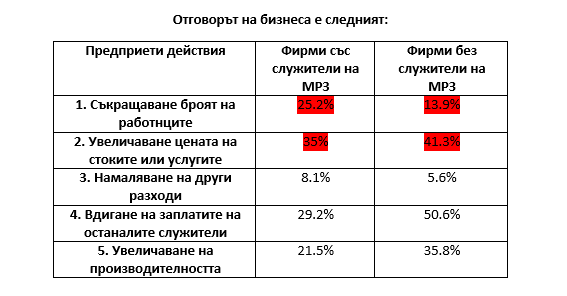
The results show without a doubt that increasing the minimum wage leads to greater unemployment and higher prices for goods and services.
We have written more than once about these and other negative effects of the minimum wage and its increase (see here and here ), which mainly affect workers who should be protected by this mechanism. The ECB study only confirms this fact.
Compared to the other 8 CEE countries, Bulgarian companies are most likely to lay off workers when the minimum wage increases.
The increase in the MRP in Bulgaria has even more serious consequences compared to other CEE countries or developed Western economies due to two more factors:
- The share of workers who receive MHP is much higher (21% in Bulgaria, in Western Europe it is below 10%)
- The age of workers in the MRP is higher. (In Bulgaria, 30% of people in the MRP are over 50, and in Western Europe this share is at least half as small)
From this we can easily draw the following conclusions:
- Bulgaria's economy is strongly affected by the negative effects that the MRP has on business - more expensive goods and services and increased unemployment.
- More expensive goods and services = higher and unexpected inflation, as well as lower profits.
- Increasing the gray area.
- Lower tax revenues.
- Older people find it difficult to retrain and/or find a job if they are laid off.
- Deteriorating working conditions because the employer is cutting other costs.
- Reduced consumption.
- Artificially inflated cost of living.
In this regard, we should also recall the latest analysis of the European Commission on the domestic economy under the European Semester program [4], according to which the country's shadow sector harms tax collection and the labor market. This shadow sector is fueled by precisely such policies as the increase in the minimum wage, which forces businesses to go underground so as not to lose workers.
It is important to note that the survey in Bulgaria was conducted in 2014, and the business responses refer to the period 2010-2013, when the MRP jumped by 29%. Since then, the MRP has increased from 310 to 510 leva, i.e. by 64.5%, which is twice as much. This suggests even more pronounced negative effects in the future.
[1] https://www.ecb.europa.eu/pub/pdf/scpwps/ecb.wp2122.en.pdf?9e72e0c058735a2eea6577de6ff6680b
[2] Bulgaria, Estonia, Hungary, Latvia, Lithuania, Poland, Romania, Slovakia and Slovenia.
[3] In the summarized version, it looks like this: 1. We laid off workers; 2. We hired fewer employees; 3. We raised the prices of the final product/service; 4. We reduced other expenses; 5. We had to increase the remaining salaries as well; 6. We increased our productivity.
[4] https://ec.europa.eu/info/sites/info/files/2017-european-semester-country-report-bulgaria-en_3.pdf
The above text expresses the personal opinion of the author based on the ECB's research and does not commit any European institution to it.





3 коментара
Pingback: ECB: Raising the Minimum Wage Leads to Layoffs and Higher Prices – Jobcenter.bg
Pingback: ECB: Raising the Minimum Wage Leads to Layoffs and Higher Prices – Jobcenter.bg
Pingback: ECB: Raising the Minimum Wage Leads to Layoffs and Higher Prices – Jobcenter.bg