EKIP– Expert Club for Economics and Politics A Different Opinion

Having examined the global demand profile for gold and silver in the first part of this series comparing gold and silver as investment alternatives, let us now turn our attention to the price dynamics of the two metals. By comparing the price trends of gold and silver over the past 20 years, we can determine the long-term trends and short-term investment opportunities in the two metals, and accordingly, what differences in returns between the two metals we can expect.
Gold achieves higher returns in the long term
The graph below shows the dynamics of the growth of gold and silver prices (per troy ounce) on a monthly basis for the last 20 years. This graph clearly shows that the price of silver fluctuates in much wider ranges than the price of gold over the last 20 years. During this time period, the highest monthly growth rate of the price of gold (on a monthly basis) was 17.35%, reached in September 1999, and the highest rate of decline was 17.38%, reached in October 2008. However, the price of silver has fluctuated much more, its record growth rate was 28.60%, and its record decline rate was 28.40%.
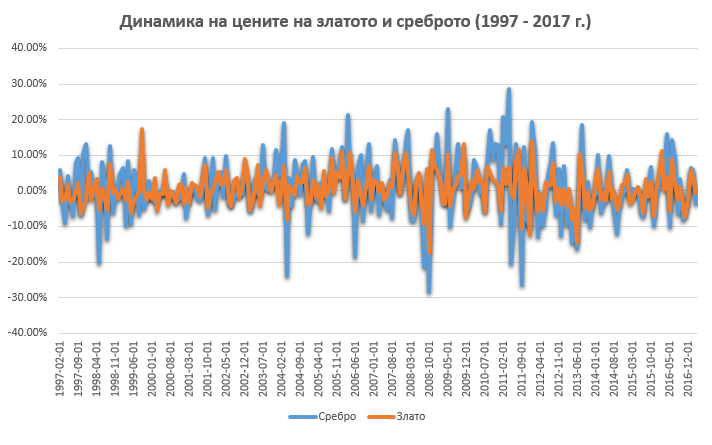
Източник: London Bullion Market Association
Interestingly, despite the greater variation and volatility, it is not a better investment in terms of its long-term return. Over the 20-year period we are looking at here, the price of gold has risen by a total of 248%, and that of silver by 235%. This equates to an average annual growth rate of 12.4% in the price of gold and an average annual growth rate of 11.7% in the price of silver. As we can see, the return on investment in both metals has been very high over the past 20 years, higher than that of investments in many other assets.
However, exactly one month later, at the end of April 2004, the price of silver was already 23.9% lower than it was at the end of March. Despite this decline, overall, silver significantly outperformed gold during this period – between October and April, the price of silver increased by 15.9%, while that of gold increased by 0.6%. If you look at the chart, you can see other similar periods, for example, from August 1997 to February 1998, when the price of silver increased by 45%, while that of gold decreased by 9%. So, as we can see, although in the long run the price of gold is higher, in the short run, within a few months or a year or two.
Of course, it is much more difficult to successfully take advantage of short-term trends than long-term ones. This requires very precise timing, in-depth knowledge of the state of the market in which you are investing, and an accurate assessment of its future dynamics. Short-term speculation is something that even the most experienced investors very often fail at. Therefore, although speculation with the price of silver can be very profitable in the short term, thanks to the higher volatility, it is also riskier. Also, let's not forget that the main advantage of investment gold over investment silver is the lack of VAT.
Why is the price of silver more volatile?
What is the reason for the higher volatility in the price of silver? If we go back to the data we looked at in the previous article, you should be able to guess. As we saw last week, the demand for silver is much more diverse. While gold is used almost exclusively for investment/monetary purposes and jewelry, silver finds very wide use in a number of industrial sectors, especially in electronics and electrical engineering.
Due to the huge demand for industrial purposes, which forms more than 50% of the total demand for silver at the global level, the price of silver is to a much greater extent dependent on the state of the industry and business in general. The business climate and the growth of industrial production can quite logically have a serious impact on the consumption of silver and, accordingly, its price on the market. This is not the case with gold - its price is to a much greater extent influenced by purely monetary and investment factors. Such factors are, for example, interest rate levels and price inflation.
These factors of course also affect the demand and therefore the price of silver. However, silver is also a precious metal and, like gold, has been used as money for millennia and is a very good hedge against inflation. However, in addition to monetary and investment factors, silver is also much more affected by fluctuations in business activity in many industrial sectors, while apart from investment gold finds wider use mainly in jewelry making and much less in technology.
Conclusion
Based on the data we analyzed in this and the previous article, the relative advantages and disadvantages of gold and silver as investment assets are now clear to us. Overall, in the long term, over the past decades, the price of gold has recorded greater growth than that of silver, measured in USD, and this with lower volatility and risk.